
 United States ‘Hello America: We Gather Here’ – Various: Mali Irene (vocals), Andrzej Ciepliński (clarinet) Vân-Ánh Vanessa Võ (dan bau, dan tranh), Tracy Silverman (electric violin), Sidney Hopson (percussion), American Composers Orchestra / Kedrick Armstrong (conductor). Zankel Hall at Carnegie Hall, New York, 27.10.2026. (DS)
Mali Irene – Deliverance (world premiere)
Thea Musgrave – Song of the Enchanter
Oswald Huỳnh – ngủ ngon (world premiere)
Alexander Timofeev – Fantasme No.2 (world premiere)
Alex Weisre – Tfiles
Daniel Bernard Roumain – America, To US
When young composers have a voice – a distinctive one – they need a place to nurture it. The American Composers Orchestra has spent the last 50 years ensuring that they do. At this year’s Carnegie Hall gala, ‘Hello America: We Gather Here’, the organization hosted a pre-concert dinner to honor the nearly 100-year-old Thea Musgrave (born in Scotland but living in the United States since 1972) who was present; and to thank long-time supporters of ACO’s New York City community outreach work, namely Ralph Bumbaca, Executive Vice President at TD Bank. The program leaflet even had an official letter of thanks from Julie Menin, the New York City Council Speaker – a sign of good times for the arts in civic circles.
The concert, held in Zankel Hall, was a fervent expression of the works we have come to expect from ACO concerts: confident, vibrant and creative. It also carried ACO’s message that American composition is about relaying the fabric of a nation’s identity in all its variety.
The opening and closing works drew from the idea of gathering under the banner of democracy. Mali Irene’s Deliverance began with drummer Sidney Hopson coming down one aisle while she came down the other, singing in wordless lyrical lines. Her piece mirrors the African-American traditional ring shout which originated in the time of Southern slavery. Upon reaching the stage, she beckoned us to our feet to sing ‘freedom’ before closing with her own lyrics. In a similar vein, Haitian-American composer Daniel Bernard Roumain’s America, to US was a sensational rock-classical work for electric violin and orchestra that incorporated what he called a ‘town hall’. Five individuals came out on stage to poetically reflect on voting, birthrights and citizen rights. A violinist joined them, expressing his voice with a Copland-esque riff. Roumain’s idea was bold and timely – a work akin to Copland’s Lincoln’s Portrait for a listener in this century.
Two other works illustrated the emotive material with which American composers frame their ethnic and religious backgrounds. ngủ ngon by Oswald Huỳnh was devised of colors and textures that were not only technically astounding in their blending of Vietnamese traditional instruments with full orchestra but framed sound landscapes in robust, block-like forms that were captivating to follow as a listener. Soloist Vân-Ánh Võ performed in elaborately woven attire on the dan bau while some audience members (like a gentleman seated in front of me) took part by shaking percussive instruments.
Alex Weiser’s beautifully crafted, melodious clarinet concerto, Tfiles, was inspired by the poetry of Kadya Molodowsky exploring Jewish prayer and ritual. The appeal came from Weiser’s ability to reveal the layered relationship one cultivates with a cultural memory. Rather than draw on obvious musical motifs, his own compositional voice threaded lightly through traditions like that of klezmer without ever directly harnessing it. His use of a bell throughout the work sounded like a memory of prayer without being insistent in its purpose. Polish clarinetist Andrzej Ciepliński (for whom the work was written) performed it with a combination of sensitivity and command – his sound soaring with clarity in a caressing gesture of the melodic lines.
Two works also held fast to the influence of the Western canon, a part of the American compositional tradition. Alexander Timofeev’s Fantasme No.2 in five short movements experimented with the ideas of gestural chaos in a Bartók-adjacent style – sometimes to exceptional effect while at other moments searching for compositional conviction. Thea Musgrave’s Song of the Enchanter, a brief yet heterogeneous orchestral work, was written in honor of the 125th anniversary of Sibelius’s birth. Famous samplings from the Finnish composer keep delightfully creeping in, only to be swept along with Musgrave’s own graceful orchestral writing. Conductor Kedrick Armstrong led all these works with astute attention to their vastly different ensemble demands while allowing a looseness of expression that contributed to the blossoming of each distinctive voice.
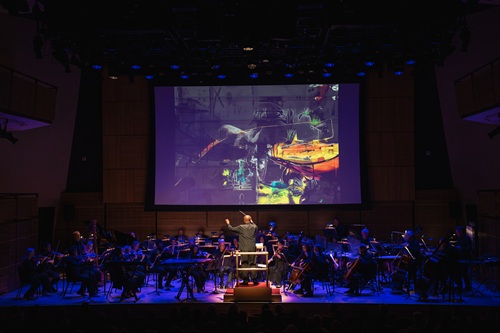
Before each piece, a brief video on a screen behind the stage of the composer speaking from home added value to the experience and brought us closer to the creative process. Less necessary yet not overbearing was the addition of an animated abstract painting projected on the screen, The Crossing by Lucrecia Zappi. Its swathes of color would gradually fill in and lines meandered across the canvas as the music progressed. Perhaps it spoke, visually, to the idea of bringing us together as a community – listening, watching and participating as one.
Daniele Sahr