
 United Kingdom Debussy, Mealor, Yakymenko, Prokofiev: David Childs (euphonium), BBC National Orchestra of Wales / Martyn Brabbins (conductor). Brangwyn Hall, Swansea, 6.11.2026. (LJ)
Debussy – Prélude à l’après-midi d’un faune (1891-4)
Paul Mealor – Euphonium Concerto (2017)
Fedir Yakymenko – Angel (Poème-Nocturne) (c.1915-22)
Prokofiev – Excerpts from Romeo and Juliet, Op.64 (1935-6)
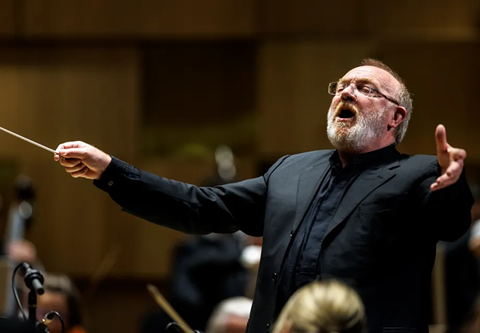
This programme brought together four different perspectives on love, longing, and loss. Martyn Brabbins conducted the BBC National Orchestra of Wales (BBC NOW) for a concert that sandwiched two new and relatively unknown pieces, by the Welsh and Ukrainian composers Paul Mealor and Fedir Yakymenko, between works by the familiar late-19th and 20th-century composers Debussy and Prokofiev.
The concert (which will be broadcast on BBC Radio 3) afforded euphonium player David Childs with an opportunity to stun his listeners with his performance of Mealor’s technically demanding Euphonium Concerto (2017). And Childs did not let this opportunity pass him by. The euphonium’s lyrical beauty was contrasted by moments that pushed the instrument to its limits. Childs’s balance between soaring melody and rhythmical intensity was apposite for a piece that is, in the composer’s own words, ‘of extreme agility, range and virtuosity’ yet holds firmly onto a ‘musical line and expressive purpose’ centred on a story of longing.
Childs’s sonority in the second movement was magnified by the excellent acoustics of Swansea’s Brangwyn Hall. Though the piece lasted only sixteen minutes, Childs’s expressive performance evoked an eternal (you could say Odyssean) story of a woman who waits for her husband to return from sea, visiting the shoreline and singing in the hope that he will answer. Childs conveyed the attending themes of absence, longing, and memory in beautiful song-like passages that had a searching quality. This lamenting sound would then suddenly move into a restlessness that was at times sorrowful. Childs played with the tenderness and virtuosity required to convey such a range of emotions.
Martyn Brabbins, who previously conducted Childs with the BBC NOW in May 2025, ensured that the piece was invigorating rather than indulgent, keeping the string and percussion sections of the orchestra moving apace for the concerto’s final movement. Brabbins also created an appropriate balance between orchestra and soloist, with the euphonium’s brassy resonance emerging from the supporting strings and percussion. The audience loved Mealor’s composition, sharing their enthusiasm with applause for Childs and Mealor, who was in attendance. It was what we could call a showstopper; something that would cause a stir at the BBC Proms.
The concert began, however, in far more familiar territory, with Debussy’s Prélude à l’après-midi d’un faune, which he finished in 1894. As one of the defining works of French Impressionism, it takes its inspiration from Stéphane Mallarme’s poem ‘L’Après-midi d’un faune’ (1876) in which a faun wakes to a sun-soaked landscape and reflects upon his encounters with several nymphs. It blurs the boundaries between memory, imagination, and reality – a theme evoked beautifully in the opening flute solo and followed by BBC NOW’s muted horns, harp glissandos, and woodwinds. In the spirit of the poem’s diaphanousness, the melody is chromatic and wandering with a sensuousness that was especially evoked by the harp. To capture this dreamlike world, the performance needs to have a sense of improvisation. Brabbins guided the sections of the orchestra to intertwine syncopated strings with sustained woodwinds, providing more suspense than I have heard in other performances. He conducted with enough clarity so that the orchestra kept its shape yet was free enough so that the sound floated.
Perhaps the least well-known composer in this programme was Fedir Yakymenko. Born near Kharkiv in 1876, Yakymenko studied composition with none other than Rimsky-Korsakov and Anatoly Lyadov at the St Petersburg Conservatory. His life was shaped by the political turbulence of the early 20th century and he eventually settled in France after leaving the Soviet Union. His work, which was influenced by impressionism and the relationship between imagination and reality, paired well with Debussy’s Prelude. Indeed, Angel (Poème-Nocturne) also takes its inspiration from a poem and is a highly atmospheric piece that features prominent moments for the woodwind and strings. In Mikhail Lermontov’s poem (‘The Angel’ written in 1831), an angel praises the purity of heaven when he ferries a young soul back to earth where the soul struggles with ‘the tedious songs of our earth’ that cannot ‘rival celestial song’.
At a little under ten minutes, this short piece is beguiling and immersive. It also reminded me of Debussy’s contemporary, César Franck’s symphonic poem Psyché, which he completed in 1887. Angel begins with a descending phrase on violins and oboes, which is expanded by the clarinet in a way that evokes the shimmering movement of the angel. The BBC NOW’s performance was especially captivating towards the end, when the sound of the piano catches the listener almost by surprise.
After the interval, the orchestra returned with twelve excepts from Prokofiev’s Romeo and Juliet that showcased both the bold and the gentle. Prokofiev’s genius is in his ability to create a language that dovetails with that of Shakespeare – each movement belonging to the great bard’s unique world of innocence, desire, jealousy, and power. Brabbins captured the innate theatricality of Prokofiev’s score very well with the infamous ‘Montagues and Capulets’ (Suite No.2/1). There was a determined attack from the string section, which upheld the tension and drama of this suite. BBC NOW’s strings were also excellent when performing ‘Romeo at Juliet’s Tomb’ (Suite No.2/7). This is the infamous moment when Romeo, unknowing of the potion plot, believes Juliet dead and, when he sees her momentarily lifeless body, takes his own life. Brass and percussion sections were deliberate and conveyed the gravitas and impending tragedy of the moment well. Indeed, Brabbins was better during these stronger suites than in the earlier dances (e.g. Suite Nos. 2/4; 1/1; 3/2). They finished with ‘Juliet’s Death’ (Suite No.3/6), which was dark, sorrowful, and beautifully concluded in C major.
Both the dreamy and personal dimensions of love and loss were evoked through this selection of music. Whilst the Debussy and Prokofiev were both enjoyable, the concert was most memorable for its introduction of two relatively unknown works. In doing so, it highlighted not only the virtuosity of a brass soloist but also showed Childs to be an advocate for the euphonium’s place in the orchestral repertoire.
Lucy Jeffery