
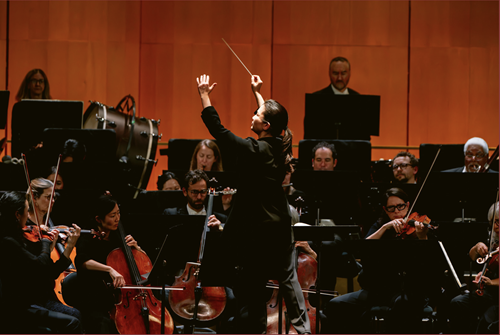
 United States R. Strauss: Kathleen O’Mara (soprano), San Francisco Opera Orchestra / Eun Sun Kim (conductor). War Memorial Opera House, San Francisco, 6.11.2026. (HS)
R. Strauss – Till Eulenspiegel’s Merry Pranks; Four Last Songs
R. Strauss (arr. Philippe Jordan, Tomás Ille) – Der Rosenkavalier Suite
Among Eun Sun Kim’s projects as music director of San Francisco Opera is to conduct all of the major Verdi, Wagner and Richard Strauss operas. Of the three, only Strauss is known for big symphonic works as well. It made perfect sense for the company’s annual orchestral concert to program works in the three areas he excelled at – an early tone poem, an orchestral song cycle and a symphonic work based on his most popular opera.
To my ears, the results got better as the evening progressed from the 1895 tone poem Till Eulenspiegel’s Merry Pranks to the 1948 Four Last Songs and found its greatest glory in a new arrangement of music from the 1911 opera Der Rosenkavalier.
Commissioned by Radio France for a debut in 2021, the Der Rosenkavalier Suite fashioned by the veteran opera conductor Philippe Jordan and composer-arranger Tomás Ille made its United States debut with this performance. It takes a different approach from the better-known version that debuted in 1944 at the New York Philharmonic conducted by Artur Rodziński. The new suite is almost twice as long, touching on excerpts that reflect Strauss’s brilliance in orchestral colors. Its nonstop 38 minutes places the music from the opera in chronological order to better follow the narrative.
As for the performance, if this sampling of Kim’s approach to Rosenkavalier’s glorious music is a preview of her conducting the whole opera anytime soon, bring it on. The way she and the orchestra brought out the details and reveled in this distinctive soundworld was immensely satisfying. Strauss’s modernization of traditional Viennese music came through exactly right, even if the melodies of the arias, duets and trios had to be handled by instruments instead of (mostly) soprano voices.
The tour began, as the opera does, with the orchestra’s horn section miming a sexual climax and ended, as the opera does, with the puckish music of the brief coda. In between, it features famous moments like the presentation of the rose, with its shimmering celesta and harps; Baron Ochs’s lecherous waltz with its broad swagger; and the sweet moments of soprano voices intertwining in the trio and duet in the final scene. But not the whole scene, just enough of a taste to make a nice course in an extensive meal.
This version also dipped into moments when the music accompanied passing scenes – breakfast being served in the Marschallin’s bedroom, the sly scheming of Valzacchi and Annina and the frantic trickery in the inn in Act III. These details glued the score together, the way scherzos and intermezzos do in a symphony.
Kim made all of this create a sense of surprise every time we turned the corner into a fresh moment. The playing from the orchestra – including solos by principal horn Kevin Rivard, concertmaster Maya Cohon and oboist Gabriel Young – was nuanced and expressive, with beneficial attention to dynamics and emphases.
That came through clearly as the suite echoed the structure of the tone poem. The two pieces even spoke the same language, both presenting a series of brief episodes in a narrative. If Eulenspiegel didn’t flow quite as gracefully as the Rosenkavalier suite, its feisty approach framed some excellent solos by Rivard, Cohon and clarinetist Joshua Choi. And even if the other details could have breathed more or bounced with more swagger, they did the job nicely.
The Four Last Songs was a late change to the program, as soprano Kathleen O’Mara stepped in to replace an indisposed Adela Zaharia who was to sing the Brentano Lieder. O’Mara, who subbed as Donna Anna in Don Giovanni at the Metropolitan Opera last year for two performances, displayed the vocal richness and technique, seamless from top to bottom, to do justice to the Strauss songs. Best was ‘Beim Schlafengehen’ (‘When Falling Asleep’), which seemed to hover in the air as if awaiting a warm embrace. For her part, Kim fashioned a supple texture and kept the momentum from ever dragging.
Harvey Steiman