 United Kingdom Wagner: Opera Forge: Soloists, Orpheus Orchestra / Kelvin Lim (conductor), The Duke’s Hall, Royal Academy of Music, London, 22.11.2026. (JR)
It is not every day a brand new opera company is born, or should I say ‘forged’. (I did wonder, given their opening choice of work, whether Siegfried’s forge gave rise to their name). Opera Forge is a new, artist-led opera company, based in London, expressly aiming at giving a chance for singers to develop and perform demanding repertoire. All the singers at this ambitious performance of Die Walküre (except for Mark Le Brocq as Siegmund) were making their debut in their respective roles.
This was a semi-staged production, with no real costumes to speak of and no set; and a complete absence of props. Sir John Tomlinson, a renowned Wotan of old, and a Patron of Opera Forge, directed the performance, and commented in the programme, alongside a proficient sketch by him of Wotan in a suit, that ‘there can be virtue in minimalism and economy’. One had to imagine the spear, the sword, even the cup of water which Sieglinde brings the thirsty Siegmund. Only once did I not fathom Hunding’s hand movements (the old TV game show ‘What’s my Line’ naughtily sprang to mind).
The performance took place in The Duke’s Hall of the Royal Academy of Music, a splendid hall, but with rather echoey acoustics which took some getting used to.
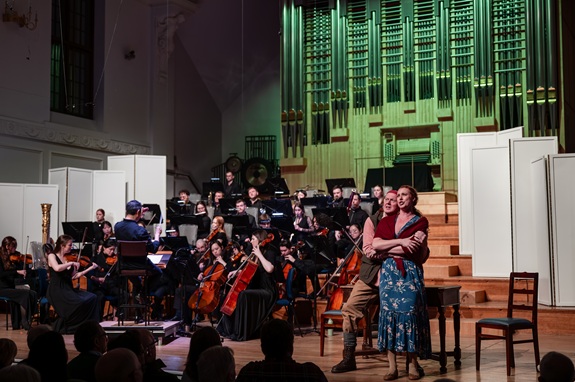
After a very accomplished opening storm from the sizeable orchestra (Orpheus Orchestra), Siegmund enters looking every bit a homeless person off London’s streets. Mark Le Brocq made an immediate vocal impression, singing strongly with the clearest of German diction and no lack of heft. I heard Le Brocq sing the role at Longborough to considerable acclaim and he shone in this performance. Le Brocq’s desperate cries of ‘Wälse!’ were most impressive. Le Brocq had a tendency to shout, not surprising given the sizeable orchestra on the stage right behind him; his ‘Winterstürme’ was less forced and all the more fetching for it. His Sieglinde, Sky Ingram, did not always have clear diction, but compensated with marked theatrical skills and a fine, vibrant voice. Both Siegmund and Sieglinde were overshadowed by Aidan Smith’s Hunding, dressed all in black, looking extremely menacing. His deep, dark bass was, for me, the best voice of the night: I was surprised to hear that he once was told he was a baritone, and thankfully ignored the advice: he is very much a Sparafucile, a Hunding and a Hagen, with acting skills to boot.
Conductor Kelvin Lim is known for his expertise in Wagner, so it is no surprise that future performances, those so far scheduled, are all of Wagner’s music (also perhaps influenced by Sir John Tomlinson). Lim, a Bayreuth Bursary recipient, was an Assistant Conductor at Welsh National Opera’s recent Flying Dutchman and has worked extensively at Longborough, including two complete Ring cycles. He clearly was at home with the score and every entry; a pity he could not be placed in front of the singers, who once in a while fell out of sync with his tempo. Lim could occasionally have held back the orchestra more, so that the singers did not all need to shout. It was sometimes quite an assault on the eardrums. (Wagner got this right in Bayreuth with the orchestra in a covered pit).
Act II opened with Brünnhilde making her first entry, in a black hooded cloak looking every bit like Claudia Winkleman from ‘The Traitors’. The Chairman of Opera Forge, David Buchler, in his pre-performance address to the audience, indicated that laryngitis had made life difficult for some singers but they were fortunate not to lose any. (I suspect there was little cover). It was clear from Brünnhilde’s first shrill and wayward ‘Hojotoho! Heiaha!’ that Katerina Mina was suffering the after-effects of a throat condition.
Rosanna Madylus as Fricka was grippingly imperious, and her glittering blouse was the best costume of the night. Wotan was sung by Latvian-British baritone Pauls Putnins, to whose voice I did not readily warm to: it was often too nasal, with little warmth, and his German diction was not always the clearest. However, his final ‘Geh!’ as he dispatched Hunding was chilling. His farewell to Brünnhilde (‘Leb wohl’) in Act III was touchingly rendered. British-Cypriot soprano Mina wisely protected her voice until the end of the third act where she came into her own with some very fine singing; perfect intonation and crisp high notes. She is mentored by Susan Bullock, one of Opera Forge’s Patrons; Bullock was in the audience at this performance.
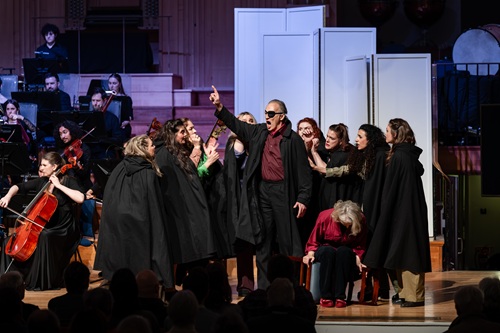
Act III opened with the thrilling ‘Ride of the Valkyries’, but given the lack of space, the Valkyries had to enter at a snail’s pace, looking like a parade of undertakers, all dressed in black cloaks, over ordinary daywear. I did think of the Scottish Widow’s TV advert. Their voices were all vibrant, bar the newbie, Christina Orjis, who seemed overwhelmed by the occasion.
Lighting (Graham Large) was as effective as it could be in this hall, the newish (2013) Kuhn organ – a major donation coming from Sir Elton John – lit up in green for the entry of Spring in Act One and lit red (with gas fire effect) for the final scene of Act III, with Brünnhilde laid to rest overhanging the organ stool.
Orpheus Orchestra performed a scaled-down orchestration of the work, to good effect. Brass were smudgy at times, and lack of rehearsal occasionally evident, with rehearsal time clearly given to exposed sections such as the opening, and close, and the ‘Ride of the Valkyries’. Rebecca Hepplewhite, principal cello, frequently caught the ear with characterful playing, as did Adam Stockbridge with the cleanest of trumpet playing.
Opera Forge will appear at Dartington next year with a short opera festival, followed in autumn 2027 with a masterclass for singers and pianists exploring Wagner’s Lieder. Their next major adventure will be Tristan and Isolde in the first half of 2028. One of their challenges will be to find a suitable stage on which to put even larger operas and to fund those which demand a chorus.
Opera Forge needs further financial support, so do take a look at their website here and click on ‘Support’ to ensure future productions of quality.
John Rhodes
Featured Image: Conductor Kelvin Lim, Orpheus Orchestra, Mark Le Brocq (Siegmund) and Sky Ingram (Sieglinde) © Julian Guidera
Cast:
Wotan – Pauls Putnins
Brünnhilde – Katerina Mina
Sieglinde – Sky Ingram
Siegmund – Mark Le Brocq
Fricka – Rozanna Madylus
Hunding – Aidan Smith
Helmwige – Lauren Roscoe
Ortlinde – Christina Orjis
Gerhilde – Anna Gregory
Waltraute – Angharad Lyddon
Siegrune – Louisa Petaï
Rossweisse – Gemma Morsley
Grimgerde – Kathy Taylor-Jones
Schwertleite – Georgia Mae Bishop
Production:
Director – Sir John Tomlinson CBE
Assistant Director – Eleanor Strutt
Production assistant: Grace Whillis
Lighting designer – Graham Large
Makeup consultant – Louisa Petaï