
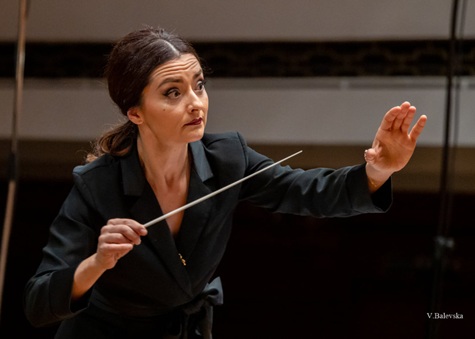
Conductor Viliana Valtcheva talks with Gregor Tassie
Bulgaria’s music is best known for its magnificent choirs and the never-ending stream of singers who have become celebrated in the world’s most famous opera theatres. Boris Christov, Ghena Dimitrova, Lyuba Welitsch, Nicolai Ghiaurov, and Sonya Yoncheva are just a few Bulgarians who have become stars on the world stage.
There is a distinguished school of instrumentalists, but relatively few conductors, with one major exception in the brilliant Emil Tchakarov, who became legendary during a relatively brief period, until his death at the early age of 43 in Paris. A prodigy of Karajan, Tchakarov was renowned at the Metropolitan Opera, Covent Garden, Maggio Musicale Fiorentino and the Mariinsky Theatre, among many others. Mravinsky picked him as his successor before his early death in 1991.
Since then, few Bulgarian conductors have become known outside Bulgaria; the composer/conductor Emil Tabakov and Nayden Todorov are among several who have worked widely in Europe, and in recent years a young woman, Delyana Lazarova, has enjoyed success as the BBC Scottish Symphony Orchestra Principal Guest Conductor, making her debut at the 2025 BBC Proms in London. On a visit to Sofia this year, I was very impressed by the work of Viliana Valtcheva, who directed a concert of quite different works across diverse genres with the Sofia Philharmonic Orchestra. I was lucky that afterwards I spoke to this outstanding young Bulgarian conductor.
Gregor Tassie: You began your musical education at the Dobri Hristov National School of Arts in your hometown of Varna. Are you from a musical family, and what attracted you to making music your career?
Viliana Valtcheva: I do not come from a musical family, but my parents have always been passionate lovers of classical music and opera. They regularly took me to opera and ballet performances, symphonic concerts and recitals. As a very young child, I was the one who expressed the wish to play the piano, and they supported me wholeheartedly.
GT: You got a major in piano in Varna before studying at the Hochschule der Künste Bern in Switzerland. With different teachers, you studied piano, bassoon, chamber, and orchestral conducting as well as musicology. At what time did you decide to make conducting your career?
VV: I had always wanted to become a conductor – and specifically an opera conductor. As a child in the theatre, what fascinated me most was what was happening in the orchestra. I loved listening to the musicians’ tuning, playing fragments and melodies from the performance that was about to begin, and hearing all those individual sounds gradually blended into one. That world captivated me from the very beginning.
GT: It has been historically difficult for young women to break into the conducting profession, because it is dominated by male conductors, so did you find it difficult to develop a career and do you have any mentors that gave you a special influence in your career? Do you listen to famous conductors’ recordings and who were they?
VV: Of course I encountered difficulties, and I continue to encounter them. At the same time, I had the enormous privilege of studying conducting in Lucerne at a time when some of the greatest conductors of the twentieth century were still with us and regularly appeared at one of the world’s most prestigious festivals, the Lucerne Festival. I was fortunate to participate actively in masterclasses with Bernard Haitink, Pierre Boulez, and Claudio Abbado. I also had the opportunity to assist Zubin Mehta on several occasions, and to work as an intern at the Zurich Opera House with Nello Santi and Fabio Luisi. My conducting professor was Ralf Weikert, the long-serving Music Director of the Zurich Opera – someone I would venture to call one of the last great representatives of the old operatic tradition. These encounters shaped me profoundly.
GT: What was the biggest influence on you taking up conducting?
VV: I simply love conducting and making music. For me, it is the most beautiful profession in the world – provided one has the opportunity to practice it in good theatres and with fine orchestras, and provided one is sufficiently prepared, both technically and intellectually, to serve the art of the great composers and interpret their music with integrity and as authentically as possible.
GT: In your Sofia concert, you directed four quite different works, and importantly one of them is a Bulgarian. Do you want to open up Vladigerov’s music to new audiences? Do you have a mission to uncover less well-known composers as you also conducted Arutunian’s Trumpet Concerto – a rare piece in the concert hall? Which composers attract you most of all?
VV: Yes, I would very much like to conduct Vladigerov abroad and help bring Bulgarian music to wider international audiences. Bulgaria has many remarkable composers and a wealth of extraordinary music that deserves to be heard. I have conducted quite a number of rarely performed composers and works, and I am always ready to learn a piece that lies outside the standard repertoire. I enjoy challenging myself. As for the composers who attract me most, it is almost impossible to give a definitive answer, because every great composer has works of genius that deserve to be performed. But if I had to choose two, I would say Stravinsky and Richard Strauss.
GT: Are there any contemporary composers that interest you?
VV: I cannot single out one contemporary composer in particular. My interest is not determined by whether a composer is established, contemporary, or rarely performed, but by the quality and individuality of the work itself. As I mentioned, I am always interested in discovering worthwhile music and in taking on repertoire that presents a genuine artistic challenge.
GT: Following conducting appointments at Lucerne and Zurich Opera Theatres, you are engaged at two Opera and Ballet Theatres in Bulgaria; Ruse and Varna. Presently you are working mostly in Italian repertoire, and Bulgarian voices have a great reputation in this repertoire, so is this the direction you prefer?
VV: I work not only in Ruse and Varna, but throughout Bulgaria. The National Opera and Ballet is still missing from that list – for the moment. My strongest affinity is certainly with Italian opera, a repertoire of almost inexhaustible richness. But I also conduct French and German opera. I am particularly proud that in 2014 I was a scholarship recipient of the Richard Wagner Foundation in Bayreuth, and during my years in Switzerland I worked extensively on German opera, including Wagner and Mozart’s Singspiel tradition. I would very much like to see more of Richard Strauss’s operas performed in Bulgaria as well.
GT: You have worked mostly in opera in Europe and Bulgaria, do you see opera as the most attractive career for you and mastering the challenge of directing large scale musical groups of orchestral, choral and singers.
VV: Opera has always been my greatest passion. For me, it represents the highest level of complexity in our art form: it brings together orchestra, singers, chorus, theatre and drama, and demands an extraordinary degree of musical and human responsiveness from a conductor. At the same time, I greatly enjoy substantial symphonic programmes and concerts with outstanding soloists. I would never want to give up in either world.
GT: Many women musicians find it difficult to work successfully on the international concert circuit, with prolonged travel and assimilating different cultures across the world. What are your own personal ambitions?
VV: I would also like, at some point, to take on an administrative and artistic leadership role within an opera house. And I would like to be among the Bulgarian women conductors who are given the opportunity to conduct in major international opera houses. Yes – that is a dream of mine.
GT: Today, we can listen to almost any piece of music through the internet. How do you see the future of classical music in Bulgaria now that people enjoy this much greater access to music?
VV: However vast the amount of music, information and choice available through the internet may become, nothing can replace the experience of being present at a live performance. The immediacy of live music – the shared concentration, the physical presence of the sound, and the unique connection between performers and audience – cannot be reproduced by any digital medium.
GT: Thank you for your time and best wishes for the future.
VV: Thank you very much for your interest and for the conversation. It has been a pleasure.
Gregor Tassie