
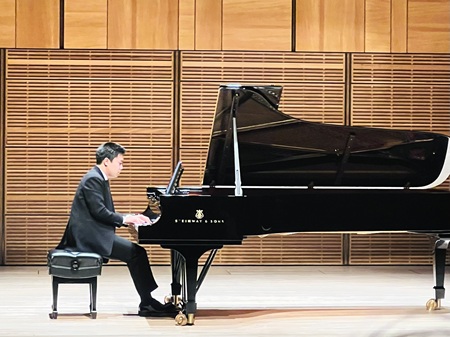
 United States Various: Youl Sun (piano). Zankel Hall at Carnegie Hall, New York, 29.10.2026. (ES-S)
Gabriela Lena Frank – Two Andean Portraits
Texu Kim – Pansori Fantasy
Debussy – Images, Books I and II
Liszt – Études d’exécution transcendante, S 139
South Korean pianist Youl Sun, the 2024 gold medalist of the Gina Bachauer International Artists Piano Competition, performed at Zankel Hall before a regrettably sparse audience. He opened his recital with two brief contemporary works: Gabriela Lena Frank’s Two Andean Portraits, commissioned for that very competition, and Texu Kim’s Pansori Fantasy.
Gabriela Lena Frank’s Peruvian heritage has long nourished her musical imagination, particularly through the landscapes, sounds and traditions of the Andes. In the first volet of the diptych, Introducción: Zampoñas (‘Panpipes’), Sun deftly balanced a flowing melody built on parallel fifths against delicate, widely spaced figures in the left hand. His phrasing in the Adagio del Altiplano conjured clouds drifting across the mountains at different speeds, creating a sense of time alternately suspended and accelerated.
The fluttering, winglike gestures heard in Frank’s work somehow seemed to reappear in Texu Kim’s Pansori Fantasy, commissioned for the 2024 Seoul International Music Competition where Sun shared first prize. Inspired by the Korean tradition of sung storytelling accompanied by a drum, the piece offered no discernible narrative, but Sun vividly articulated its contrasting rhythms and ornamented turns of phrase.
Both contemporary works had a distinctly Debussyan quality, providing a natural transition to the two books of Images with their exotic soundscapes. In Reflets dans l’eau, Sun introduced a slight undercurrent of agitation, even a hint of danger, while maintaining a sense of rhythmic freedom. The unison passages of the sarabande-like Hommage à Rameau acquired a narrative quality under Sun’s fingers as he caressed the dissonances, much as he would later do in Et la lune descend sur le temple qui fut.
Overall, the second book came closer to the quintessential Debussyan art of suggestion rather than assertion. In Cloches à travers les feuilles, the bell-like chords were resonant without being overly penetrating, while those in Et la lune… sounded translucent. Yet Mouvement and the turbulent central section of the concluding Poissons d’or were marked by a Liszt-like percussiveness and excessive use of the pedal.
The second half of the program was devoted entirely to Liszt’s hourlong cycle of twelve Transcendental Études, which Sun dispatched with astonishing speed, force and accuracy. At times, the successive positions of his hands blurred like frames in a rapidly moving film, yet every note remained distinctly audible. His command of a wide range of tonal shades and colors was never in doubt. Despite occasional moments of expressive repose, however, his playing seemed emotionally detached, as if he were more intent on displaying his virtuosity than on exploring the music’s poetic dimensions.
Mazeppa (No.4) had genuine dramatic sweep, but its finer details were sometimes overwhelmed by sheer force. In Feux follets (No.5), dazzling fingerwork lent the performance a somewhat mechanical quality at the expense of the music’s elusive playfulness. In Wilde Jagd (No.8), Sun vividly characterized the shifting moods and Robert Schumannesque volatility of the music.
With Ricordanza (No.9), the prevailing urgency gave way to intimate, Chopinesque lyricism, supple phrasing and expressive freedom. The following Allegro agitato molto (No.10) was compelling in a different way, its passionate intensity lending the technical fireworks genuine musical purpose. Harmonies du soir (No.11), however, lost something of the subtlety and transparency of its sonorities which anticipate Debussy’s Images, heard earlier in the recital.
Ultimately, admiration gave way to fatigue. Whether this resulted from the cumulative demands of Liszt’s writing or from Sun’s interpretive choices was difficult to determine. A judicious selection of études might have made a stronger impression than the complete cycle whose sheer weight blunted the impact of individual achievements.
Edward Sava-Segal