
 United States Robertson, Salt & Spirit (world premiere): Victor Ryan Robertson (tenor), Clinton Smith (piano, arranger). Opera Parallèle, Z Space, San Francisco, 14.11.2026. (HS)
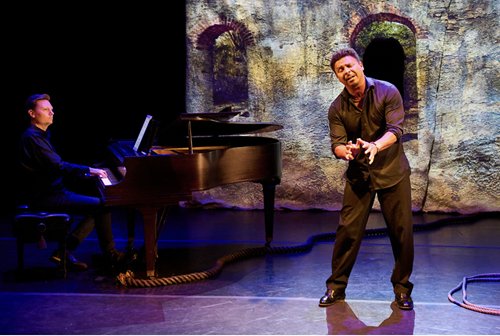
Salt & Spirit, a fascinating and soulful new work presented by Opera Parallèle, the feisty San Francisco Bay Area opera company, had its world premiere on Saturday. It is not exactly an opera although it features the seriously talented tenor Victor Ryan Robertson, but it weaves the music into a story staged with familiar elements of opera.
The subtitle sums it up: ‘An operatic experience rooted in Gullah Geechee Spirituals’. The songs are those of African people brought in slavery to the Carolina Low Country as early as the late-17th century. Their knowhow is today acknowledged to have brought a mastery of rice-growing that was foundational to the South’s infrastructure and foodways.
That they have managed to maintain a vibrant culture for three centuries is a miracle in itself. It also inspired DeBose Heyward’s novel Porgy and Bess and George Gershwin’s 1935 musical setting as opera (which borrowed a few tropes from Gullah Geechee music). The South Carolina-born Robertson, who has performed Sportin’ Life in several Porgy stagings, has been delving into the original spirituals for more than a decade. Some of this music found its way into Gullah Interpretations, his project to present music sketched in a book he found on historical spirituals.
Everything about this tightly focused one-hour production is classy. Brian Staufenbiel, creative director of Opera Parallèle, collaborated with Robertson to design and direct. Roberston doesn’t just sing, he roams the stage in everyman vintage country garb, climbing over boxes and coiled ropes. Video projections morph a background screen into sea scenes, a country church, houses and gardens. Arched windows cut into the screen let him make entrances and exits with finesse.
He also interacts with the audience at Z Space, a sort of off-off-Broadway setting that specializes in new performing arts in San Francisco as does Opera Parallèle. He sings to specific places in the crowd, gets the whole audience swinging from side to side and performs like the opera actor he is. There is no orchestra, just pianist Clinton Smith, who arranged all but one of the spirituals and matched each phrase’s intent impressively with Robertson’s singing. Smith, who teaches and conducts at the University of South Carolina, brought a jazz-aware feel to the rhythms and gestures.
The music can hint at blues, gospel and country, but it is framed with a classical attention to form. There is even an occasional nod to Bach in the piano score which injects moments of formality. At the core, though, it is all about the sort of reverence to be found in the Black church, underlying joyful hope amidst sorrow.
The songs are separated into four acts. ‘Act I, The Portal of the Ancestors & Earthly Bondage’ began with ‘I look down the road’, an unexpectedly peaceful depiction of human transition into death; and ‘Ole Egypt’, Black slaves’ reference to the biblical Israelites’ bondage under the Pharaoh and its parallel with theirs in America. ‘Keep a’runnin’ is a refrain in this up-tempo song. ‘Sinnuh’ uses a full-on gospel style to depict the contrast between their downtrodden life ‘down there’ with the promise of Heaven.
‘Act II, Deep water, Awakening & Sovereignty’ begins with ‘Fault een me’, a blues-like treatment of the biblical Jonah and the whale story, ending with the refrain, ‘Jonah cried out, cried out, cried out’. The rousing ‘Don’t ya mind’ advises us to defy the ‘debble’, and ‘No man look like me’, a camp-meeting song, closes with ‘’Cause duh lawd will find me’ despite living in a world of sin.
‘Act III, The Bloodline, Grief & the Proper Sendoff’ returns to the moment of faith at death with the first song, ‘Home een da rock’, a ‘shout’ song like many fiery gospel tunes. ’Tell John’ takes it up a step, praying that the roll call in Revelation will wait for their arrival. An unexpected seriousness pervades ‘Simme yuh muh leaduh’ (‘Send me a leader’), reminding us that we all must die, and the music of ‘Sipporatin Line’ reveals that there can be joy in the line that separates our lives from what comes next.
After all that, ‘Act IV, The Bloodline, Grief & the Proper Send-Off’ starts off joyfully with ‘Welcome Table’, a jazzy take on the contrast between a master’s table, off-limits to slaves, and what is to be found in Heaven. The finale, ‘Chillun of the wilderness’, takes a step back from the joy to describe the Israelites’ 40 years in the desert after fleeing Egypt. At the end, the music fades away on an uncertain note, a reminder that we really don’t know what is next.
Robertson used high falsetto through all this to great effect against his brightly focused chest-voice tenor, and elegant musicianship to elevate the earthy music.
Jay Cruz, credited as sound designer, wrangled a mix of prerecorded historical narration and brief appearances by a background chorus. A composer, Cruz also did the especially moving arrangement of ‘’Cause duh lawd will find me’, the only song not arranged by Smith. Cruz’s work with the sound system (Robertson was not miked) fit seamlessly with lighting and projections designed by Ohio-based Jessica Ann Drayton.
As cultural heritage consultant to this production, Heather Hodges, based in New Orleans and chair of the board of trustees at the American Folklife Center at the Library of Congress, lent a historian’s knowledge to the story’s references to Gullah Geechee culture.
It is a lot to fit into 60 minutes, but the evening flowed with the songs, all of which had their own personalities. There was never a sense of sameness. The projections created eye-catching, highly artistic backgrounds. Salt & Spirit deserves revivals everywhere.
Harvey Steiman
Creatives:
Stage director & Production design – Brian Staufenbiel
Lighting & Projections – Jessica Ann Drayton
Sound design – Jay Cruz
Cultural heritage consultant – Heather Hodges