 United Kingdom Verdi, Rigoletto: Soloists, Chorus and Orchestra of Opera North / Patrick Lange (conductor). Lyric Theatre, The Lowry, Salford, 12.11.2026. (MC)
This Opera North Rigoletto is a revival of the 2022 production by British-Nigerian director Femi Elufowoju Jr. For what was his first ever opera project Elufowoju Jr sought to provide a work that ‘depicts the society he was born into, and continues to live in, as a Black man.’ Although I knew this production by reputation this was the first occasion I had seen Elufowoju Jr’s Rigoletto.
A tale of wickedness, deception, vengeance and love, Francesco Maria Piave’s libretto for Verdi’s Rigoletto is based after the contentious Victor Hugo 1832 play Le roi s’amuse (The King Amuses Himself) and concerns the hierarchy of the Duke of Mantua’s court. Originally set in 16th-century Mantua, Rigoletto a hunchback, despises his humble rank as court jester yet knows his station. He tries everything he can to stop his daughter Gilda from being seduced by the Duke of Mantua an inveterate womaniser. Yet he is too late as Gilda is already in love with the Duke who has seduced her. The assassin Sparafucile is hired by Rigoletto to murder the Duke and in all the confusion Gilda dies tragically.
Just six months ago at the Semperoper Dresden I reported on (here) a revival of stage director Nikolaus Lehnhoff’s 2008 modern dress Rigoletto. An acclaimed production, the verdict of Italian critic Elvio Giudici was ‘one of the most significant of recent times.’ Describing Rigoletto as ‘a melodramatic and gothic drama’ Lehnhoff and his design team had created a dark, bleak and rather claustrophobic landscape. It was a production where the margins separated reality from the chimeric. Although Lehnhoff’s Rigoletto attracted some debate at the time of its introduction it was nothing compared to the furore that met Jonathan Miller’s 1982 production for English National Opera. Miller had switched the action forward from 16th-century Mantua to the underworld of 1950s Mafia gangsters in New York City’s Little Italy.
For his reworking of Rigoletto Elufowoju Jr has added racial oppression to the litany of problems that already exist in the Mantua court such as misogyny and discrimination. Rigoletto’s hunchback impairment has been replaced with a mental health condition having been ‘plagued by the paranoia of a Black man in a predominantly white world, and his mind is constantly working against him.’ He focuses on alienation and inequality as these are matters that can impact upon how a person behaves. In Elufowoju Jr’s production the ‘outsider’ roles of Rigoletto, Gilda, Monterone, Marullo and Countess Ceprano were ‘sung by people of colour’.
In the opera a key theme is Monterone’s curse. Outraged that the Duke has seduced his daughter, Monterone is cruelly mocked by the sharp-tongued Rigoletto and responds by cursing them both. A curse is a belief deeply rooted in traditional African religion and culture. Elufowoju Jr. believes that ‘because of their ethnicity these characters are aware of the power and impact of the curse phenomenon, and their response is infectious.’ Unless audience members had time to read the programme interview between Shamima Noor and Elufowoju Jr., they were unlikely to know the African customs and practices he discussed. For example, how many knew the special importance of the curse in African cultures, or the symbolism of the life-size zebra model on the stage, which can represent unity, balance and harmony?
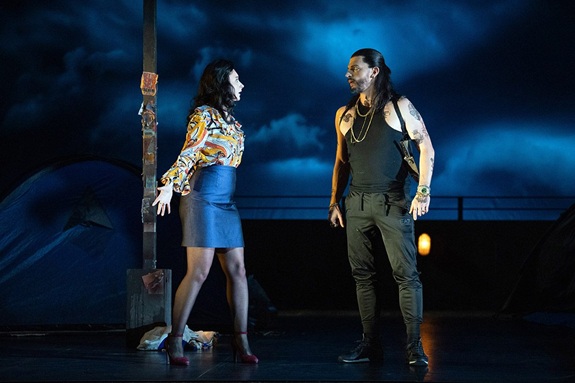
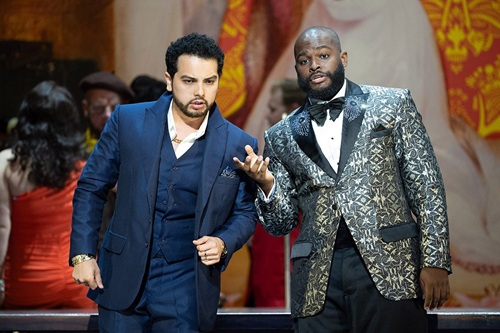
It was Rae Smith who provided both the visually stimulating set and costume designs. The first-act reception, or party, is held in the large hall of the Duke of Mantua’s residence, with the guests in modern day clothing including a few noticeably bright and bold African inspired outfits. In Act II Smith’s set for Gilda’s room looked fussy, entirely overdressed. The back wall was decorated with what looked like a representation of John Gadsby Chapman’s artwork the Baptism of Pocahontas and positioned in front on a raised platform was the life-size model zebra. Smith’s pièce de résistance was undoubtedly the Act III set, which made a real impact: a grim scene of inner-city deprivation seen through the evening gloom. There was the front of a roadside café with an awning over the serving hatch, small tents for rough sleepers and an old burnt-out sports car. Clearly not to everyone’s taste, I did enjoy the light-hearted moments including the early appearance at the front of the stage of a pizza delivery boy on a push-bike and the rather slapstick kidnapping incident of Gilda where the thugs wore clown masks.
Tough to beat in the leading role of Rigoletto was the performance of American baritone Blake Denson. This was his debut for Opera North and his first Rigoletto although he might easily have been seasoned in the role. With his powerful and steadfast baritone, and acting ability together with genuine stage presence he successfully conveyed Rigoletto as a tormented soul. Denson was simply magnificent.
American lyric soprano Jasmine Habersham had appeared as Gilda in the Opera North premiere of Elufowoju Jr’s Rigoletto in 2022. Habersham was Gilda again and seemed to take a while to settle vocally. To my ears in her Act I aria ‘Caro nome’ her coloratura sounded laboured. As Habersham improved, she created a convincingly affectionate and naïve character, the recipient of more despair than she deserved.
As the Duke of Mantua, Mexico tenor Leonardo Sánchez was making his Opera North debut. Confident and highly musical Sánchez displayed his attractive tone so effectively projected, yet I didn’t feel he exhibited the level of licentiousness that I expected from the Duke.
Moscow born mezzo-soprano Alyona Abramova was convincing as Maddalena, the sister of assassin Sparafucile. Using her seductive wiles and deviousness to her utmost Abramova presented the character so well. Callum Thorpe stood out as the hired assassin Sparafucile. His splendidly resonant bass together with long black hair and vest and carrying a sheathed knife made him suitably villainous. Although spending little time on the stage Count Monterone is a pivotal character. Stalwart bass-baritone Sir Willard White excelled as Monterone who gives the curse to both the Duke and Rigoletto, and spends most of his time in prison
Engaging the audience entirely the Orchestra of Opera North flourished under the impressive pacing and effective dynamics required by conductor Patrick Lange. Decidedly successful the Chorus of Opera North aptly demonstrated the worth of being a full-time ensemble.
Remodelling an original opera setting such as this Rigoletto to a more modern context is commonly a deliberate invitation to reassess its contemporary relevance. Reflecting on this revival, director Elufowoju Jr. did successfully challenge me and, I suspect some others to reconsider the divisiveness and suffering of racial prejudice, oppression and the abuse of power and control. Of course, terrible abuse is very much alive and relevant today as demonstrated by recent court cases involving several high-profile celebrities.
I salute the vision and creativity of stage director Femi Elufowoju Jr. and his design team, and in the title role Blake Denson stood out strongly. This revival of Rigoletto was tremendous entertainment.
Michael Cookson
Featured Image: Alyona Abramova as Maddalena and Callum Thorpe as Sparafucile © Richard H Smith
Cast:
Duke of Mantua – Leonardo Sánchez
Rigoletto – Blake Denson
Gilda – Jasmine Habersham
Sparafucile – Callum Thorpe
Count Monterone – Sir Willard White
Maddalena – Alyona Abramova
Marullo – Themba Mvula
Matteo Borsa – Thomas Elwin
Count Ceprano – Ross McInroy
Countess Ceprano – Molly Barker-Knowles
Giovanna – Helen Évora
Court Usher / Bodyguard – James Davies
Page – Laura Kelly
Creatives:
Stage Director – Femi Elufowoju Jr.
Set and Costume designer – Rae Smith
Lighting designer – Howard Hudson
Choreographer – Laila Diallo
Fight director – Alison de Burgh
Chorus master – Anthony Kraus