
 United States Various: Vadim Gluzman, Katherine McLin (violins), Pro Musica Chamber Orchestra / Ken-David Masur (conductor). Southern Theater, Columbus, 8.11.2026. (MSJ)
Bach – Orchestral Suite No.3 in G, BWV1068
Pärt – Tabula rasa
Beethoven – Symphony No.6 in F, ‘Pastoral’
The audible gasp that came from somewhere in the back of the auditorium after the end of the first movement of Arvo Pärt’s Tabula rasa summons up this Pro Musica Columbus performance more succinctly than I will ever be able to do. But I’ll give it my best.
Stark in its simplicity, Tabula rasa marked a new beginning for the Estonian composer – thus the title which translates as ‘blank slate’. Having built a career in his youthful decades in the more usual styles of Eastern European composers of the 1960s and 70s, Pärt left continual dissonance and serialism behind in 1977 and stepped into new kind of minimalism with this piece, quite different from the kinetic process music of Philip Glass and Steve Reich in the United States. Pärt had his eyes on a different, visionary horizon, and this double violin concerto was his great leap into the unknown.
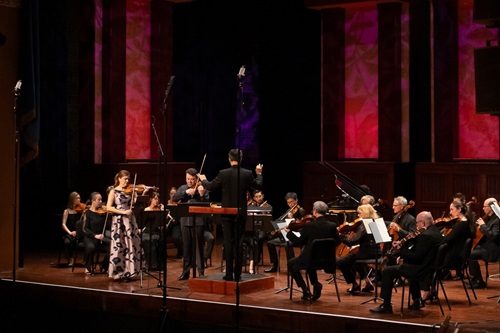
The first movement, Ludus (‘Game’), though slow is active. The second, Silentium (‘Silence’), exists in a trancelike stasis. The game of the first movement is a very serious one, the music’s tautly controlled fury suggesting a barely-suppressed violence. The soloists for this performance were Pro Musica Columbus’s creative partner, Vadim Gluzman, and the orchestra’s concertmaster, Katherine McLin. Gluzman is, quite simply, one of the world’s most brilliant violinists, as evidenced a few years back in our coverage of his performance of Tchaikovsky’s violin concerto with the Cleveland Orchestra (review here). But here Gluzman applied his honeyed tone to Pärt’s concentrated meditation breathtakingly. McLin’s more expressively plangent timbre made it easy to hear how the two solo lines take turns cradling each other, and conductor Ken-David Masur accomplished the difficult task of making the sparse lines for string orchestra and prepared piano sound like a single unfolding thought. The long, slow winding-down of the second movement made it clear just how much the work’s spell is co-created by the audience, who are called upon for an unusual level of concentration. The result was as close to a literal spellbinding as can be wrought in this modern world.
The other works on the program explored more earthly planes of existence. Masur was brought in to substitute for music director David Danzmayr, whose wife had just given birth. He relished the Bach, offering bright tempos and crisply lifted rhythms and particularly sought to shape sectional contributions into long phrases, clarifying to the ear how Bach passed ideas from section to section. While the famous air floated beautifully, the dominant impression came from Masur’s evocation of the dance roots of the suite’s movements. At one point, it even looked like the conductor was about to break into a jig himself!
Beethoven’s ‘Pastoral’ Symphony was well-balanced between forward movement and lingering delight. As an example, the first movement’s upbeat joy on arriving in the country (as Beethoven’s subtitle puts it) didn’t prevent Masur from wrapping up large paragraphs with a momentary slowing, almost as if to glance back with a smile at the ground already covered. The slow movement was exquisitely placed at just about as broad a tempo as it can take while still flowing ceaselessly onward, as a burbling brook should. He gave the birdcall solos near the end of the movement as much time as the players desired to conjure their trills and chirps.
The dancing peasants of the third movement were light on their feet and lively, transitioning into a storm movement that was more a thundershower than a severe storm. This may have resulted, in part, from the timpani being played with soft-headed sticks instead of wooden heads. Also, it remains difficult to judge just how much sound is lost to the fly-system rafters of the Southern Theater’s stage. It always surprises me how remote the orchestra sounds here in comparison to the moderate size of the venue, which means that all the seats in the house are comparatively close to the stage although the orchestra doesn’t sound close. But without baffles to redirect the sound, it is likely that a great deal of the orchestra’s volume goes up instead of out, a tendency that is reinforced by the sound baffle in front of the timpani, in place to protect adjacent players but which likely pushes the sound of the drums upward.
Regardless, the weather was sufficient to provoke the lyrical thanksgiving of the final movement. The orchestra responded warmly to Ken-David Masur, and it is worth noting that despite having soloed in the Pärt, Katherine McLin resumed her post as concertmaster in the Beethoven, showing a commitment to being at the pulse of the performance, a distinction which could be applied to the entire ensemble.
Mark Sebastian Jordan