
 United States Mahler, Gordon: Robert Walters (English horn), Cleveland Orchestra / Tugan Sokhiev (conductor). Mandel Concert Hall at Severance Music Center, Cleveland, 13.11.2025. (MSJ)
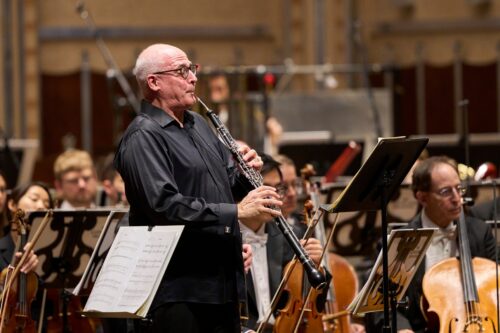
Geoffrey Gordon – Mad Song
Mahler – Symphony No.6 in A minor, ‘Tragic’
Tugan Sokhiev made his Cleveland Orchestra debut with a striking but oddly unsatisfying performance of Mahler’s mighty Sixth Symphony. It was perplexing, really, because there was so much decisive, quality musicianship on display. Sokhiev’s tempos were smartly chosen, his handling of phrases showed thoughtful consideration, and he paid close attention to many details of Mahler’s bewilderingly complex score that often get missed. Yet, despite all the admirable features, the work never caught fire or felt like anything more than an exercise in impressive control.
There can be no question of Sokhiev’s ability. In just one week, he had the Cleveland Orchestra sounding startlingly different than they usually do: in place of their usual elegant blend was a vivid highlighting of different orchestral colors. A strange exception was the pair of timpani at the back of the orchestra who seemed intentionally held back, only unleashing their full volume in the final dark explosion of sound that ends the symphony tragically. For an orchestra that is already known for restrained timpani, it was an odd and underwhelming choice. One can understand Sokhiev’s urge to hold some energy in reserve for later in this long and demanding work, but he also had the timpani decrescendo as they were announcing the motto rhythm of the piece, a direct contradiction of Mahler’s score which marks the timpani part for those two bars as ‘sempre f’ (‘always loud’).
The score need not be followed like some sort of religious document, but that kind of tucking in of details was all over the place throughout the performance. Nothing was allowed to develop organically without Sokhiev’s fingerprints all over it. While timpani were restrained, the brass were encouraged to play out. That was exciting until it became wearing because so many other instruments and sections were being restricted at the same time. Additionally, there were an unusual number of errors in big solos which made one wonder if the orchestra and conductor were at all comfortable with each other.
So much was held back and to such a degree that the performance rarely surged forward. It never brought the feeling of desperation that Mahler’s careening succession of manic marches needs. By comparison, the Cleveland Orchestra performance in 2017 led by music director Franz Welser-Möst was far fierier and more emotional, even though tempos and the use of the original Andante/Scherzo order of movements were the same. (As an aside, some people get bent out of shape about the order of the inner movements, but I can see why Mahler changed his mind: there are advantages and disadvantages in either order, and I simply choose to accept whichever one I am hearing at the moment.) But as similar as Welser-Möst and Sokhiev were in basic running time, the performances were extremely different. Welser-Möst is hardly known as a firebrand – he is one of the most reserved maestros in the business. But he knows when a work needs to blaze, and his Sixth did. At best, this one occasionally smoldered.
Another moment that failed to ignite was the first hammer blow of the Finale. The orchestra was using its ‘home’ box, an enormous wooden box struck with a large wooden hammer, unlike the smaller box they take on tour. Its sound is fantastic, though the moment was smudged here. The climax was built up to skillfully, but something went awry at the moment of impact: the hammer blow and the bass drum thud were out of alignment and the peak lacked its usual decisive effect. It hardly mattered, though, considering how the following passage was played matter-of-factly, without any panic or wildness. The second hammer blow came off with better focus but, again, the music that followed it sounded relatively unperturbed, less like a moment of crisis and more like an etude. The extremely well-executed moments of the performance (the end of the first movement, the mean snap of the Scherzo, the closing barrage) in no way made up for the lack of emotional catharsis in the Finale.
Part of the problem could be the presence of a demanding concerto in the first half of the program. One could argue that the Mahler should be treated like a special occasion and not saddled with company which can only detract energy from a piece that needs every moment of concentration it can get. That being said, the English horn concerto Mad Song by American composer Geoffrey Gordon was an interesting evocation of the swirling writings of poet William Blake and an impressive showcase for Robert Walters, the Cleveland Orchestra’s solo English horn. One of the luminaries of the orchestra’s formidable woodwind section, he can be counted on to deliver important solos throughout the orchestral repertory. Walters was only playing the concerto on this night, and it put him through the wringer, utilizing the entire range of the instrument and giving him moments to soar.
It wasn’t clear, at first, that this would be the case. Gordon’s score opens with an all-too stereotypical modern abstract onslaught of percussion. Blake’s poem ‘Mad Song’ evokes a powerful sense of mental instability, but percussion onslaughts do seem to be the default modernist gesture. Perhaps Gordon was determined to avoid an equally stereotypical chromatic swooping of strings in response to Blake’s opening line, ‘The wild winds weep’, but I wish there would have been some other option. The percussion was followed, of course, by atonal tone clusters and the like, before the English horn solo was able to extract itself with more interesting material.
But the work turned out to be more than by-the-book abstract modernism. Orchestral textures thinned and some melodic, even passingly tonal, material emerged, around which the piece began to gel emotionally. This more tender side of the music gave Walters the chance to sing darkly as only the English horn can. The second movement drew me in, culminating in a passionate and riveting solo cadenza which Walters tore into commandingly. Throughout the third movement, the piece remained compelling, even when the tone clusters and percussion barrages returned. Walters was masterful, and Sokhiev and the orchestra supported him vividly. The composer was present to receive the audience’s warm response.
Mark Sebastian Jordan
Featured Image: Tugan Sokhiev conducts the Cleveland Orchestra in Mahler’s Symphony No.6 © Roger Mastroianni/TCO