 Italy Rossini Opera Festival 2026 – Rossini, Le siège de Conrinthe: Soloists, Coro del Teatro Ventidio basso (choir leader: Pasquale Veleno), Orchestra del Teatro Comunale di Bologna / Carlo Rizzi (conductor). Auditorium Scavolini, Pesaro, 11.8.2026. (AB)
The Rossini Opera Festival decided to open its 2026 edition with a new production (this year’s only one) of Le siège de Corinthe, exactly two hundred years after its Paris première. This anniversary serves as a welcome reminder of why the work mattered in the first place, as it occupies a special place in Rossini’s career, being his first opera in French and the first he composed specifically for the Parisian stage.
Le siège is based on Maometto II, Rossini’s Neapolitan opera of 1820, but to call it merely a revision would be misleading. Rossini transferred the action from Negroponte to Corinth, reworked the characters, expanded the opera to three acts, enlarged its choral and ceremonial dimensions and added the ballet obligatory in grand opéra. More significantly, he shifted the dramatic emphasis. Maometto II is essentially a concentrated private tragedy; Le siège places the emotional conflict within the destruction of an entire people. Pamyra’s impossible position between her love for Mahomet and her loyalty to her father and homeland remains central, but Rossini surrounds it with armies, priests, patriotic exhortations, prayers and collective catastrophe.
One can hear the transformation immediately: this is unmistakably Rossini, yet the sound has changed. The orchestration is broader, giving greater weight to the middle and lower strings and creating fuller textures in the brass and woodwind. The immediacy of the drama is striking. Rossini absorbs elements of French declamation and tragédie lyrique, yet the result never sounds derivative. He takes possession of the emerging language of grand opéra in a way that remains unmistakably his own.
The subject was brilliantly chosen for Paris in 1826. The opera ostensibly deals with the Ottoman capture of Corinth in the 15th century, yet the Greek War of Independence had generated enormous enthusiasm across Europe, intensified by the fall of Missolonghi. Within that framework, the opera’s Greek heroine Pamyra discovers that the man she once met in Athens and has loved ever since, Almanzor, is in fact Mahomet, the conqueror destroying the Corinthian people. Her father, Cléomène, regards her love as a betrayal, while Mahomet – equally enamoured of her – attempts to draw her into his world by proposing immediate marriage. Néoclès, whom her father has promised to Pamyra, also fights for her love. The two men thus represent rival romantic and political alternatives, and in the end Pamyra chooses Greece and kills herself as Corinth falls and the Greeks perish in a vast conflagration.
For a director in 2026, this raises obvious questions. What are we to do with an opera that idealises the Greeks as heroic victims and presents the Ottomans largely as conquering outsiders? And what does collective martyrdom mean today, when images of occupied cities, civilian destruction and cultural heritage reduced to rubble once again surround us?
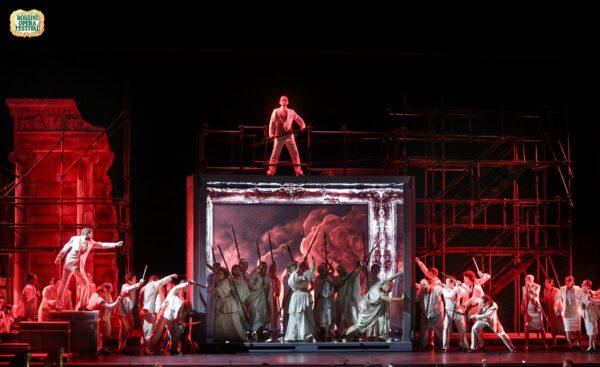
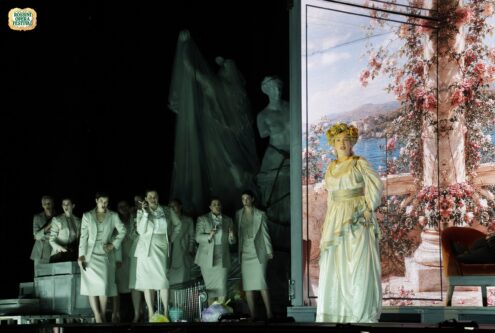
Davide Livermore attempts to shift the conflict away from a binary opposition between ‘European’ Greece and Islam towards something broader: classical culture under assault from shallow, consumerist modernity. Here, the Greeks inhabit a museum-like world of archaeological fragments, crates and scaffolding, wearing Gianluca Falaschi’s white pseudo-antique costumes. The Turks arrive in immaculate modern white suits, carrying smartphones, smoking, taking selfies and photographing the conquered. Culture, so the message seems to be, is something for them to consume, possess and discard. The proposition is understandable: ancient beauty is besieged not by Islam but by modern vulgarity. The difficulty is that the idea becomes less persuasive the more insistently it is explained.
The Turks are presented so insistently as vulgar caricatures that they cease to generate any genuine danger. At the same time, the Greeks are so determinedly idealised that the confrontation becomes schematic. Are these really Greeks and Turks? Antiquity and modernity? Culture and capitalism? Victims and tourists? Quite apart from whether this is an appropriate binary opposition – and I do not think it is – Livermore appears to mean all of these things at once, yet never develops any one of them with sufficient consequence.
The piles of brightly coloured rubbish bags are symptomatic. Classical fragments become surrounded by refuse, and even a supermarket trolley appears. The symbolism is very much in your face, but it has little consequence for what is actually happening on stage.
D-Wok’s video projections, shown on a very large screen within a movable box that forms the central background for much of the evening, are somewhat more successful. Digitally generated, sometimes distinctly AI-like images create a fantasy Greece of luminous seas, sumptuous architecture and idealised classical splendour. As the war progresses, these images collapse into fire and devastation.
Yet here, too, there is simply too much. Images transform and dissolve while competing with dancers, ruins, scaffolding and singers. The eye is constantly occupied, whereas the actual direction of the performers is surprisingly thin. Again and again, singers are left to stand, turn, pose, smoke or wait for their next intervention. Livermore has created a large visual machine, but too often the people inside it remain surprisingly static figures in a vast tableau. This becomes particularly problematic in Act III. Hiéros and the chorus transform impending military defeat into spiritual victory as the Greeks prepare for martyrdom. It is a musically overwhelming scene, but also one that should make a contemporary audience uncomfortable: a collective is being mobilised towards death. Is this heroism, fanaticism, manipulation, or the final act of agency available to a defeated people? Livermore’s metaphor of cultural decay has surprisingly little to say here.
The Act II ballet works better. Erika Rambaldoni’s choreography turns the obligatory Parisian ballet into an expression of Pamyra’s divided consciousness.
Musically, the evening stands on much firmer ground. Carlo Rizzi adopts a clear, controlled and transparent approach, resisting any temptation to inflate Rossini into proto-Meyerbeer. The Orchestra del Teatro Comunale di Bologna plays superbly, with strength in the lower strings, eloquent woodwind and considerable weight without any loss of transparency. The Coro del Teatro Ventidio Basso, prepared by Pasquale Veleno, is outstanding, making the chorus a genuine protagonist.
Ultimately, however, the evening belongs to Vasilisa Berzhanskaya. Her Pamyra combines a dark, saturated middle register with an upper voice of remarkable amplitude, while retaining extraordinary flexibility. Her coloratura remains effortless and beautifully clear, even in the softest pianissimos. Adrian Sâmpetrean offers a strong Mahomet, singing with smooth, cultivated authority rather than bluster. Maxim Mironov’s elegant Néoclès combines silvery upper notes with greater substance in the middle register, while Matteo Roma is a solid, increasingly dark-toned Cléomène. Simón Orfila gives Hiéros the required authority, especially in the final act, while Anna-Doris Capitelli is a warm and stylish Ismène. Giuseppe De Luca and Tianxuefei Sun complete the cast capably.
In the end, this Le siège de Corinthe is more convincing when heard than when watched, despite the considerable visual effort. Livermore begins with an idea that might have been worth pursuing but fails to develop it fully. Rossini, on the other hand, remains anything but evasive. Two hundred years later, the most striking aspect of the work is still the confidence with which he transforms his own musical language for Paris, and the Rossini Opera Festival has always played a decisive role in bringing that legacy back to life.
Andreas Bücker
Featured Image: [featured singers l-r] Giuseppe De Luca (Omar), Adrian Sâmpetrean (Mahomet II), Vasilisa Berzhanskaya (Pamyra), and Maxim Mironov (Néoclès)
Production:
Director – Davide Livermore
Assistant director – Sax Nicosia
Staging – Eleonora Peronetti, Paolo Gepcucco, Davide Livermore
Video design – D-Wok
Costumes – Gianluca Falaschi
Choreography – Erika Rombaldoni
Lighting – Nicolas Bovey
Cast:
Mahomet II – Adrian Sâmpetrean
Cléomène – Matteo Roma
Pamyra – Vasilisa Berzhanskaya
Néoclès – Maxoim Mironov
Hiéros – Simón Orfila
Adraste – Tianxuefei Sun
Omar – Giuseppe De Luca
Ismène – Anna-Doris Capitelli
My first experience at the Rossini Opera Festival in Pesaro will always remain very special to me. I enjoyed every moment of those unforgettable days, and reading this brilliant review by Dr Andreas Bücker brings all those emotions back. His analysis is not only impressively precise and deeply informed, but also wonderfully clear: he explains both Rossini’s extraordinary musical transformation and the limitations of the production with remarkable intellectual elegance. This is criticism worthy of a true expert, revealing exceptional intelligence, profound musicological knowledge, and rare artistic sensitivity. His words make me relive the happiness of being there, surrounded by such music, history and beauty. A truly exceptional piece of writing.