
 United States Various: Jean-Guihen Queyras (cello), Alexandre Tharaud (piano). Stephen A. Schwarzman Auditorium, Frick Collection, New York, 8.11.2026. (ES-S)
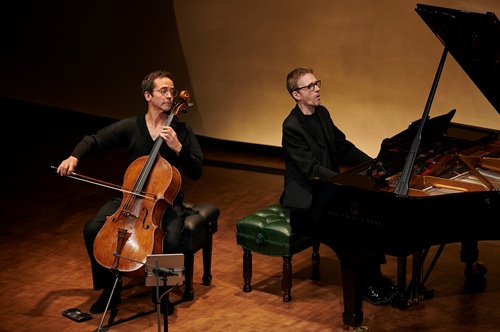
Thirty years of making music together have given cellist Jean-Guihen Queyras and pianist Alexandre Tharaud a shared musical language. Their recital at the Frick Collection demonstrated the versatility of that partnership across an unusually wide range of styles, from the French Baroque to 20th-century modernism.
A program that began with a suite and a sonata performed in their entirety took an intriguing turn after the intermission, when the two musicians presented a series of short pieces or individual movements from larger works to which they had become particularly attached over the years. Played mostly attacca, these selections were arranged into three sequences, each reflecting affinities apparent to the duo even if not immediately obvious to the listener.
The first of these juxtapositions moved back in time from Berg’s Four Pieces, Op.5, to the luminous Adagio from Schubert’s ‘Arpeggione’ Sonata, then forward again to the two outer movements of Benjamin Britten’s Cello Sonata, Op.65. Originally written for clarinet and piano, Berg’s Four Pieces retained their aphoristic character in Queyras and Tharaud’s arrangement for cello and piano, compressing a remarkable range of expression into fleeting gestures, abrupt contrasts and moments of eerie stillness. The performers brought out the music’s nervous intensity without sacrificing its more elusive, introspective character. Schubert’s Adagio, an oasis of calm, unfolded with unhurried tenderness. Queyras’s long melodic lines, supported by Tharaud’s delicate accompaniment, preserved the music’s intimate, almost vocal character. The mood shifted again with Britten’s Cello Sonata. The Dialogo alternated ironic, almost conversational exchanges between cello and piano with passages of cantabile. In the concluding Moto perpetuo, Queyras and Tharaud propelled the music forward with seemingly inexhaustible energy, maintaining clarity and precision through its relentless rhythmic motion.
The next sequence spanned more than two centuries of French music. It began with the Prélude from Marin Marais’s Pièces de viole, whose vocal quality seemed to linger in the opening bars of the Prologue to Debussy’s Cello Sonata. Queyras and Tharaud revealed the subtleties of Debussy’s musical language through finely shaded colors, flexible phrasing and an acute sensitivity to its elusive harmonies. Fauré’s Sicilienne shared that sense of refinement but replaced Debussy’s fluid, unpredictable contours with a more continuous melodic flow. Queyras shaped its lilting melody with effortless grace, while Tharaud’s accompaniment lent it a wistful tenderness. A sudden burst of energy followed in Papillon, where Queyras’s nimble bowing and Tharaud’s sparkling piano playing captured the music’s fluttering lightness.
Poulenc’s Suite française, heard before the intermission, reached further back into French musical history, drawing on Renaissance dances by Claude Gervaise that the 20th-century composer reimagined in his neoclassical idiom. Queyras and Tharaud captured the work’s blend of courtly elegance and mischievous wit through crisp articulation and sharply defined dance rhythms, contrasting the livelier movements with a more restrained approach to the slower ones.
The second half concluded with three of Brahms’s Hungarian Dances (Nos.1, 7 and 5), offering perhaps the clearest demonstration of the instinctive understanding Queyras and Tharaud have developed over three decades of playing together. They negotiated the dances’ intricate rhythms, sudden changes of tempo and pauses of unpredictable length with uncanny precision, barely exchanging a glance. Every subtle breath seemed anticipated by both musicians, lending the performances a spontaneity that belied the extraordinary control required.
The evening’s most substantial work was also by Brahms: his Cello Sonata No.1 in E minor. Queyras opened the Allegro non troppo with a dark, warm tone in the cello’s lower register, while Tharaud succeeded in giving Brahms’s densely woven piano writing both weight and transparency. Cello and piano alternately came to the fore and stepped back, their shifting roles carefully balanced. In the Allegretto quasi Menuetto, the two musicians gave the minuet a slightly reserved, old-fashioned grace, relaxing into a more flowing lyricism in the contrasting Trio. In the finale, they brought vigorous energy to Brahms’s fugal writing, giving each contrapuntal entry a distinct profile while maintaining the momentum.
Queyras and Tharaud’s long partnership also found a playful expression in a ritual repeated throughout the evening. Before each bow to the audience, both musicians removed their reading glasses and placed them beside the keyboard; then, with amused gestures, they helped each other pick them up before returning to the music.
The musicians offered a single encore: a heartfelt Melody by Ukrainian composer Borys Lyatoshynsky, a choice with particular resonance today.
Edward Sava-Segal
Poulenc – Suite française (d’après Claude Gervaise), FP80
Brahms – Cello Sonata No.1 in E minor, Op.38; Hungarian Dances Nos.1, 7 & 5 (arr. Queyras/Tharaud)
Berg – Vier Stücke, Op.5 (arr. Queyras/ Tharaud)
Schubert – Sonata in A minor, D.821 ‘Arpeggione’: Adagio
Britten – Cello Sonata, Op.65: Dialogo & Presto
Marais – Pièces de Viole, Book II, Suite No.1 in D minor: Prélude
Debussy – Sonata for Cello and Piano, L.35: Prologue
Fauré – Sicilienne, Op.78; Papillon, Op.77
Encore: Borys Lyatoshynsky – Melody