
Finding the sacred in Jewish history and poetry with composer Alex Weiser
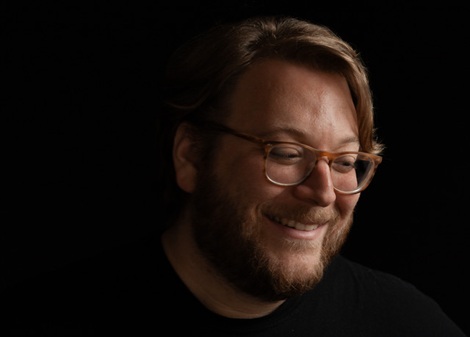
The New Yorker has praised composer Alex Weiser for his ‘knack for crafting music that is at once historically rooted and of its moment’. Drawing on Jewish history, Yiddish literature and the search for spiritual meaning, he creates music that bridges past and present, exploring tradition, longing and the fragility of human life.
Weiser spoke ahead of the US premiere of Tfiles Clarinet Concerto, featuring clarinetist Andrzej Ciepliński, the American Composers Orchestra and conductor Kedrick Armstrong at Carnegie Hall’s Zankel Hall on 27 October 2026.
Rick Perdian: You came to classical music by way of classic rock. How did that journey lead you to composition?
Alex Weiser: I was born and raised in New York City in the East Village. I came to love music because of my father. He is an audiophile who takes his stereo really seriously. Growing up, he would turn off the lights and we would just sit and listen. I have come to realize that was a rare introduction to music. So many people listen to music in the background rather than paying attention to it.
My dad’s tastes, for the most part, centered on classic rock, so that is what I grew up with. In middle school, I started playing the guitar because I loved music and wanted to be closer to it. In my freshman year at Stuyvesant High School, I took a music appreciation course, was introduced to the classical canon and was totally blown away. I was used to listening attentively and was ready to absorb this music’s richness. I’d heard pieces here and there but had never really listened to classical music.
One of my teachers, Joseph Tamosaitis, or Mr. Tamosaitis, as I call him, was my mentor in high school. When I wanted to play in the school orchestra, he told me to take up the viola because they always needed violists. He gave me a book to study so I could take AP music theory and, when I started composing, he recommended that I study with Paul Alan Levi whom he had known at Juilliard. Mr. Tamosaitis and Paul Alan Levi were the two people who set me on my path.
When I was applying to college, I wanted to pursue music and learn more about it. I went to Yale where they offer a general degree in music, but my concentration was composition. It was an amazing place to be, surrounded by so many inspiring people writing music at such a high level. Some of my older colleagues and friends, like Ted Hearne, Andrew Norman, Christopher Cerrone and Timo Andres, were there, and I am still in touch with them. It was an exciting environment and their work inspired me to push myself to be the best I could be.
RP: Did you have pieces performed then?
AW: I was very active writing music and trying out tons of stuff. Yale brought in guest ensembles from all over the country, like the Fifth House Ensemble from Chicago and the JACK Quartet. I also wrote for student groups, including orchestral pieces. I composed pieces for my friends too, some of whom have gone on to become wonderful professional musicians.
After Yale, I moved back to New York and earned a master’s degree in composition at New York University (NYU). I studied with Michael Gordon and Julia Wolfe, two of my favorite composers. At the same time, I taught at the Third Street Music School and worked at the MATA Festival, an annual contemporary classical music festival in New York.
RP: What are you working on at the moment?
AW: I just finished a new clarinet quintet for Andrzej Ciepliński, Klezmer-loshn, which will receive its world premiere from Andrzej at the Trzy Cztery Festival in Warsaw on 3 December 2026. The other big thing is Tevye’s Daughters, drawn from Sholem Aleichem’s stories upon which Fiddler on the Roof is based. The piece centers on Shprintse, Tevye’s second-youngest daughter, who takes her own life after a romance ends, unable to challenge the social constraints governing her life. It’s an amazing story, shedding new light on a family we thought we knew so well.
Stephanie Fleischmann’s libretto tells it as a story within a story. Shprintse’s surviving sisters have immigrated to the US and have a home in the Catskills, a mountainous region of upstate New York that became a major summer destination for Jewish New Yorkers. The setting is bucolic, similar to the small Jewish village in which the original stories were set. A granddaughter’s romance becomes the occasion to dredge up old stories about Shprintse, while the piece also explores immigration to America and Jewish life there in the 1960s.
We’ve been workshopping it for a few years. The piece was commissioned by American Lyric Theater (ALT). We had a team from ALT with us throughout the workshops providing feedback. Cori Ellison, who has worked extensively with composers and librettists to shape their material for the stage, is our dramaturg, and Mary Birnbaum, who works with singers in the Met’s Lindemann Young Artist Development Program, was a dramatic advisor for the most recent workshop.
The process is a little unnerving at times because you’re getting so much feedback, but we want input from everyone because we want to iron everything out. I can’t get inside each person’s head but it is important to imagine yourself as an audience member not as a creator. You have to create some distance and imagine that it’s washing over you for the first time.
We’re ready for the premiere and have some exciting stuff in the works which we hope to be able to announce soon.
RP: We’re here to talk about the Tfiles Clarinet Concerto. How did that commission come about?
AW: It was in 2021, just days after I got married. Kajetan Prochyra, then curator of the POLIN Museum’s music program and curator of the POLIN Music Festival, emailed to congratulate me on my recent marriage and ask if I would compose a clarinet concerto for the museum for Andrzej Ciepliński.
The POLIN Museum of the History of Polish Jews documents a thousand years of Jewish life in Poland, from its medieval beginnings through the Holocaust to the revival of Jewish culture in contemporary Poland. The museum had worked with David Krakauer, who is great, no question about that, but they wanted a different kind of clarinet piece. Kajtek said he had heard my album and all the days were purple, released in 2019, and loved it. It was a breakthrough work for me and a finalist for the 2020 Pulitzer Prize in Music.
The recording brought my work to the attention of a lot of people. It is a song cycle for voice, piano, percussion and string trio, setting Yiddish and English poetry by Anna Margolin, Rokhl Korn, Avrom Sutzkever, Edward Hirsch and Mark Strand. The songs explore spirituality, longing, beauty, suffering and the transience of life through poems that are a kind of secular prayer. What drew Kajtek to the album, and what was relevant to the concerto, was that it didn’t sound Jewish. I was setting words to music and exploring the ideas in the poetry, which did not call for Jewish folk sounds.
They are wonderful examples of Yiddish modernist poetry so, to me, my settings were a natural response, but they took a lot of people by surprise, in a good way. The music was Jewish but did not sound Jewish in the conventional sense. Kajtek honed in on that and asked if I could do the same for the clarinet.
I was really excited about the prospect. I had composed a lot of songs to Yiddish texts and thought I could use them as inspiration for a purely instrumental piece. I had marked Tfiles (Prayers) by Kadya Molodowsky (1894–1975) for future use, and I thought her poems could provide an interesting basis for the concerto. Coincidentally, she had lived in both Warsaw and New York. Stephanie and I would later draw on Molodowsky’s amazing life story for Tevye’s Daughters.
The three poems in Tfiles resonate with me because they are prayers but not in the traditional sense: they are instead a personal search for meaning. That duality matched my artistic impulse for the concerto. I was interested in exploring Jewish history and culture but not in an orthodox way. I did not want to reproduce something from the past. I envision the clarinetist as a supplicant, reflecting the poems’ search for God, rather than acting as a virtuoso. That is the structure of the concerto and how it plays out.
RP: Tell us about the premiere in Warsaw.
AW: It was on 23 February 2024 in the auditorium of the POLIN Museum, with Andrzej as soloist performing with the Polish Radio Orchestra, conducted by Michał Klauza, as part of the POLIN Music Festival. It was amazing. Polish Radio has a rehearsal space with a beautiful acoustic which, coincidentally, is where Klezmer-loshn will premiere.
I had already been to POLIN, but to be part of the thousand-year story of Jews in Poland that the museum details was really special. The night before the concert, Eliza Bagg, who sang on the recording of and all the days were purple, performed the song cycle at the museum with members of the Polish Radio Orchestra. It was in the museum’s lobby, a beautiful space. The concerto was performed in the museum’s main hall the following evening. It was just incredible.
When I returned to New York, I told my teacher and mentor Michael Gordon that I felt like a real composer. He told me not to get used to it: ‘You are a real composer but what you just experienced will always be special’.
Rick Perdian
(This interview has been edited and condensed for clarity.)