
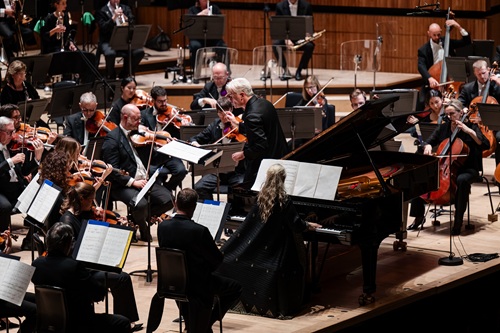
 United Kingdom Howell, Simpson, Stravinsky: Tamara Stefanovich (piano), London Philharmonic Orchestra / Edward Gardner (conductor). Royal Festival Hall, London. 23.10.2026. (AV-E)
Dorothy Howell – Lamia, symphonic poem
Mark Simpson – Piano Concerto (world premiere)
Stravinsky — The Firebird, complete ballet (1910)
Dorothy Howell’s Lamia proved an evocative discovery, its sensuous orchestral writing drawing the listener into a world of intoxicating beauty and latent danger. An iridescent woodwind theme curled sinuously through the hall, almost incense-like in its heady allure, while the strings swelled with aching, late-Romantic passion. This shimmering, hypnotic beauty gave way to the brass-heavy dread of the tragic wedding scene, where the music’s darker force became almost overwhelming. Howell’s gift for musical storytelling lay in this thrilling contrast between sensual allure and the terrifying consequences of tragedy. It revealed a first-rate composer whose expressive gifts deserve far wider recognition. Edward Gardner drew finely nuanced playing from the London Philharmonic Orchestra, bringing the score’s magical colours and emotional intensity vividly to life. Lamia should be heard much more often.
Mark Simpson’s Piano Concerto, receiving its world premiere, confirmed this ‘non-contemporary’ composer as one of the most imaginative orchestrators working today: a subterranean soundworld, unmistakably unique. Simpson describes composing as expressing something within the self that cannot be fully verbalised — a threshold where the mouth fails, and the body takes over composing the music. Through restless piano spasms, defecating brass, and purging percussion, the inner guts erupted with an excruciating excremental force.
The concerto’s volatile frenzy was disrupted by breathless, paralysing cramps, trapping its explosive outbursts in a claustrophobic emotional vacuum. A manic, adrenaline-choked central movement decayed into a colossal, bone-crushing finale, the piano and orchestra locked in a feral, skin-tearing friction. Tamara Stefanovich executed the terrifying muscular tightrope with iron-clad control, clarity and grit, exposing the concerto’s anatomical architecture without sacrificing its structural momentum. Simpson beamed upon the stage, triggering rapturous and spasmodic applause from a packed-to-bursting audience.
Stravinsky’s complete Firebird ballet brought the evening to a scintillating close, its extraordinary orchestral colours conjuring a world of mystery, violence and transformation. Gardner paced the score seamlessly, sustaining its momentum while giving every transformation its due. At the outset, eerie string tremolos conjured a spectral, half-lit world, their delicate, shimmering textures heightening the sense of mystery. Above them, darting woodwind figures flickered and sparkled through the orchestral shadows, flutes skittering in breathless trills while oboes and clarinets cut through the textures with sharp, incisive accents. Their restless agility captured the Firebird’s elusive, supernatural presence.
The Infernal Dance erupted in savage rhythmic energy, with gleaming brass and percussion striking sparks from Stravinsky’s brilliantly combustible textures. Gardner relished the score’s sudden contrasts, moving between sinister stillness and explosive force without disrupting its irresistible momentum. The London Philharmonic Orchestra’s playing was immaculate: strings shimmering and glistening, woodwinds darting with pin-sharp precision, and brass blazing with thrilling power. In the finale, the offstage brass, including the glowing Wagner tubas, sounded from both sides of the hall, creating an astonishing spatial effect. Seeing the instruments positioned away from the orchestra made the experience all the more remarkable, as their sonorous calls seemed to emerge from beyond the stage, enveloping the audience in Stravinsky’s magical soundworld. Gardner built towards the triumphant apotheosis with unerring control, allowing the final brass chorale to unfold with ecstatic, exuberant radiance. The result was a performance of incandescent brilliance, revealing the orchestra at world-class level.
Alexander Verney-Elliott