 Germany Berliner Barocktage – Francesco Cavalli, La Calisto: Soloists, Ensemble L’Arpeggiata, Akademie für Alte Musik Berlin / Christina Pluhar (conductor & musical editor). Staatsoper Unter den Linden Berlin, 8.11.2026. (AB)
Premiered in Venice in 1651, La Calisto was hardly a success. Despite its promising subject, the opera received only ten performances before disappearing into obscurity. Cavalli, a pupil of Claudio Monteverdi, composed the work to a libretto by Giovanni Faustini, drawing on Ovid’s Metamorphoses. Its mixture of erotic intrigue, mythological fantasy and irreverent comedy was perfectly suited to Venetian carnival culture, where the emergence of public opera houses had made this still relatively young art form accessible to audiences beyond the aristocratic courts.
It was an inspired choice to open this year’s Berliner Barocktage at the Staatsoper Unter den Linden, and Stefan Herheim’s imaginative and visually enchanting production, combined with Christina Pluhar’s excellent musical direction, demonstrated just how irresistibly entertaining and surprisingly contemporary 17th-century Venetian opera can be.
The story revolves around the nymph Calisto, a devoted follower of the chaste goddess Diana. Giove (Jupiter), determined to seduce her, assumes Diana’s appearance and exploits Calisto’s attraction to the goddess. His jealous wife Giunone subsequently transforms the unfortunate nymph into a bear. Unable to reverse the punishment, Giove ultimately elevates Calisto to the heavens as the constellation Ursa Major. Meanwhile, Diana struggles with her attraction to the young shepherd Endimione, while the lovesick Pane and various other amorous satyrs contribute to the general confusion.
Herheim approaches this story with remarkable theatrical imagination. His production, previously presented at the Theater an der Wien, celebrates the opera’s erotic exuberance without reducing its characters to mere caricatures. Sexual ambiguity and fluidity, disguise and shifting identities become integral and natural elements of this world – he makes them part of the story without making them the story.
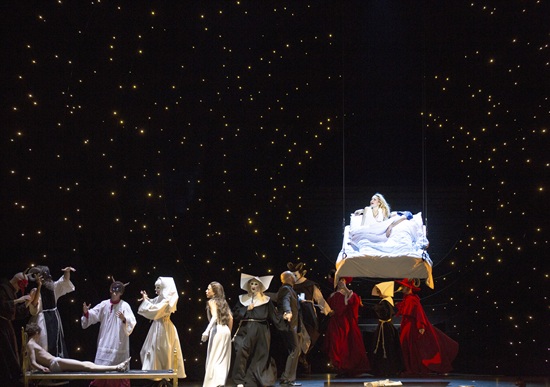
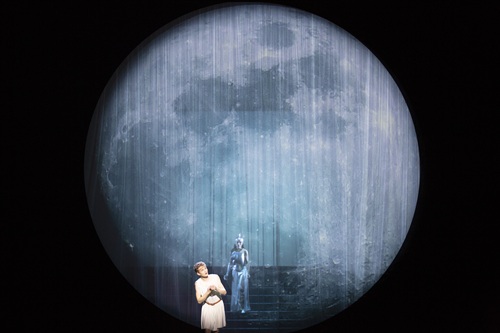
Silke Bauer’s stunning stage design combines the machinery of Baroque theatre with an almost futuristic visual language. Concentric, illuminated structures initially suggest female anatomy before opening into fantastical landscapes inhabited by birds, deer and other creatures. A luminous crescent moon and expansive celestial panoramas create moments of genuine magic. The visual splendour is further enhanced by Jean-Paul Bernau’s imaginative animal masks, Yashi’s extravagant costumes and Beate Vollack’s lively ballet choreography.
Herheim even manages to introduce an ecological dimension without making it seem forced. The burning Earth becomes an image of a threatened world, while Giove’s appearance as a firefighter adds another layer of comedy.
Musically, the evening was equally convincing. Venetian operatic manuscripts generally preserve little more than the vocal lines and a basso continuo foundation, leaving considerable freedom concerning instrumentation and realisation of musical lines. Christina Pluhar has produced a wonderfully imaginative edition of the music, that brings together her Ensemble L’Arpeggiata and the Akademie für Alte Musik Berlin. Theorbos, Baroque guitars, harps, keyboards and strings create constantly changing textures, enriched by expressive woodwinds and subtle percussion. Pluhar’s approach is rhythmically animated, occasionally even weaving jazzy passages into the musical texture without compromising the music’s historical character. Her treatment of ornamentation is impressive, as it becomes an essential vehicle of emotional expression rather mere decoration.
At the centre of the excellent cast of singers stands Vera-Lotte Boecker. Although her repertoire extends to Richard Strauss and Janáček, her bright, beautifully focused soprano proves equally persuasive in Cavalli. She combines effortless vocal flexibility with remarkable dramatic intelligence, moving convincingly between innocence, an awakening desire for Diana and emotional vulnerability. Her Calisto is anything but a passive victim: she discovers her sexuality with increasing confidence and develops into a self-assured woman, culminating in a spectacular encounter with Giove/Diana ascending towards the heavens in a bed suspended above the stage.
Milan Siljanov is equally impressive as Giove. His resonant, rounded bass possesses considerable warmth and authority, while his disguise as Diana allows him to demonstrate an accomplished falsetto, making the transformation as convincing vocally as it is theatrically.
Renato Dolcini brings a supple, articulate baritone to Mercurio, portraying the divine accomplice as a thoroughly contemporary opportunist. Giuseppina Bridelli gives Giunone aristocratic authority, her commanding mezzo-soprano voice expressing wounded pride and vindictive determination.
Luciana Mancini’s Diana dark mezzo conveys the goddess’s authority, though its occasionally rather austere colouring diminishes the sensuality of her encounters with Endimione. Arnaud Gluck, by contrast, sings the lovesick young shepherd boy with touching sincerity, and his delicate countertenor and beautifully sustained pianissimo creates some of the opera’s most intimate moments.
The comic roles are also very well served. Jake Arditti’s agile, vigorous countertenor makes Satirino a delightfully uninhibited creature, while Marcel Beekman’s theatrical portrayal of the nymph Linfea provides some of the evening’s funniest moments. David Tricou contributes an energetic and entertaining Pane in his frustrated pursuit of Diana.
This truly is an exceptional production, thanks to the remarkable harmony between Herheim’s theatrical imagination and Pluhar’s musical interpretation. The sheer inventiveness of the staging, the vitality and sensual beauty of Cavalli’s music, and the outstanding cast have made this a triumphant opening to the Berliner Barocktage.
Andreas Bücker
Featured Image: [l-r] Arnaud Gluck (Endimione), Luciana Mancini (Diana), Vera-Lotte Boecker (Calisto), Milam Siljanov (Giove) and Renato Dolcini (Mercurio) © Bernd Uhlig
Production:
Director – Stefan Herheim
Stage designs – Silke Bauer
Costumes – Yashi
Lighting – Stefan Herheim, Karl Wiedemann
Video – Roman Hagenbrock
Choreography – Beate Vollack
Dramaturgy – Kai Weßler
Cast:
Calisto – Vera-Lotte Boecker
Giove – Milan Siljanov
Mercurio / Il Destino – Renato Dolcini
Giunone / L’Eternitá – Guiseppina Bridelli
Endimione / Furia II – Arnaud Gluck
Diana – Luciana Mancini
Linfea / La Natura – Marcel Beekmen
Satirino / Furia I – Jake Arditti
Pane – David Tricou
Silvano – João Fernandes