 United Kingdom Bizet, Carmen: Soloists, Royal Opera Chorus, Orchestra of the Royal Opera House / Sesto Quatrini (conductor). Broadcast live (directed by Rhodri Huw) from the Royal Opera House, Covent Garden, and viewed at Cineworld, Newport, Isle of Wight, 10.11.2026. (DH) ****
« Je ne sais pas si dans sa vie cette fille-là a jamais dit un mot de vérité ; mais, quand elle parlait, je la croyais : c’était plus fort que moi. » (‘I don’t know whether that girl ever spoke a word of truth in her life, but when she did speak, I believed her – I couldn’t help myself.’)
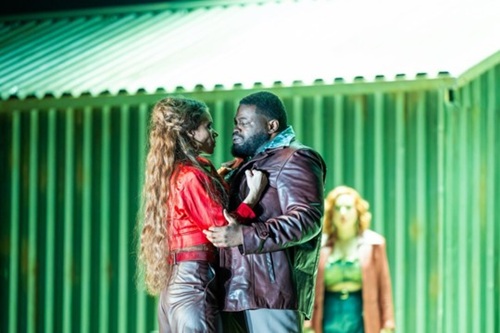
That is Don José on Carmen in Mérimée’s novella. Carmen the opera is dead in the water if Carmen herself lacks charisma. In this second revival of Damiano Michieletto’s 2024 Royal Opera production, Ginger Costa-Jackson has charisma and then some. What is most interesting about the way she exercises it is the effect she has on others. In an opera where almost every important relationship revolves around Carmen or is mediated by her, Costa-Jackson is superb at showing you how she exercises that power over others, in a way which took me straight back to the novella (fittingly, the spoken dialogue is credited ‘after Meilhac, Halévy and Mérimée’). Mérimée’s José can’t help himself, and Russell Thomas’s Don José at times seems almost her puppet. I don’t mean that as a criticism of his acting: he is in thrall to her in a way I have rarely seen in this opera, and that is down to the power of Costa-Jackson as an actor. Her voice is equally arresting. It is extraordinarily powerful and extraordinarily clear, with a dark lower register that is distinctive without being conventionally beautiful. I suspect she has thought hard about how she wants this Carmen to sound; nothing seems left to chance. In the Seguidilla, ‘Près des remparts de Séville’, for example, when she is first alone with José, she invests her singing with great flexibility and colour, matching the alluring tavern she conjures up for him. In the darker world of the Act III Card Scene, as she draws death twice in the ‘Air des cartes’, the voice has changed utterly: unfathomably dark and imbued with a deadening stillness.
Just as striking is the way Costa-Jackson the performer seems to draw performances out of those around her. Again, that’s most noticeable with Thomas. At first we see an immensely strong-looking man, with a hugely powerful voice and presence, who doesn’t quite know how to react to her; then we watch her pull him in, and his performance ignites from what had seemed a damp-squib start. By the Flower Song, ‘La fleur que tu m’avais jetée’, his singing is sublime, but it has the moral and metaphysical force of a broken, enslaved soul too. Costa-Jackson’s effect on others was also evident from an excellent interval feature on the Jette Parker Artists taking part in the production, in the programme’s 25th-anniversary season. It was fascinating to hear Seohyun Go and Ellen Pearson describe how much Costa-Jackson had given them and how she had taken them under her wing. Something of that mutual trust was palpable on the stage, too. Both Go and Pearson were excellent.
What of the production itself? Readers of Seen and Heard will have seen my colleagues Colin Clarke’s and Jim Pritchard’s reviews of the 2024 staging (here and here), so briefly: we are in a poor rural community in 1970s Spain, where Franco, or his ghost, still lurks. The run-down buildings of Paolo Fantin’s sets, and the half-hearted efforts of Zuniga and his men to keep order when their hearts aren’t really in it, give the whole thing an end-of-an-era feel. The setting works well, and characters of every kind are presented plausibly and feel true to life. Perhaps the production’s single biggest gain is its Micaëla, sung here by Adriana González. Sensibly, even primly dressed and wearing large spectacles, she is perhaps not quite the Micaëla previous productions have led us to expect, but the characterisation works really well here. She is intelligent, deeply sensitive and compassionate, and González makes her simply heartbreaking; I have never seen a Micaëla that has moved me so much. Her voice is exquisite, but what is most remarkable is the control and restraint she brings to her Act III aria, ‘Je dis que rien ne m’épouvante’. I wouldn’t have complained had the audience applauded for even longer than they did.
Alexander Vinogradov’s Escamillo is tremendous, never more so than in Act III, when he arrives at the smugglers’ camp and encounters Don José. He tells José he is madly in love (‘Je suis amoureux, mon cher, à la folie’), yet it comes out as entirely calculating; simply the words he needs to say to make his latest conquest. The cynicism is there in the same breath, when he observes that Carmen’s affairs never last six months. His singing is authoritative, and he has a stagey sort of magnetism (appropriate for his trade) whenever he appears. Barnaby Rea makes the most of Zuniga, who in this staging embodies that end-of-an-era feel; he is very good at conveying authority that is curtailed, a man with little real agency.
Other members of the Jette Parker contingent are outstanding too. Go and Pearson join Giorgi Guliashvili’s Dancaïro, Emyr Lloyd Jones’s Remendado and Costa-Jackson in the Act II quintet, ‘Nous avons en tête une affaire’, a real highlight of the evening, musically accomplished but, more importantly, dramatically coherent and forceful.
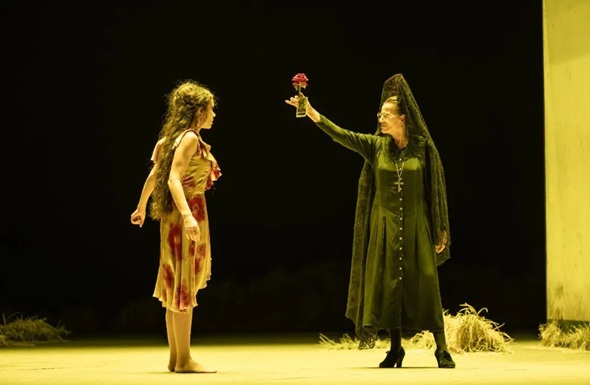
The great strength of Michieletto’s production, then, lies in the relationships between characters and the psychological depth they acquire. What doesn’t work so well? For me, three things. First, as well-documented by now, Michieletto puts Don José’s mother (Ruth Alfie Adams) on stage, a grim embodiment of fate who appears at various moments brandishing the tarot card of death. It is the sort of idea that might have worked on paper, but in practice, and particularly in this revival, it comes across as risibly melodramatic. It is a device that has no real power, and, on the contrary, in key scenes it risks undermining them altogether. It adds nothing to the evening’s tension, which was there regardless.
Second, a group of children (from the Royal Opera’s Youth Opera Company) appear between the acts, charmingly enough, holding up placards to show how much time has passed. The trouble is that they distract from Bizet’s music and prompt the audience to react in ways that feel inappropriate and disruptive. Nor does the device seem to have much to do with the rest of the production. I came to this Carmen having recently seen Phelim McDermott’s Così fan tutte from the Met, where signs are used during the overtures in a way which feels far more rooted in the staging, and with far greater theatricality and wit. By comparison, the device here feels poorly integrated. Not that the Covent Garden audience needed any excuse to make a noise while the music was playing, during the entr’acte between Acts I and II, the conductor, Sesto Quatrini, had to turn and give the auditorium a sustained fierce look to silence chatter that had carried on well into the music – a surprising moment in one of our major opera houses.
Third, the chorus. At times it is as if Michieletto wasn’t quite sure what to do with them, a point Jim Pritchard also made in 2024. They sing very well of course but are generally required to group around the stage going through rather basic movement or dance, and there is a general clumsiness and awkwardness about their stage placement throughout. That is perhaps most evident in Act IV, outside the toreador’s dressing room, where the direction to the chorus appears to have been: ‘Now, could you all just jump up and down a lot?’ It isn’t very inspiring, and they could have been better used.
Quatrini’s conducting was one of the highlights of the night: lively, incisive, sensitive and responsive. The interval gave us a glimpse of him in rehearsal with some of the Jette Parker Artists, and he is clearly a consummate musician – someone we should see more of at Covent Garden. The orchestra responded in kind.
The cinema presentation was, as usual, of a very high standard. Rhodri Huw’s screen direction let us see everything important, the interval features were illuminating, and Jess Gillam is as natural and relaxed a host as I can imagine. She did a great job introducing the opera and talking to Oliver Mears, Director of Opera, and Elaine Kidd, Head of the Jette Parker Artists Programme. Kidd paid a touching tribute to the late David Gowland for his leadership of the Programme since its inception.
Despite its flaws, then, this was a highly enjoyable night at the opera. Psychologically it felt grounded, and that is the single most important thing: this was a drama moving inexorably to its conclusion from the very first meeting between Don José and Carmen. Which is perhaps why the mother and her tarot card felt so superfluous. Mérimée’s Carmen needs no one to show her the cards. Facing José at the end of the novella, she reads her fate for herself: « Tu veux me tuer, je le vois bien ; c’est écrit, mais tu ne me feras pas céder. » (‘You want to kill me, I can see that; it is written, but you will never make me give in.’) Costa-Jackson’s Carmen knew it too and gave no ground.
Dominic Hartley
Featured Image: Ginger Costa-Jackson (Carmen) and Don José’s mother (Ruth Alfie Adams) (© Mihaela Bodlovic
Cast:
Carmen – Ginger Costa-Jackson
Don José – Russell Thomas
Micaëla – Adriana González
Escamillo – Alexander Vinogradov
Zuniga – Barnaby Rea
Frasquita – Seohyun Go
Mercédès – Ellen Pearson
Dancaïro – Giorgi Guliashvili
Remendado – Emyr Lloyd Jones
Moralès – Sam Hird
Bohemian – Dawid Kimberg
Marchande d’oranges – Miranda Westcott
Don José’s mother – Ruth Alfie Adams
Creatives:
Director – Damiano Michieletto
Revival director – Dan Dooner
Set designer – Paolo Fantin
Costume designer – Carla Teti
Lighting designer – Alessandro Carletti
Dramaturg – Elisa Zaninotto
Chorus director – William Spaulding