
 United Kingdom Enescu, Bartók, and Brahms: Inmo Yang (violin), BBC Symphony Orchestra / Sakari Oramo (conductor). Barbican Hall, London, 10.11.2026 (MB)
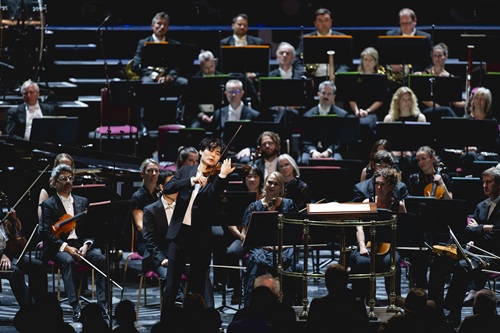
Enescu – Romanian Rhapsody No.1 in A major, Op.11 No.1
Bartók – Violin Concerto No.1, Sz.36, BB 48a
Brahms – Symphony No.1 in C minor, Op.68
Wagner’s Ring was 150 years old this summer. Another key 19th-century musical work, composed by the man once and by some still seen as Wagner’s antipode, celebrated its sesquicentenary only last week. Whether that was the reason for programming Brahms’s First Symphony here and now, I do not know; neither it nor the Ring is a stranger to us. At any rate, this Barbican performance from Sakari Oramo and the BBC Symphony Orchestra was an estimable one, preferable in every respect to the sloppy, disengaged Brahms I heard from Christian Thielemann in Salzburg (review here) in August.
First, though came a first half itself of distinctly unequal halves. George Enescu’s first Romanian Rhapsody came and went at length, almost impossible to credit as the work of the composer of Œdipe, or indeed the distinguished conductor we know from recordings. It was, of course, a sin of youth, one that irritated Enescu in later years, and there is no harm in hearing it from time to time, even if it outstays the welcome that might be better accorded to three or four minutes’ worth of music. Woodwind solos were characterful, as was an especially fine viola solo. The orchestra was in general warm, lively, seemingly enthused by Oramo’s guidance; all concerned milked it for whatever it might be worth. What else can I say? It is certainly rhapsodic and felt so, but not in the way Bartók would make his own — and make so much more out of.
Bartók’s First Violin Concerto led us immediately into a different realm, at times akin to the fashioning of a Szymanowskian magic carpet, albeit here with distinctly Prokofiev-like moments of bitter-sweetness as subtly brought out by violinist Inmo Yang and Oramo. (It is the other way round really, of course, but that was at least how I heard them.) Yang’s opening solo struck a fine balance between rumination and direction, as did all that was to follow. The first movement travelled through quasi-chamber music – this could have been a quartet – and beautifully balanced orchestral counterpoint as more instruments joined, in an awakening akin to a natural process, a coming of spring in post-Romantic fashion, Eichard Strauss and even Wagner surfacing, proving a welcome tonic on a cold, rainy evening. Intimations of The Wooden Prince and Bluebeard’s Castle were to be heard, but equally the musicians did not push too hard, happy to give the younger Bartók his own voice, all the while spun in finest silk. Quizzical and exuberant, ardent and indeed erotic, soloist and orchestra struck a similarly well-judged partnership in the second movement, rhythmically tight or malleable as called for. Different types of material were well characterised yet also related, indeed consequent, all at a duly high temperature. Quite why so many soloists are intent on giving an encore I can never understand. Occasionally it adds something other than time, but not so much here in the guise of a Telemann fantasia (the second movement of No.7 in E-flat major).
And so to Brahms. The BBC SO’s richness of tone reminded us, should we have needed it, that this orchestra can hold its own with any. Oramo’s way with the first movement introduction and indeed the first movement as a whole was, to my ears, surprisingly swift but not unwarrantedly so. It had its own logic and marked Brahms here in a particular line of succession to Beethoven, Haydn too, which was perhaps all the more different from Wagner’s. More important, it seemed to come from a place of both pain and hope: our lot, as well as Brahms’s, if we are lucky. It certainly developed in recognisably Beethovenian motivic fashion, the development in particular with no shortage of Romantic fury. The second movement brought a rich vein of consolation that contained, even gave voice to, rather than overcoming still-enduring pain. It offered spacious contrast, again audibly in descent from a more Classical conception of the symphony. There were especially fine violin and horn solos, as well as a beautiful complement of Harmoniemusik. Oramo captured to a tee the third movement’s own flow and its place in the greater river-flow of the symphony as a whole. It offered release, but also its own involvement and complexity, balanced through cross-rhythm and harmony; Brahms’s haunting ‘giant’ Beethoven was still very much present. The finale emerged directly from its close, reasserting struggle, earlier even that explicit reference, prior to major-mode triumph. Moreover, when those intimations came, they were not necessarily reassuring; all in its own time, a proper motto for Brahms more generally and certainly in the genesis and construction of this symphony. What followed was less painted than sculpted, yet ultimately found necessary release.
Mark Berry