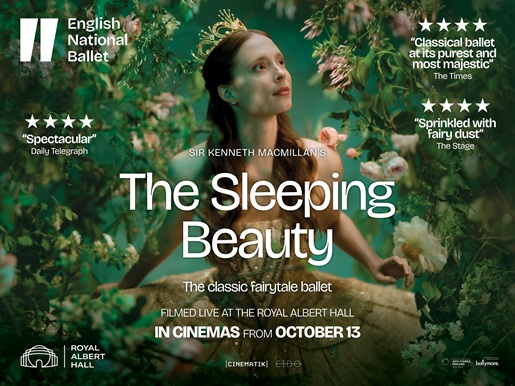
 United Kingdom English National Ballet’s The Sleeping Beauty: Soloists, Dancers of English National Ballet, English National Ballet Philharmonic / Maria Seletskaja (conductor). Filmed (directed by Ross MacGibbon) at the Royal Albert Hall, London, on 28 June 2025 and available in UK cinemas from 13.9.2026. (JPr) ***
In the cinemas near me in Essex the cinema showings of The Sleeping Beauty appear to be at 7pm which I would suggest is not really suitable for its target audience. The aim of English National Ballet’s artistic director Aaron S. Watkin for his version – of Sir Kenneth MacMillan’s legendary choreography – was ‘to make it more accessible for today’s audience’. Okay that may be older newcomers (!) to ballet but I would suggest it is especially for the youngest ones too; but they will not be coming out on a school night, even if 7pm was not already too late for them anyway. (Cinema tickets are available if you click here.)
There is now only about 2 hours of dancing in two acts; which with a short interval is more ENB’s My First Ballet: The Sleeping Beauty – or an East-European touring version that might visit your local theatre – than the traditional full-length performance of the classic ballet. Something for the Fairies has been cut from the Prologue I believe, and we do not get Red Riding Hood and the Wolf at the Wedding. More crucially the women caught knitting have gone so the Carabosse’s appearance as the old crone with a spindle comes as a surprise as does Prince Désiré’s first appearance after the interval. In the absence of the Hunting Scene, we have no real idea who the prince is as he goes straight into his lovelorn adagio solo.
So much mime has been left in. By now I ‘know’ what the characters are ‘saying’ when, for instance, the queen tells Aurora she must choose – between her four suitors at her 16th birthday celebration – who to marry. Then when the Lilac Fairy ‘explains’ Aurora is sleeping and not dead from Carabosse’s curse or later prompts the prince to awaken her with kiss. Who high up in the Royal Albert Hall would have appreciated that and on screen in close-up it could look like confusing semaphoring for the uninitiated.
Don’t get me wrong, the ENB danced with great commitment and technical accomplishment even if it is clearly a very youthful Sleeping Beauty where the queen (Isabelle Brouwers) looks almost as young as her daughter. Even in its original version, with sumptuous sets by Peter Farmer, it has never been my favourite staging. That remains the one Rudolf Nureyev first created for them in 1975 when they were London Festival Ballet. I saw that many times then, and in subsequent revivals, as well as seeing the ballet many times at Covent Garden. Truth be told, at the end I wished this had been Nureyev’s more realistic – or as much ‘realism’ as a fairy tale allows – staging. His truly magical panorama boat ride is something I can never get out of mind when I see this ballet. Especially since in the Royal Albert Hall there was little real magic as the prince just seems on a Disney theme park boat ride through some dry ice.
ENB have dispensed with any genuine sets and replaced it with a huge rear wall and a stage extending halfway into the stalls of the Royal Albert Hall. The late Kenneth’s daughter, Charlotte MacMillan’s designs needs little more than a couple of thrones, a bed and some stools. The performance was not exactly ‘in the round’ but there is a large area which the dancers needed to fill. The orchestra was hidden behind the cyclorama and onto that video wall (and occasionally the floor) various imagery is projected; it also has doors for characters to enter and exit or otherwise they use the stairs on either side up through the audience. When Ross MacGibbon’s camerawork for the screen pulls back the design-sketch-like colonnades overshadow the dancers on the stage who look too small in comparison to those columns. There are fluffy moving clouds, stormy skies and lightning (for Carabosse’s entrance), a rather sepia-looking dense forest, a rough sea, and finally those columns either nature-reclaimed or garlanded with flowers as – amongst much else – the backdrop to the various scenes. I understand the ballet time travels from the Jacobean age and the mid-17th century to the mid-18th century with Nicholas Georgiadis’s costumes based on paintings by Van Dyke and Tiepolo a hundred years apart. Perhaps it is a fading memory, but I did not recall the tutus and other elaborate costumes being so vividly rose-pink, or vibrantly pastel-shaded, or glittery. Or perhaps this was due to the rather bright lighting throughout.
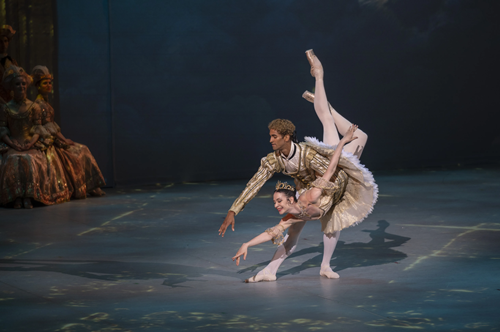
Aurora – of course the heroine of The Sleeping Beauty – has not appeared until after a (still too?) lengthy Prologue and what is now a pas de douze. She dances immediately with the four princes her parents offer as prospective husbands. This is the infamous Rose Adage. Each man presents Aurora with a single rose as they partner her in slow extensions to the side and turns en pointe. Between each change of partner there are – ideally – long balances before the next suitor’s hand is taken. Aurora remains in position and only at the very last moment reaches a hand out for support. Like that other supreme test for the ballerina, Odile’s 32 fouettés in Swan Lake, it challenges the dancer’s technique, but it should also showcase her acting ability as Aurora is supposed to go on an emotional journey from this naive 16-year-old girl to womanhood through a loss of innocence.
A year on from this performance Anna Nevzorova is still only a First Soloist and hopefully further promotion isn’t far away? She first joined ENB for the 2023/24 season having followed Aaron S Watkin from his previous employers, the Dresden Semperoper Ballet. Nevzorova’s Aurora had an aura that will make me remember this Sleeping Beauty far longer than it truly deserves. Nevertheless, her princes were extremely attentive and close at hand (!) and time never particularly stood still during the Rose Adage. Nevzorova’s sense of serene detachment worked well in the Act II Scene 2 Vision Scene and her dancing gained even greater fluidity as she relaxed more for the last-act wedding celebrations. Nevzorova’s arms are exquisite, her footwork precise and that she is an honest, natural actor radiates from the screen.
Nevzorova was very solidly – if occasionally insecurely – partnered by Davi Ramos (a guest artist from Australian Ballet). I doubt they had danced together many times and the spectacular trio of fish dives towards the end were spoilt by his grabbing Nevrozova somewhat inelegantly. Ramos is a long-limbed, elegant danseur noble, tall and athletic and with definite potential but his Désiré lacked charisma. His Act II Scene 2 melancholic adagio solo was actually beautifully controlled and elegiac, whilst his other solo work seemed underpowered.
Marius Petipa – for it is his steps this Sleeping Beauty pays homage to – and MacMillan’s choreography give the young ENB dancers a number of solo opportunities; firstly, as the fairies who bring Aurora the gifts she will need in life. First Artist Anri Sugiura was more smiley-smiley than an authoritative Lilac Fairy. First Artist Eireen Evrard caught the eye as Carabosse, the wicked fairy who vengefully curses Aurora. Truth be told the performance only takes off when she appears like a psychotic Queen Elizabeth I with red permed wig, ruff and Tudor-inspired dress in her carriage accompanied by four creepy, bald minions.
This production leaves nowhere for the mostly young dancers to hide, and nobody appeared to. I wish I could give all who deserve it a namecheck whether king, queen, master of ceremonies, cavalier, prince, fairy tale character, peasant or courtier as everyone clearly knew the importance of what they were doing, appeared fully engaged and showed secure technique when dancing. Some of them are listed below.
Finally, some wonderful violin solos (leader Matthew Scrivener) and horn calls emphasised the fine playing of the very familiar Tchaikovsky score by the always reliable English National Ballet Philharmonic under their music director Maria Seletskaja, who to her credit did not appear to indulge her dancers in any way.
In the cinema look out for the short dance film during the interval, The Silt of It, created with dancers from the ENB’s youth company which ‘brings together dance and film in a poetic meditation on resilience, transformation, and renewal.’
Jim Pritchard
Cast included:
Princess Aurora – Anna Nevzorova
Prince Désiré – Davi Ramos
Lilac Fairy – Anri Sugiura
Carabosse – Eireen Evrard
King – James Streeter
Queen – Isabelle Brouwers
Catalabutte – Richard Luck-Hille
Fairy of the Crystal Fountain – Yihan Qin
Fairy of the Enchanted Garden – Ivana Bueno
Fairy of the Woodland Glade – Haruhi Otani
Songbird Fairy – Georgia Bould
Fairy of the Golden Vine – Julia Conway
Gold – Ken Saruhashi
Diamond – Julia Conway
Silver – Anna Ciriano, Carolyne Galvao, Swanice Luong
White Cat & Puss in Boots – Georgia Bould, Rhys Antoni
Princess Florine & The Bluebird – Haruhi Otani, Shunhei Fuchiyama
Production:
Choreography – Sir Kenneth MacMillan (after Marius Petipa)
Music – Pyotr Ilyich Tchaikovsky
Costume design – Nicholas Georgiadis
Set design – Charlotte MacMillan