 France Wagner, Das Rheingold: Soloists, Orchestre de l’Opéra national de Paris / Pablo Heras-Casado (conductor). Livestreamed (directed by Jérémie Cuvillier) from Opéra Bastille, Paris, 15.11.2026. (JPr)
After watching and forming my own ideas I quickly looked at some of the reviews when Calixto Bieito’s Das Rheingold was initially put on in 2025. There have now been some second thoughts and – traditionalist I may be at heart – when this prologue to Wagner’s Ring ended I had an urge to watch it all over again, so good was it. Some of the blurb introducing Bieito’s Konzept suggests he ‘places Rheingold in a context dominated by digital virtuality and questions the impact of technology and science on human beings’. Obviously, this is sooooo 2026 with the global concerns of the dangers of AI to humanity’s future and rarely now does a day go by without an outage or critical infrastructure failure caused by an equipment defect, a faulty update, or more often than will be admitted, a cyberattack.
As the prelude began as inaudibly as ever, eyes were assailed by the opening salvo of changing images on a stage-deep metal grille screen that would be later revealed to have hidden windows and doors. Among much else there is a family – some of whom were possibly robots – at dinner and a two-story house, which as the opening ends appears to be blown-up in a nuclear holocaust. While I am probably overthinking this the Rhinemaidens Margarita Polonskaya, Isabel Signoret and Katharina Magiera) could well have been AI avatars in blue wetsuits with conduit cables wrapped round them. Alberich (Brian Mulligan) is in a ‘dirty old man’ black raincoat and touches himself before enveloping himself in some cabling and relieving his sexual frustration by using a naked sex doll as a punch bag. We see molten lava-like gold (at first from a woman’s mouth) before it cools into a rock which explodes. Alberich retrieves a huge gold ring that he wears round his neck and is burdened by until it is lost to Wotan. At this point Alberich utters two words not in the libretto ‘Mine, mine!’ He has had little interaction with the Rhinemaidens who appear to glitch when he shuffles off.
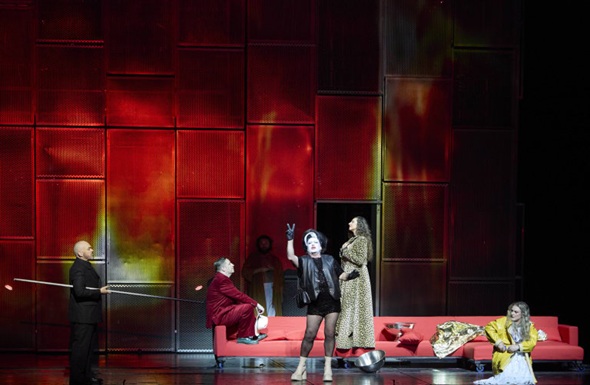
On the screen we enter a world of female faces part-Fritz Lang’s Metropolis, part-James Cameron’s Terminatrix cyborg and later part-Star Trek’s Borg Queen. On a huge red sofa Christopher Maltman’s Wotan (in black rehearsal-like clothes) is asleep under a gold foil cover with his hand in a tureen of (Freia’s) apples; Fricka (Eve-Maud Hubeaux) has a sheer black dress with an animal print overcoat; Freia (Eliza Boom) in yellow anorak over a dress embroidered with flowers; Froh (Matthew Cairns) has a silver baseball cap; a bare-chested Donner (Florent Mbia) with his hammer is in a fawn dressing gown; Fasolt (Kwangchul Youn) in a plain business suit; and Fafner (Mika Kares) in red suit with white cowboy Stetson. What ‘world’ have we entered into? Probably Silicon Valley with its chipmakers, software developers and data centres (all hinted at with continuous video projections we see).
Oddly enough Kwangchul Youn in his suit looked the image of former Nvidia CEO Jensen Huang infamous in the media recently for his extramarital affairs and involvement in a spying scandal. This is a total coincidence as Youn already sang Fasolt – who tries to force himself on Freia at one point – last year. The suggestion of other sexual shenanigans is never far away, Wotan and Fricka grapple on the sofa before she catches the eye of Fafner and pursues him for most of the rest of the opera.
Loge gets the most extreme makeover appearing as a cigarette-smoking Amy Winehouse tribute act with beehive, short sparkly black dress under a biker (Lone Wolf No Club) jacket, fishnet tights and white platform shoes. It would be an image to haunt your dreams had famed Tristan and Siegfried (amongst much else) Simon O’Neill not been so brilliant vocally and in the quirky characterisation. This Loge even appears to blow a kiss towards the conductor, Pablo Heras-Casado, at one point. Whether Bieito intended it or not, Loge is now the pivotal protagonist of this Rheingold, not Alberich or Wotan.
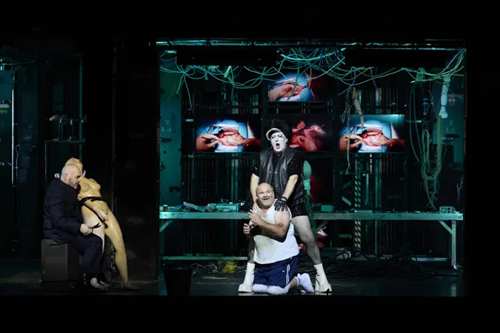
Wotan and Loge (tottering around on those high heels) leave the other gods behind and although apples litter the stage they appear to be poisoned in Freia’s absence. Nibelheim rises up and not for the first time is a laboratory (of sorts) with androids being assembled. As Fricka looks on it is where Alberich appears to be attempting to create the perfect woman. He almost gets there as one (named in the list as Juliette Morel’s silent Gisela) interacts with him. There are more cables and only a much put-upon Mime (Gerhard Siegel). On a bank of screens there is a close-up of an operation and at the back we see Space Invaders projected. The Tarnhelm is a metallic-mesh scarf and Alberich turning into a dragon involves little more than cables and a faceless mask; whilst after donning a frog mask Alberich is (too?) quickly restrained.
There are no Nibelungs just a trolley of gold coins pushed in by Mime in a gold mask and there is a large gold shield with a stylised human face that Loge brings in from Nibelheim. After Wotan claims the ring it seems to force itself over his head and Alberich leaves carrying out his living doll. A blowsy Fricka reappears in dark glasses and smeared lipstick. Wotan has a metal rod for his spear and is visibly weakened. There is a passing attempt to cover Freia (now in an ivory wedding dress) with coins accompanied with appropriate imagery on the screen. Erda (Marie-Nicole Lemieux) enters as a hooded figure in a dark anorak and she and Wotan grope each other. As Wotan concedes and gives up the ring Fafner uses it to dispatch Fasolt before going off with Freia. Donner and Froh sing from on high and the words ‘Dieu existe’ (God exists) and ‘C’est toi’ (It’s you) fill the screen. Wotan and Fricka change into astronaut-like blue overalls and the spear gets venerated and encased. Together Wotan and Fricka go up a lowered boarding ramp into what might be a data farm (there are cables galore) or – for those familiar with it – Star Trek’s Borg Cube of the hive-mind alien Collective. Loge is left with a single flame as Fafner (in white straitjacket) and Freia celebrate … what? Possibly the birth of the young baby shown with the ring round its neck. Wither Bieito’s Ring? We’ll soon see.
So that is what you see, what about what you hear? I will reflect more on Pablo Heras-Casado approach to the Ring cycle as it continues over the next three operas. Aside from the odd blip in the horns, the musical standard of the orchestra and the singing sounded very high through my loudspeakers. Heras-Casado had a good grasp of the dramatic architecture of Rheingold from the shimmering underwater world of the Rhine, descending into Nibelheim’s industrial clatter, and rising to the glittering, fateful ascent of the gods into Valhalla. Probably aided by technology the conductor successfully balanced the pit with the stage so that the voices were never drowned out by a dense, shifting orchestral accompaniment.
Most of the singers will come and go again during this Paris Ring and will be reported more on later. In this Rheingold the standout performance was – as suggested above – Simon O’Neill singing as well as I have heard him and clearly relishing Bieito’s vision for the problem-solving, voice of reason Loge. The rest of the cast are clearly some of best singing-actors on today’s opera stages from the three harmonious Rheinmaidens, Kwangchul Youn’s melancholic Fasolt, Mika Kares’s materialistic, brutal Fafner, to the meticulously detailed performances of the lesser gods, Mime, Alberich, Fricka and Wotan. The only disappointment was a rather insecure-sounding Marie-Nicole Lemieux who was not the elemental, authoritative Erda some are.
Jim Pritchard
Featured Image: Christopher Maltman (Wotan), Fafner (Mika Kares), Loge (Simon O’Neill), Fricka (Eve-Maud Hubeaux) and Freia (Eliza Boom) © Herwig Prammer/OnP
Creatives:
Staging – Calixto Bieito
Sets – Rebecca Ringst
Costumes – Ingo Krügler
Lighting – Michael Bauer
Video – Sarah Derendinger
Dramaturgy – Bettina Auer
Cast:
Wotan – Christopher Maltman
Loge – Simon O’Neill
Alberich – Brian Mulligan
Fricka – Eve-Maud Hubeaux
Erda – Marie-Nicole Lemieux
Fasolt – Kwangchul Youn
Fafner – Mika Kares
Mime – Gerhard Siegel
Froh – Matthew Cairns
Freia – Eliza Boom
Donner – Florent Mbia
Woglinde – Margarita Polonskaya
Wellgunde – Isabel Signoret
Flosshilde – Katharina Magiera
Gisela – Juliette Morel