 United States Adams, Nixon in China: Soloists, Washington National Opera Chorus and Orchestra / Robert Spano (conductor). DAR Constitution Hall, Washington, 14.11. 2026. (RP)
Although John Adams composed Nixon in China in 1987, it seems particularly relevant today. Perhaps that explains why it is appearing in opera houses across the United States and Europe. Adams and librettist Alice Goodman explored China’s emergence from decades of isolation and the high-stakes maneuvering behind its opening to the West. Seen against today’s geopolitical tensions, their work seems almost prescient, particularly this week as President Donald Trump travels to China to meet Chinese President Xi Jinping.
At the opera’s 1987 premiere at Houston Grand Opera, few needed reminding of the circumstances surrounding President Richard Nixon’s 1972 visit to China. Watergate was still fresh in the public consciousness, and Nixon remained deeply polarizing. He was the only American president to resign rather than face impeachment, following a bipartisan collapse of support. That was another era. Impeachment has since become part of the political playbook.
An ardent anti-communist, Nixon nevertheless recognized the need for rapprochement after decades of China’s isolation from the West. He also saw an opportunity to exploit the growing rift between China and the Soviet Union and use the visit as leverage in efforts to end the Vietnam War. The Paris Peace Accords were signed in 1973, but the war continued until the fall of Saigon in April 1975 when Gerald Ford was president. The opening to China helped pave the way for its emergence as an economic and military powerhouse. It also introduced panda diplomacy to the United States, a practice that remains a bargaining chip in relations between the two countries.
That is the historical backdrop to Adams’s opera. Following the landing in Beijing of The Spirit of ’76, as Air Force One was dubbed for the occasion, the focus turns to Nixon’s meeting with Mao and the elaborate banquet hosted by Premier Chou En-lai. From there, the drama shifts to the personal histories, ambitions and relationships of the principal figures, including Secretary of State Henry Kissinger.
Politics extend beyond the opera to the unusual circumstances surrounding this production. With the Kennedy Center closed, Washington National Opera had to find alternative stages. DAR Constitution Hall became the venue for Nixon in China and Puccini’s Madama Butterfly which are running concurrently. The 4,000-seat hall was built to accommodate the DAR’s annual Continental Congress while also serving as a venue for public cultural and educational events. It last hosted grand opera in 2003 when the Kennedy Center closed for renovations.
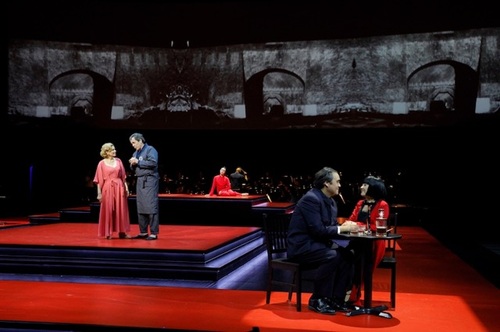
For its 2026 season, WNO has transformed Constitution Hall into an unconventional opera venue, installing a central thrust stage surrounded on three sides by café-style seating. This brings performers much closer to the audience than in a traditional proscenium theater while the orchestra, positioned behind the stage, remains visible. The staging consists of a large red square, raised on one side, with another elevated platform at its center.
Director Elkhanah Pulitzer’s concept is historically grounded and effective. Apart from a few pieces of furniture brought on and off the stage, there is no set. Instead, historical footage provides the visual context, beginning with crowds gathered outside the White House to wish the Nixons well before their departure and continuing with images of the school Pat Nixon visited in China. The footage appears on large screens and a huge cube suspended above the stage. Pulitzer seems intent on countering the narcotic pull of video. The images are often repetitive and sometimes abstract, redirecting attention to the action onstage. Even so, the temptation to look up is difficult to resist.
WNO has assembled a first-rate cast, beginning with Thomas Hampson as Nixon and Renée Fleming as Pat. Hampson is a natural for the role. He captures the President’s mannerisms, including his characteristic double-arm V-for-victory salute, and even some of his distinctive speech patterns. An intellectual singer, always grounded in history and authenticity, Hampson brings those qualities to his characterization along with the full range of emotions Nixon experiences as he relishes the knowledge that he is making history.
Fleming’s Pat Nixon is a revelation. Who knew the former First Lady had such a personality and so many aspirations of her own? Fleming brings welcome humanity to a cast of characters who take themselves and their place in history very seriously. Having grown up poor on a small California truck farm, Pat approaches each day as if it were Christmas. She is awed by much but takes particular delight in small things, such as a toy elephant presented to her as a gift. It happens to be the symbol of the Republican Party her husband heads. Fleming’s Pat is a sympathetic ear to Nixon’s musings and obsessions, although there is often a bemused look on her face as he speaks.
Adams specified that Mao be sung by a heldentenor, and John Matthew Myers fit the bill splendidly. His Mao was a rather feeble, sometimes rambling old man. The years seemed to slip away as he recalled his first glimpse of the ‘tasty little starlet’ who would become his wife. Kathleen Kim unleashed Madame Mao’s explosive aria, ‘I am the wife of Mao Tse-tung’, a bravura coloratura showpiece crowned by a high D. Her zeal, coupled with the driving orchestral rhythms, lent incandescent brilliance to Madame Mao’s outpouring of outsized ambitions and fury.
Robert Pomakov’s Henry Kissinger is an unctuous fixer, perfectly capturing the contradictions of the real-life figure who ranged from brainiac babe magnet to geopolitical kingmaker. The most reflective character onstage was Joo Won Kang’s Chou En-lai, whose rich baritone eloquently probed the meaning of what was transpiring, ultimately posing the unsettling, still unanswered question: ‘How much of what we did was good?’
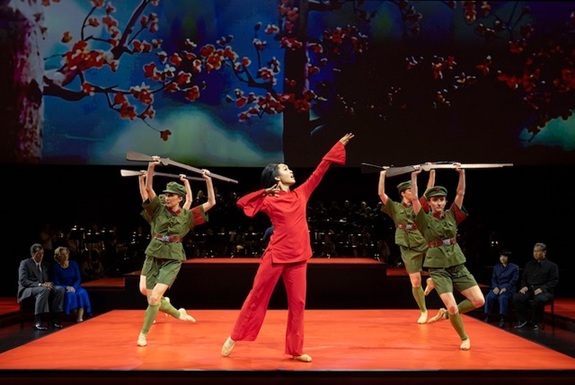
Act II’s centerpiece is ‘The Red Detachment of Women’, a revolutionary ballet devised under the direction of Madame Mao. It tells the story of a young peasant woman, portrayed with commanding technique and steely emotion by Kayla Mei-Wan Thomas, who is held captive and brutally abused by a tyrannical landlord, portrayed here as a seedy, lascivious Kissinger. Jessica Lang’s choreography features sharply defined movements and tableau-like poses, executed with cool precision by the dancers. The action is so compelling that one understands how Mrs. Nixon becomes emotionally involved, even feeling compelled to intervene on the young woman’s behalf.
Robert Spano returned to Nixon in China after conducting Houston’s 30th-anniversary revival. He has a long association with Adams’s music, and his authority was evident from the first downbeat. In the orchestral introduction, he built energy and anticipation through repetitive instrumental figures, telegraphing that something momentous was about to happen. The chorus followed with a forceful, disciplined rendition of ‘Soldiers of heaven hold the sky’, heightening a sense of occasion and grandeur as the Chinese military awaited the arrival of The Spirit of ’76.
Although grounded in minimalism, Adams’s score is remarkably eclectic, incorporating jazz and big-band inflections, Stravinskian rhythmic energy, expansive late-Romantic gestures and the coloratura flourishes of 19th-century Italian opera in Madame Mao’s aria. Spano was particularly adept at bringing these disparate elements together without sacrificing the score’s forward propulsion and dramatic pulse. The sudden surge of Wagnerian sound during the ballet was just one example of his skill in balancing the contrasting musical idioms.
This production demands to be seen at this moment in history. WNO deserves support for the pluck and ingenuity it took to make it happen. And there won’t be many more opportunities to hear two of America’s greatest operatic talents, now in the autumn of their careers, performing in peak form. Constitution Hall is a big theater. Help fill it, if you can.
Rick Perdian
Featured Image: Kayla Mei-Wan Thomas (solo dancer) © Cory Weaver
Performers:
Richard Nixon – Thomas Hampson
Pat Nixon – Renée Fleming
Mao Tse–Tung – John Matthew Myers
Madame Mao – Kathleen Kim
Chou En–Lai – Joo Won Kang
Henry Kissinger – Robert Pomakov
First Secretary – Veronica Siebert
Second Secretary – Anna Maria Vacca
Third Secretary – Cecelia McKinley
Wu Ching–Hua – Kayla Thomas
Hung Ch’ang–Ch’ing – Tianyu Wang
Solo Dancers – Kayla Mei-Wan Thomas, Jaryd Farcon
Production:
Director – Elkhanah Pulitzer
Choreographer – Jessica Lang
Sets – Alexander V. Nichols
Costumes – Elisabeth A. Scott
Lighting – Duane Schuler
Projection – Bill Morrison
Sound – Mark Grey
Chorus master – Steven Gathman
Dramaturg – Lucia Scheckner