 United Kingdom Hildegard von Bingen, Bartók Bluebeard’s Castle, Stravinsky Oedipus Rex: Soloists, Chorus and Orchestra of Welsh National Opera / Lidiya Yankovskaya (conductor). Mayflower Theatre, Southampton, 12.11.2026. (DH) *****
Christine Rice (Judith) and Nathan Berg (Bluebeard) in Bluebeard’s Castle © Dafydd Owen
The first thing that struck me about Welsh National Opera’s new double bill was the poster. It is a brilliantly staged wedding photo. The company is posed around a table of tiered cakes and candles, brides from several centuries in white to one side, men in black suits to the other, and, sprawled at the men’s feet, a lone woman in a satin slip. Behind them, quite deliberately, you can see the lighting stand, the ladder, the drapes and the bare boards: a wedding, yes, but also a stage. Walking past the Mayflower in the days and weeks before WNO arrived, I found I couldn’t get it out of my head, the image compelling and unsettling in equal measure. As it turned out, it was an accurate premonition of the sensations I felt on the night.
The lights go down. You are mentally attuned for the opening of the Bartók, but what comes out of the sheer darkness is medieval chant. Your mind doesn’t focus quite at first on the words but rather on the antique beauty and the unfamiliar mode of the music. There is a second chant. And what was a faint hint before becomes tangible: low strings in the orchestra grounding the singing. And only then comes the Prologue.
From the off, and not for the first time in a Joe Hill-Gibbins production, I found myself immersed: head telling me this was theatre, effect, heart convinced it was much more important than that. Not that there was much time to process. After LJ Parkinson’s deliciously flamboyant delivery of that Prologue, those same low strings now open Bluebeard’s Castle, and it feels like a return to what has just been heard. That was Hildegard von Bingen. This is Bartók, but the two are closer than eight centuries would suggest: each sets out from a single, unharmonised line in an old mode, Hildegard’s church modes in one case, in the other the pentatonic idiom of the Hungarian village songs Bartók and Kodály had been collecting, which he believed could make the old modes new again.
On the stage a long wedding table topped with a white cloth dominates, and it provides the focus throughout the opera. Judith (Christine Rice) and Bluebeard (Nathan Berg) walk, sometimes run around it, crawl under it, walk on it. Parkinson is attentive valet and stage manager, marshalling props, setting tables, walking a spotlight, and for the treasury door strutting along the table scattering largesse in the form of glitter. Hill-Gibbins has made the typically imaginative decision to take the logic of Balázs’s symbolist drama and recast the means of realising it. For Balázs, Bluebeard’s castle was ‘not a realistic stone castle… The castle is his soul.’ The principal stage effect envisaged as the work was created was a stream of coloured light from each door. Hill-Gibbins replaces the light with substance (wine for blood – a pool that grows and spills over as the drama advances, flowers for the garden, which scattered glitter), but each prop still stands for its room rather than depicting it. So, symbolist thinking carried out with physical things, that also feels very Hill-Gibbins to me. We get matter and mess rather than an ethereal glow.
The apogee is reached at the seventh door, where the rear curtain lifts to reveal Bluebeard’s previous wives, clad in white of course and moving in a slightly desultory way to join Judith and Bluebeard at the table. It is a powerful image on its own (Balázs has three wives; here there are fourteen, which only adds to it) but then you realise these were the same women singing Hildegard at the start. The first chant was O rubor sanguinis – ‘O redness of blood’ – Hildegard’s antiphon for St Ursula and the virgin martyrs of Cologne. We had heard the wives before we saw them, singing of the blood that has been seeping into every room of the castle since the first door. And where does this leave Judith in this production? We see her at the close at the point of realisation. Rice’s expression to me conveyed trauma and exhaustion but also a glint of determination: nothing more can shock me, I have the measure of you now, she seemed to be suggesting.
Rice and Berg are magnificent, musically both seemed utterly at home, never once in danger of being swamped by the very fine playing of the Orchestra of Welsh National Opera under Lidiya Yankovskaya. Even in the huge rhapsodic rush to C major at the fifth door, they more than held their own. When watching Bluebeard it sometimes feels as though it is a miracle you can hear what is being sung at all. And after all, what is being sung is a twisty, elliptical symbolist text from which emotion seems to fall in tiny shards. Both Rice and Berg show a wonderful ability though to infer instinctively from those shards and produce living people, not puppets. So much is unsaid but so much is apparently known. It is acting of the first order and the pair’s understanding of each other clearly runs deep.
I reflected during the interval on the pairings of Bluebeard over the years. I remembered a particularly grisly English National Opera production in 2009 that paired it with an Irish clog-dancing version of The Rite of Spring, which was magnificent in its way but resolutely incongruous. The neo-classical Stravinsky of Oedipus Rex does seem a better fit, and in the powerhouse ENO days there was a striking David Alden pairing of the two under Mark Elder. Alden’s Oedipus was the first time I believed in the work in the theatre, rather than in the concert hall. Hill-Gibbins in the programme is entertainingly straightforward as to what he sees as synergies: ‘to me it’s a sort of psychosexual nightmare double bill’. Quite. But how to animate the psychology in Cocteau and Stravinsky’s formal straitjacket, replete with rhetoric and set in Latin, which Stravinsky prized as ‘a medium not dead but turned to stone’?
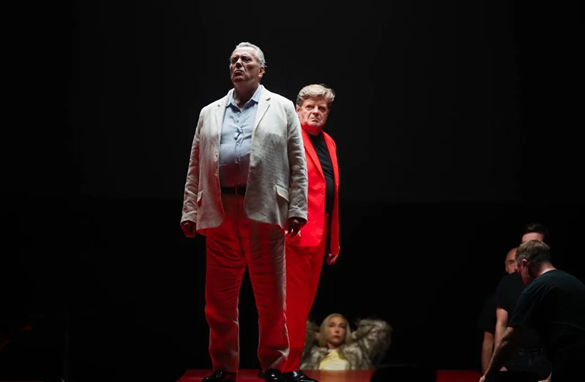
The centre of the action is again a huge table. This time it is blood red (like the suit Oedipus wears) and spreads across the stage with odd angles and endings. The setting vaguely suggests a bar or restaurant where the principals and chorus sit at various times and are served. Most of the time though, the chorus circle the table in various groupings and poses, observing the situation spiralling out of control and intensifying the claustrophobia felt by everyone caught up in the nightmare. This is Hill-Gibbins again rethinking creators’ original intentions to brilliant effect. Stravinsky pictured his chorus seated in a single row across the stage and asked for minimal movement and masked principals; Hill-Gibbins gives us a restless, modern-dress crowd and faces we can read. Interestingly the result comes over as a fruitful tension – Stravinsky in the score attempting to ritualise the spectacle, Hill-Gibbins encouraging his players to think outside it.
And they meet him full on. Rice as Jocasta is magnetic. Her ‘anti-oracle’ aria is delivered as a contemptuous put-down of imbecilic superstition delivered from a position of pure entitlement. How she injects so much sheer personality – a word I never thought I would use in relation to this work – I don’t quite know. Remarkably, she was singing Gluck’s Iphigénie for ENO at the London Coliseum the night before and is due to again two days later. That completes an extraordinary doom-inflected trio to hold in one week. Peter Hoare doesn’t go for quite the same approach with Oedipus. He seems fatally care-laden from the start, so that while he is proudly proclaiming to the people of Thebes that he is just the man to sort out the mystery, you never sense that he believes it. It is a short step from there to inexorable and rapid decline in this work and Hoare portrays it very cleverly. As with Rice, part of the effectiveness of his portrayal is what he is doing when he is not singing: skulking, crawling, crouching, and finally crumpled in a heap before he is banished from Thebes. By contrast Berg as Tiresias (luxury casting!) achieves his unnerving presence largely through stillness, at least until his fateful message is delivered. You watch him brooding at the table, wondering when he will explode and blurt it all out. All of the cast and indeed the chorus similarly rise to Hill-Gibbins’s riveting vision of the work. Finally, LJ Parkinson’s narrator deserves special mention for breaking with the mock-heroic declamatory approach many predecessors (not least Cocteau himself) have taken. Parkinson is arch, witty, and knowing in a perfectly calibrated way, which doesn’t deflate the spectacle but keeps reminding us that it is one – exactly what Cocteau’s narration was designed to do.
Yankovskaya observes in the programme that the works complement one another precisely because their musical foundations are so different. Her superb direction made that contrast vividly apparent: in the Bartók, the musical line supporting the inner emotions of the characters; in the Stravinsky, everything deliberately externalised, the music almost alienating, apparently trying to stop us from getting anywhere close. That couldn’t have happened without a responsive and generous group of musicians, and once again the orchestra displayed those characteristics admirably. As did the chorus, women and men alike, vocally magnificent, but also consummately dramatic in everything they did.
There was something else ticking away as I watched. Hildegard’s second chant right at the start of the evening begins Rex noster – ‘our king’. Jocasta is hailed as regina nostra, ‘our queen’, and at the very end the chorus bids farewell to Oedipus noster, ‘our Oedipus’. Hill-Gibbins never lets us forget we are watching theatre – the poster told us as much before we had set foot in the building – and yet by the end I found myself almost mourning with the chorus: head still insisting it was all effect, heart claiming Oedipus as ours in his fallen humanity.
‘Ours’ is also how WNO has always felt to me, wherever it goes. My introduction to opera was WNO at the Birmingham Hippodrome, where the company was doing so much at the time to bring the art form to the young. More recently my ties have been to Southampton: as well as having many memories of outstanding performances at the Mayflower, one of my favourite theatres in the country, I have seen, as a volunteer for a local charity, WNO’s work with the community here literally giving voice to people seeking asylum and refuge. These are desperately hard times for the company, as has been well documented. An evening as gripping as this is the best argument I know for why WNO must keep coming to Southampton, and why audiences here are right to call it theirs as well as Wales’s.
Dominic Hartley
Featured Image: The former wives, WNO Chorus, in Bluebeard’s Castle © Dafydd Owen
Cast:
Bluebeard’s Castle
Prologue (The Bard) – LJ Parkinson
Duke Bluebeard – Nathan Berg
Judith – Christine Rice
Oedipus Rex
Oedipus – Peter Hoare
Jocasta – Christine Rice
Creon / Messenger – Stephen Richardson
Tiresias – Nathan Berg
Shepherd – Alun Rhys-Jenkins
Narrator – LJ Parkinson
Hildegard von Bingen, O rubor sanguinis and Rex noster promptus est – sopranos and mezzo-sopranos of the WNO Chorus
Creatives:
Director – Joe Hill-Gibbins
Original Set designer (Bluebeard’s Castle) – Rosanna Vize
Set and Costume designer (Oedipus Rex)
Revival Set and Costume designer (Bluebeard’s Castle) – Milla Clarke
Lighting designer – Jack Knowles
Movement director – Emma Woods
Chorus master – Frederick Brown
Original production of Bluebeard’s Castle by English National Opera