
 United States Monteverdi: Soloists, Les Arts Florissants / William Christie and Paul Agnew (music directors). Kauffman Concert Hall, 92NY Center for Culture and Arts, New York, 11.11.2026. (ES-S)
Monteverdi – Volgendo il ciel – Ballo, from Madrigals, Book 8; Baci soavi e cari, Book 1; Ecco mormorar l’onde, Book 2; Chiome d’oro, bel tesoro, Book 7; Lamento della Ninfa, Book 8; Sfogava con le stelle, Book 4; Si ch’io vorrei morire, Book 4; A quest’olmo, a quest’ombre, Book 8; Il combattimento di Tancredi e Clorinda, Book 8; Ohimè dov’e il mio ben – Romanesca, Book 7; Zefiro torna, Book 6; Tirsi e Clori – Ballo; Book 7
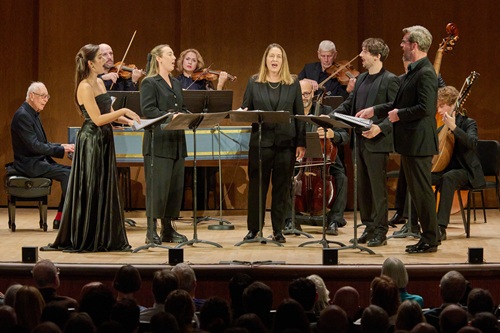
Though no stranger to New York audiences, Les Arts Florissants, the renowned French early-music ensemble, made its 92NY debut in the Kaufmann Concert Hall with a program of madrigals spanning Claudio Monteverdi’s career, from his First Book of 1587 to his Eighth of 1638. Although arranged to emphasize contrasting moods rather than chronological progression, the twelve selections revealed the evolving balance between contrapuntal discipline and dramatic freedom in his writing. In his later works, the demands of the text increasingly governed the unfolding of a phrase or the handling of a dissonance. Instruments, too, assumed more independent roles as the music became more theatrical.
William Christie and Paul Agnew, who have worked together for more than three decades, shared the musical direction. Singing as one of the tenors, Agnew cued his colleagues with anything from a change of expression to an emphatic gesture, remaining actively involved even when seated between his contributions. Christie took charge from the harpsichord in the pieces accompanied by continuo alone. Leader Emmanuel Resche-Caserta appeared to assume a more prominent role when the other strings joined the continuo.
In Il combattimento di Tancredi e Clorinda, the evening’s centerpiece, the two opponents initially faced each other with statuesque stillness while Agnew, as narrator, supplied most of the gestures. The action became more physical, perhaps a tad excessively, as Clorinda was lowered to the floor at her death. Monteverdi’s setting of verses from Torquato Tasso’s Gerusalemme liberata assigns much of the storytelling to the narrator and instruments, with Tancredi and Clorinda intervening only briefly. Agnew sang with conviction and intelligence, carefully judging the weight and intensity of each phrase. The strings were equally active, their rapidly repeated notes conveying the agitation of combat.
Monteverdi’s evocations of hoofbeats and clashing weapons gave the conflict an audible physical presence, while the players closely followed the contours of the vocal lines. Opposite tenor Bastien Rimondi’s Tancredi, Rebecca Leggett portrayed a Clorinda of tragic intensity, her mezzo-soprano having a distinctly soprano-like timbre. Her plea, ‘Amico, hai vinto: io ti perdon… perdona’ (‘Friend, you have won: I forgive you… forgive me’), marks the turn from combat to reconciliation. Leggett’s tone grew more luminous toward the close, giving particular poignancy to ‘S’apre il ciel; io vado in pace’ (‘Heaven opens; I go in peace’).
While Il combattimento depicted the violence of battle, Lamento della Ninfa turned to the inner world of an abandoned lover. Ana Vieira Leite brought a clear, pliant soprano to the nymph’s lament, shaping its increasingly anguished phrases with subtle changes of color and intensity over a repeated descending four-note bass line. Her cry, ‘Dove, dov’è la fè / ch’el traditor giurò?’ (‘Where, where is the faith that the traitor swore?’), captured the despair in Ottavio Rinuccini’s verses. Paul Agnew, Bastien Rimondi and bass-baritone Edward Grint formed a sympathetic chorus, their closely blended voices providing measured commentary in contrast to the nymph’s more flexible vocal line.
As in Lamento della Ninfa, Ohimè, dov’è il mio ben, a duet from Monteverdi’s Seventh Book of madrigals, was accompanied by basso continuo alone. Vieira Leite and Leggett alternated and intertwined their vocal lines over the recurring harmonic progression of a romanesca. Christie at the harpsichord, Félix Knecht on cello and Yuli Bayeul on theorbo responded sensitively to the singers as they repeated the questions, ‘Where is my beloved, where is my heart?’
Throughout the program, different combinations of voices brought fresh colors to Monteverdi’s writing, particularly in the five-voice madrigals. Individual voices emerged clearly from the contrapuntal texture of Baci soavi e cari before receding into the ensemble. Mélodie Ruvio’s warm contralto provided a discreet anchor, adding depth while preserving the balance among the singers. Delicate phrasing and carefully graded dynamics in Ecco mormorar l’onde suggested the murmuring waves and trembling leaves of Tasso’s verses without exaggerating their pictorial effects. In Sì ch’io vorrei morire, the singers gave the overlapping exclamations of ‘Ahi, vita mia’ a sensuous fluidity. In Zefiro torna, they brought out the contrast between the joyful return of spring and the poet’s unrelieved sorrow, giving weight to the prolonged dissonances that darken the latter passages.
The dialogue between voices and instruments was particularly engaging in Chiome d’oro, where Vieira Leite and Leggett matched the violins’ agility in playful exchanges. Their closely coordinated phrasing highlighted Monteverdi’s shifting harmonies as they sang of golden tresses binding a lover in a thousand ways. A gentler atmosphere prevailed in A quest’olmo, a quest’ombre, which closed the first half, as the performers suggested the languid pleasures of an Arcadian landscape.
Monteverdi’s balli, with their lively interplay of voices, instruments and dance rhythms, provided a festive frame for the evening. In Volgendo il ciel, Rimondi assumed the role of a poet praising Emperor Ferdinand III, delivering the ceremonial verses with crisp articulation and declamatory assurance over the ensemble’s buoyant rhythms. The concluding Tirsi e Clori began with a more intimate exchange between Rimondi as the shepherd Tirsi and Leggett as Clori. His animated invitation met her hesitant responses, the two voices gradually finding a shared playful spirit. Their dialogue broadened into a call for the other shepherds and nymphs to join the dance, as everyone came together for a jubilant finale.
Edward Sava-Segal
Soloists:
Ana Vieira Leite, soprano
Rebecca Leggett, mezzo-soprano
Mélodie Ruvio, contralto
Paul Agnew, tenor
Bastien Rimondi, tenor
Edward Grint, bass-baritone
Musicians:
Emmanuel Resche-Caserta, violin (leader/musical assistant)
Tami Troman, violin
Simon Heyerick, viola
Félix Knecht, cello (basso continuo)
Michael Chanu, double bass (basso continuo)
Yuli Bayeul, theorbo (basso continuo)
William Christie, harpsichord (basso continuo)