 Ireland Bizet, Carmen: Soloists, Chorus and Orchestra of Irish National Opera / Fergus Sheil (Conductor). Bord Gáis Energy Theatre, Dublin, 6.11.2026. (RB)
I have watched quite a few productions of Carmen over the last few years. Bizet’s masterpiece remains one of the most popular operas ever written and it is not hard to see why given its earworm melodies, its rich palette of orchestral colour and its memorable cast of characters. When it was first performed it caused quite a scandal. It features a sexually empowered gypsy woman as the title character, it portrays seedy characters including factory workers and smugglers, and it depicts shocking violence including a knife fight between two women and the murder of the heroine at the end of the opera. The themes in the opera seem increasingly relevant for our times: immigrants and outsiders are increasingly treated with hostility and suspicion, and women and girls have been subject to shocking and increasing levels of violence.
Irish National Opera originally staged Paul Curran’s production of Carmen in 2022, so this was a revival of that production directed by Sarah Baxter. Curran sets the production in the late 1950s as this was an era of conservatism which targeted women in society in a very patronising and sexist way. He does not specify where the production is set but one can guess from the sets that it could be a South American beachfront-type setting.
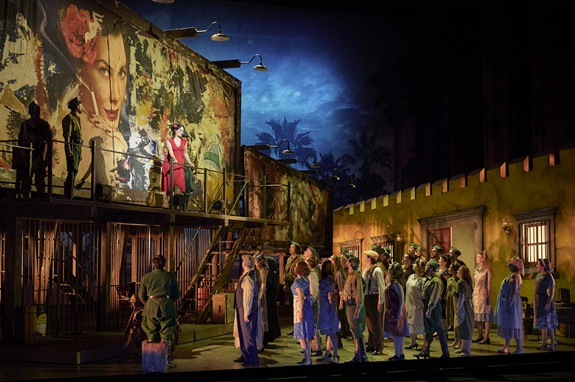
Gary McCann’s split-level sets and costumes (part of a co-production with Opera Philadelphia and Seattle Opera) were very impressive. In the opening act there are two large billboards depicting a woman smoking a cigarette centre stage. A green beach house was at the side of the stage and there were palm trees and a beach in the distance. Scaffolding allowed soldiers to patrol the upper level of the set. The gates of the cigarette factory were represented by solid imposing steel bars and made to look like the exterior of a prison cell. In Act III the smugglers met in a large dark, cavernous warehouse. The construction team used clever visual illusions to make this seem much bigger than it was. In the final act, the action moved to another impressive split-level structure representing the entrance to a bullfighting arena.
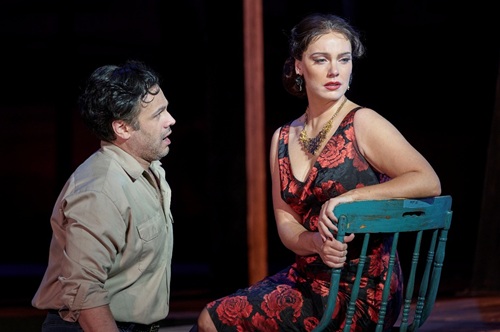
The costumes were all straight from the 1950s and helped to capture the ambience of the period. The soldiers wore green uniforms while the chorus wore a select of different 1950s outfits. Carmen wore a series of red dresses which got increasingly dazzling and elaborate as the production went on, while Micaëla wore a more homely conservative blue dress. In the final act four dancing matadors wore identical costumers in contrasting colours. There was an incredible profusion of eye-catching colours in both the sets and costumes throughout the production.
Curran said that he wanted the production to feel and run like a movie and he succeeded in this. The opening act created a panoramic feel with its beachfront in the distance. The bars of the cigarette factory and the patrolling soldiers conveyed the impression of trapped labourers being forced to work for slave wages. There was a feeling of camaraderie among the workers when Carmen first took centre stage. As the scene shifted to Lillas Pastia’s Inn, the production was enlivened by some impressive dance sequences. Escamillo made his entrance of a motorcycle wearing a black leather jacket and looking like a character from Grease. The third act with its ominous dimly lit warehouse had a noir feel as confrontations played out and characters emerged from the shadows. The final act opened with a boisterous crowd scene and some balletic dance moves from the four matadors. The bloody denouement did not pull its punches and showed Don José strangling and stabbing Carmen before (in a departure from the libretto) stabbing himself. It was impossible not to be drawn in and swept up in the action and events of the opera.
This was a very impressive debut from Niamh O’Sullivan in the role of Carmen. She was an imposing figure on the stage and in the opening act deployed her feminine wiles in a highly manipulative way. This came to a head when she played the castanets and danced for Don José in Act II. O’Sullivan displayed an almost callous, indifferent attitude when she decided Don José was not for her. This was in keeping with the independence of the character and helped to explain why he became so enraged. She struck increasingly defiant poses and gestures before the final climactic showdown. O’Sullivan has a gorgeous lyrical mezzo voice, and she was impressive across the vocal range. She displayed a rich, resonant lower vocal register and a sultry tone in the famous ‘Habanera’; I would have liked to hear a greater variety of vocal colours in this number. The ‘Seguidilla’ had a coquettish playfulness, and the ornamentation was elegantly handled although there was scope to make more of the flighty, teasing elements in the aria. O’Sullivan seemed to increase in confidence as the production went on and her performance in ‘Les tringles des sistres tintainent’ was superb. She captured the chilling stoicism of the moment perfectly in the pivotal card scene. In her final confrontation with Don José, O’Sullivan seemed to use her whole body to generate vocal power, and she rose to the dramatic challenge of the scene brilliantly.
Brazilian tenor, Atalla Ayan, was equally impressive in the role of Don José. I was not entirely convinced by his dramatic portrayal in the first act where he depicted Don José as a naïve, innocent vulnerable character. He came across as too submissive and there was a lack of sexual chemistry between him and O’Sullivan. However, he did a good job portraying José’s subsequent descent into a spiral of destructive, obsessive passion. He produced the best singing of the evening in the ‘Flower Song’ and, indeed, this is one of the best performances I have heard of this aria. Ayan injected the vocal line with a wonderful sense of intimacy and longing and there was a perfectly controlled build up in dynamics. The high notes at the climax to the song were soft, expressive and exquisitely beautiful. His voice soared over the thick orchestral accompaniment in the final scene, and one could hear the harrowing sense of desperation.
There was much to admire in Stacey Alleaume’s performance as Micaëla. She was dignified and resolute and not afraid to assert herself at key points even when faced with potential dangers in the smugglers’ hideout. She brought a wonderful lyricism and intimacy to the vocal line in her Act I duet with Ayan’s Don José. Her performance of ‘Je dis que rien ne m’ëpouvante’ was expressive and moving. She sang the expansive soaring melody beautifully and dispatched Bizet’s ringing top notes with vocal authority. The suspended vocal lines and dynamic shadings were beautifully controlled, although I would have liked her to project the tone a little more in the lower vocal register. David Bižić brought effortless machismo and swagger to the role of Escamillo. With his entrance on the motorbike he proceeded to dance and flirt with the ladies. He sang the famous ‘Toreador Aria’ with a robust commanding tone and was impressive across the vocal range.
The rest of the cast all acquitted themselves well. Jade Phoenix and Anna-Helena Maclachlan both gave very fine performances in the roles of Frasquita and Mercédès. They sang beautifully in the ensemble numbers and Phoenix handled some of the very high vocal writing extremely well. John Molloy also cut an imposing figure in the role of Zuniga bringing a whiff of entitled arrogance to the role.
The Chorus and Children’s Chorus were firing on all cylinders throughout as they brought Bizet’s rag-tag band of factory workers, soldiers, gypsies and bandits winningly to life. The main chorus members sang with gusto and threw themselves into their roles with aplomb. The performance of the chorus number at the start of Act II was particularly good. The Children’s Chorus gave a first-rate performance of Act I’s marching chorus and treated the audience to some nifty choreographed moves.
Fergus Sheil ensured the cast, chorus and orchestra remained on track and ensured an excellent balance of sound between the singers and the orchestra throughout. The opening Prelude was taken at a cracking pace, and the orchestra did a marvellous job bringing out the distinctive Spanish flavour of the music. The ‘fate motif’ which runs through the opera was ominous and full of foreboding. The percussionists did a great job enhancing the Spanish dance rhythms and bringing out the score’s distinctive colours.
Overall, this was a brilliant production featuring first-rate singing and playing from the cast, chorus and orchestra.
Robert Beattie
Featured Image: Irish National Opera’s Carmen Act I: Niamh O’Sullivan (Carmen) on balcony © Ros Kavanagh
Production:
Director – Paul Curran
Revival director – Sarah Baxter
Set & Costume designer – Gary McCann
Lighting designer – Paul Hackenmueller
Choreographer/Movement director – Muirne Bloomer
Chorus director – Susannah Wapshott
Cast:
Carmen – Niamh O’Sullivan
Don José – Atalla Ayan
Micaëla – Stacey Alleaume
Escamillo – David Bižić
Zuniga – John Molloy
Moralès – Seán Boylan
Frasquita – Jade Phoenix
Mercédès – Anna-Helena Maclachlan
Dancaïre – Ben McAteer