 United Kingdom Mahler (arr. Britten), Mozart, R. Schumann: Yeol Eum Son (piano), Bournemouth Symphony Orchestra / Andrew Manze (conductor). Lighthouse, Poole, 25.11.2026. (CK)
Mahler (arr. Britten) – What the Wild Flowers Tell Me
Mozart – Piano Concerto No.22 in E-flat, K482
R. Schumann – Symphony No.1 ‘Spring’
Britten’s 1941 arrangement of the minuet from Mahler’s Third Symphony, What the Wild Flowers Tell Me, is evidence of a remarkable cultural shift. The first public performance of the whole symphony in the UK was still 20 years away (it was the last Mahler symphony to reach these shores): with the predominating critical hostility to Mahler at the time (Eric Blom famously said ‘We don’t want Mahler here’) the composer’s supporters must have despaired of ever hearing this gargantuan work. The best hope would have been a trip to Amsterdam. Hence, presumably, the request that Britten provide a reduction of this brief, inoffensive (and, even in Mahler’s original, lightly scored) movement as a taster. Now, of course, the Third – despite its expensive size and formidable length – is one of Mahler’s best-loved symphonies (it has been my own favourite since hearing Barbirolli on the radio and Horenstein in the concert hall).
Andrew Manze secured a notably clear and light-footed performance from the Bournemouth Symphony Orchestra, with beguiling sounds from Lucie Sprague’s oboe, Eleanor Blakeney’s horn and Eluned Pierce’s busy harp. I wondered whether Britten would include the lovely moment where the ruthe (a bundle of birch twigs) imitates the sound of a bird startled from the undergrowth: he did, though in this performance it was seen but not heard.
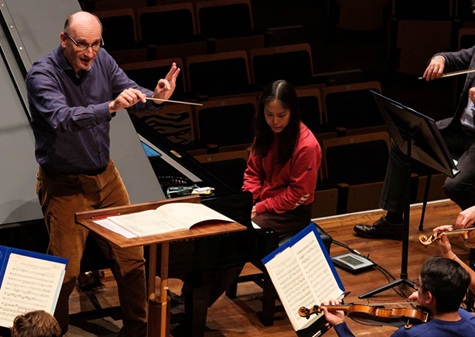
Manze’s background in the world of historical performance practice – and his expertise in English music of the 20th century – must surely inform the pristine vividness of the playing he elicited from the orchestra. Very tall and slim, his sweeping gestures faintly reminded me of Klaus Tennstedt, though without that great and gangling German conductor’s ungainliness (one critic dubbed him ‘The Demented Stork’). A lovely performance, and an appetising trailer for a forthcoming concert of major works by Britten and Mahler.
Mozart’s Piano Concerto, K482, is sandwiched between his best known and most often played concertos – K466 and K467 on the one hand, K488 and K491 on the other. Yeol Eum Son’s was a performance to set one wondering why it is not as popular as they. I was transported before the piano had played a note: the grand orchestral introduction was so clear, with suave horns, clean timpani. Son’s first entry was polite – do you mind if I join you? – but it wasn’t long before she and the orchestra were in animated conversation. It was delightful: her playing was brimming with character. I will be shot for this, but it is possible to sound too elegant and refined in Mozart (I hardly dare whisper the name Perahia): this was merry music-making, with much to admire in the articulation of the strings, the blending of the winds, the vigour of Manze’s conducting.
The Andante was heartstoppingly beautiful: the plaintive muted violins, the wistful entry of the soloist, Mozart’s treatment of the winds and horns almost as a separate orchestra (clarinets replacing the usual oboes), with prominent roles for flute and bassoon second time around. And I shall not soon forget the verve with which Son launched the carefree, Papageno-like tune of the finale: this was playing of brilliance and ebullience, eschewing elegance in favour of sparkle and wit. By now in a party mood, we all enjoyed the little twirl that the bassoons pin on the theme’s tail each time it comes around. Son delighted us further with her unpretentious encore: the well-known Allegro from Mozart’s little Piano Sonata in C, K545.
Lighthouse was less full than usual for this concert: it may have been the weather, or it may have been a consequence of the fact that Robert Schumann’s symphonies are not as well known or as often played as they should be. If converts are needed, Manze’s reading of the ‘Spring’ Symphony should have made some. He opted for lightness and agility with a reduced string body – four double basses, six cellos and so on: after the stern opening fanfares and the slow introduction the Allegro proper was fast and light, the offbeat accents crisp and clear, the woodwind bright-edged and glinting. The return of the fanfares was splendid; towards the end of the movement Manze was whipping up the strings like a chef creating an enormous syllabub.
In the Larghetto he moulded them with careful attention to dynamics, building tension towards the movement’s uncertain ending and the sudden eruption of the Scherzo, vigorous and strongly accented, its two Trios pointing to something happier than the minor-key energy of the main material. And there was no gainsaying the jovial élan of the finale, with its delicious little interlude for horns and flute.
Do we have a Robert Schumann problem? At this year’s BBC Proms there was an all-Schumann concert – the Genoveva Overture, the Violin Concerto and the Second Symphony – and even with the bankable presence of Sir Simon Rattle and Isabelle Faust the hall was half full. Perhaps the Piano Concerto and the ‘Rhenish’ Symphony would have attracted a larger audience: but still…
Chris Kettle