 United States Janáček, Jenůfa: Soloists, Chorus and Orchestra of the Metropolitan Opera / Tomáš Hanus (conductor). Metropolitan Opera House, New York, 23.11.2026. (ES-S)
In Leoš Janáček’s Jenůfa, the most terrible act is born of a tragic entanglement of maternal love and self-interest. Convinced that she is protecting her stepdaughter from public disgrace, the Kostelnička ultimately sacrifices an innocent life to preserve her own standing in the community. It is this oppressive power of communal judgment that Claus Guth places at the center of his interpretation.
First staged five years ago at London’s Royal Opera House, Guth’s production has now arrived at the much larger Metropolitan Opera. Yet the transfer is remarkably successful. From the orchestra seats, the principal singers could be heard clearly, their positioning near the front of the stage helping to overcome the hall’s vast dimensions. A curtain of black latticework, resembling the barred entrance to a prison cell, rises to reveal Michael Levine’s stark setting. Towering, windowless white walls seem to close in on the occupants, dwarfing the rows of beds and chairs set out in rigid order. Black-clad village women engage in routine tasks – peeling potatoes and arranging chairs and sheets – while Teresa Rotemberg’s choreography alternates regimented collective movements with the more exuberant dancing that accompanies Števa’s arrival. Sudden, angular gestures echo the jagged rhythms and insistent repetitions of Janáček’s score.
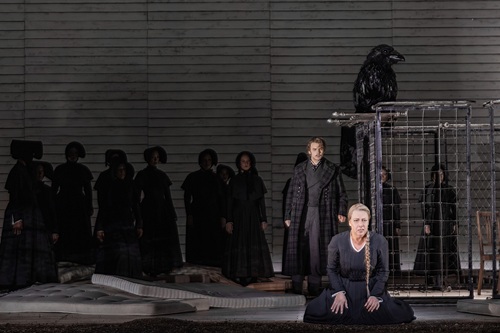
In the second act, order gives way to disarray. Guth’s staging becomes increasingly expressionist, its black-and-white imagery evoking the work of William Kentridge. The women, wearing black bonnets, move as a mass before taking their seats facing the back wall. Some eventually attempt to climb it, like insects or dark thoughts struggling to escape. The mattresses now lie scattered across the floor, overlapping like broken sheets of ice beneath which the infant’s body will be concealed. The Kostelnička’s house, a lattice-like cell, casts shadows that extend nightmarishly across the backdrop, blurring the boundary between physical imprisonment and inner torment. Particularly haunting is a figure in a long black robe with an enormous raven’s head. It scales the outside of the house, perches above it and later prowls behind it. A traditional harbinger of death, the raven seems to embody her mounting dread, anticipating the guilt that will follow her crime.
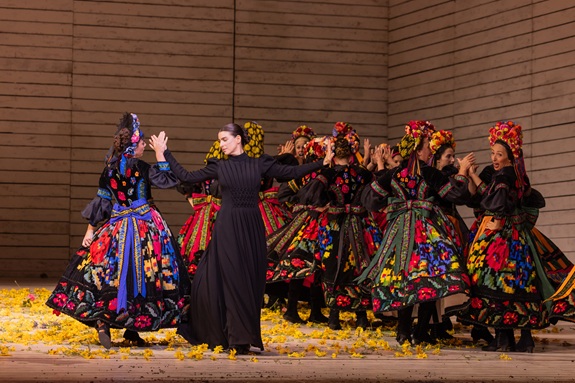
In Act III, James Farncombe’s warmer lighting suggests the arrival of spring, while yellow flowers carpeting the floor provide the first substantial burst of color. The black dresses of the wedding guests, designed by Gesine Völlm, are embroidered with varied, brightly colored folkloric motifs. The walls, however, remain unchanged. Jenůfa’s plain black mourning dress casts doubt on that promise of renewal. News that the frozen infant has been found shatters the celebration. The villagers converge on Jenůfa, forming a hostile human wall, until Laca intervenes. Guth stages the confrontation with restraint, allowing Janáček’s music to drive the scene.
Asmik Grigorian’s Jenůfa and Nina Stemme’s Kostelnička anchor the performance. Grigorian, who also sang the role in Guth’s original London production, is an exceptionally intelligent singing actress whose subtle gestures and reactions to those around her reveal the depth of her identification with Jenůfa. Her singing is equally compelling, particularly in the second-act prayer where finely shaded phrasing and a wealth of vocal nuances convey vulnerability without sacrificing inner strength.
Stemme establishes the Kostelnička’s unyielding resolve when she forbids Jenůfa’s marriage to Števa until he has remained sober for a year. Her severity is rooted in memories of life with an abusive alcoholic husband; a fate she hopes to spare her stepdaughter. Although her upper register has lost some of its former steadiness, Stemme transcends this limitation through eloquent delivery and dramatic conviction. Affecting in Act II, she is even more powerful in Act III, as her self-possession dissolves into almost frenzied agitation. Jenůfa, meanwhile, gradually emerges from her initial devastation to respond to her stepmother with extraordinary calm and forgiveness. Only then does the Kostelnička acknowledge that she loved herself more than her stepdaughter. The woman who once claimed the authority to determine Jenůfa’s fate now stands before her in desperate need of absolution.
Sean Panikkar delivered a riveting portrayal of Laca, Jenůfa’s jealous suitor, matching Grigorian’s fierce commitment. His perceptive acting captured Laca’s obsessive love for Jenůfa and his bitter resentment of his half-brother Števa, which erupts in a violent attack that disfigures Jenůfa. Panikkar also revealed a tenderness beneath Laca’s aggression, making his eventual selfless devotion to Jenůfa entirely believable. His tenor had a penetrating edge, yet he could summon remarkable delicacy when the music demanded it. All the more impressive, then, that he made his role debut after only weeks of preparation. Ryan Capozzo was convincing as Števa, capturing both his cocky self-assurance and his underlying cowardice. The supporting cast and Metropolitan Opera Chorus performed admirably.
Under Tomáš Hanus, the Metropolitan Opera Orchestra brought out the richness of Janáček’s score, from its driving momentum to passages of unexpected lyricism. Born in Brno and steeped in the composer’s operas, he demonstrated an instinctive understanding of their speech-inspired musical language, eliciting rhythmically incisive playing. By comparison, the principal singers, none of them native Czech speakers, articulated the text with care but often missed the natural cadence, subtle shifts of emphasis and conversational spontaneity that distinguish Janáček’s vocal writing.
In the final moments of Guth’s staging, Jenůfa and Laca step in front of the descending black latticed curtain. For the first time, the barrier that has confined them stands behind them. Yet whether they can ever free themselves from the past remains uncertain.
Edward Sava-Segal
Featured Image: Asmik Grigorian (Jenůfa) in Janáček’s Jenůfa © Evan Zimmerman / Met Opera
Production:
Director – Claus Guth
Sets – Michael Levine
Costumes – Gesine Völlm
Lighting – James Farncombe
Choreographer – Teresa Rotemberg
Video – rocafilm
Dramaturg – Yvonne Gebauer
C. Graham Berwind III Chorus Director – Tilman Michael
Cast:
Jenůfa – Asmik Grigorian
Grandmother Buryjovka – Elena Zaremba
Laca Klemeň – Sean Panikkar
Jana – Jazmine Saunders
Foreman of the mill – Roland Wood
Kostelnička Buryjovka – Nina Stemme
Števa Buryja – Ryan Capozzo
Barena – Cadie J. Bryan
Shepherdess – Sophia Baete
Mayor – Kevin Short
Mayor’s Wife – Eve Gigliotti
Karolka – Erica Petrocelli
Aunt – Edyta Kulczak