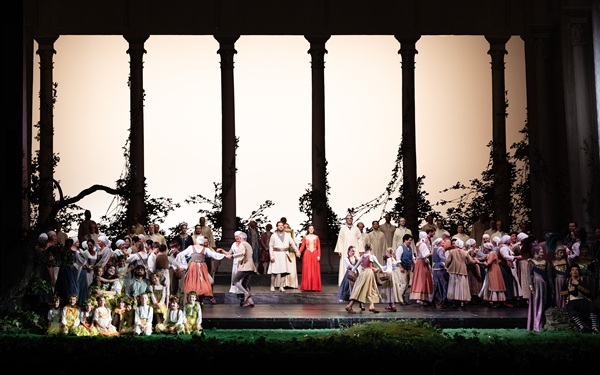
 Germany Mozart, Die Zauberflöte: Soloists, Chorus of Bavarian State Opera, Bavarian State Orchestra / Michele Spotti (conductor), Nationaltheater, Munich, 20.11.2026. (AL-L)
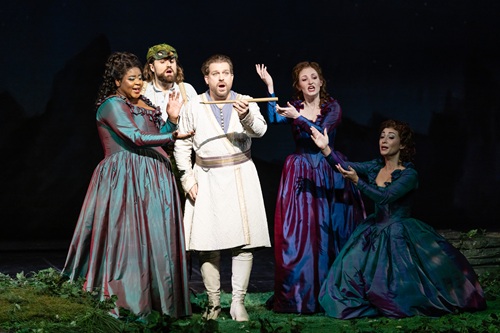
Few productions hold a place in Munich’s operatic life comparable to August Everding’s Die Zauberflöte. It opened on 30 October 1978, a year after Everding took charge of Bayerische Staatsoper, and was revisited on 31 October 2004 by Helmut Lehberger, his long-standing collaborator, while Jürgen Rose rebuilt with the house workshops the sets and costumes he had designed twenty-six years earlier. A 1983 Unitel film, with Kurt Moll, Francisco Araiza, Edita Gruberová, Lucia Popp and Wolfgang Brendel, preserves its original form. I first saw it live in 1984, with Edith Mathis as Pamina, Peter Schreier as Tamino, Brendel as Papageno and Theo Adam as the Speaker, with Wolfgang Sawallisch in the pit. Forty-two years later, the show is still running, and the house is still full.
The staging is resolutely traditional, and Everding’s basic concept appears to have survived intact. To allow the scenes to follow one another without interruption, Rose relied on painted cloths and architectural elements. The number and variety of the sets remain impressive, a reminder of an era when a major house could afford such luxury. The serpent still breathes real flames. Whether the direction of the singers has been retouched over successive revivals is hard to say. The ensembles are well structured and the crowd movements efficient, but the evening holds no surprises and leaves little room for spontaneity. Humour is scarcer than it should be, even though Everding summed up his intention as the need to sacrifice neither the seriousness nor the comedy of the work. One change at least is visible: as expected, Monostatos is no longer in blackface.
It is worth recalling how many recent productions have weighed down this Singspiel with symbols and layered readings. Here, this is a case of ‘less is more’ or ‘if it is not broken, do not fix it’. As early as 1978, Everding and Sawallisch revised and substantially shortened Schikaneder’s dialogue, and moved the trio for Sarastro, Tamino and Pamina a few numbers for dramaturgical reasons. Not all of the spoken text survives, and the evening moves along without the clock ever making itself felt.
The audience included many children (the house recommends the show from the age of six), in a packed and remarkably attentive auditorium. As with other Staatsoper revivals, starting with Jean-Pierre Ponnelle’s admirable La Cenerentola, this is a sound introduction to opera for a new generation. Several friends of my own generation have told me that this Zauberflöte marked their first evening at the Nationaltheater with their parents.
Musically, the cast has potential, but this first night of the run also displayed the familiar small flaws of a revival’s opening performance. Act I lacked assurance; Act II was already on firmer ground.
Julian Prégardien was an uncertain Tamino: his phrasing was elegant, but the top notes were not there. Tareq Nazmi, replacing Franz-Josef Selig as Sarastro, knows this production well, having sung this role in it several times, yet he was unusually cautious in Act I and more at ease thereafter. Jasmin Delfs was likewise more convincing in the Queen of the Night’s second aria, with incisive coloratura.
Liv Redpath had a few intonation problems in Act I and was more comfortable in Act II, perhaps better rehearsed. The voice is large and the top attractive, but her singing remained somewhat monochrome and her Pamina rather cool. Mozart gave Pamina, starting with ‘Ach, ich fühl’s’, music that should allow her to touch the audience far more deeply.
Konstantin Krimmel, by contrast, was entirely at home as Papageno. He has sung the role often in this production, and it showed: he took more liberties than anyone else on the stage and his ovation at the curtain was well earned. Martin Snell, a regular member of the company, made a fine Speaker, through his personal authority and the quality of his phrasing. The Three Ladies (Sarah Dufresne, Martina Myskohlid, Natalie Lewis) were exceptional; this is Munich, after all. The three soloists from the Tölzer Knabenchor were equally notable for the accuracy of their intonation. The chorus, prepared by Bobin Kim, sang well, although the staging places it too far back after the trials of fire and water.
In the pit, Michele Spotti had to contend with the usual start-of-run conditions. A few untidy entries in the overture, unusual for the Bavarian State Orchestra, and a certain caution in Act I gave way to a more confident reading. The ensembles were carefully prepared, and later performances should gain in fluency.
In the end, this Zauberflöte is a period piece: a serious, harmless production, perhaps simply a little too serious, even somewhat stern. But you can take your children, and help raise a new generation of opera lovers.
Antoine Lévy-Leboyer
Featured Image: Centre: Julian Prégardien (Tamino) and Liv Redpath (Pamina) © Geoffroy Schied
Cast:
Sarastro — Tareq Nazmi
Tamino — Julian Prégardien
Speaker / First Priest — Martin Snell
Queen of the Night — Jasmin Delfs
Pamina — Liv Redpath
First Lady — Sarah Dufresne
Second Lady — Martina Myskohlid
Third Lady — Natalie Lewis
Three Boys — Soloists of the Tölzer Knabenchor
Papageno — Konstantin Krimmel
Papagena — Tata Razmadze
Monostatos — Tansel Akzeybek
First Armed Man / Second Priest — Shawn Roth
Second Armed Man — Roman Chabaranok
Production:
Director — August Everding
Co-director (2004) — Helmut Lehberger
Sets and Costumes — Jürgen Rose
Lighting — Michael Bauer
Choreographic collaboration — Beate Vollack
Chorus director — Bobin Kim