
 United States ‘Intimacy’ – Kurtág, Schubert, Schoenberg, Mozart: Pierre-Laurent Aimard (piano). Kauffman Concert Hall, 92NY Center for Culture and Arts, New York, 18.11.2026. (ES-S)
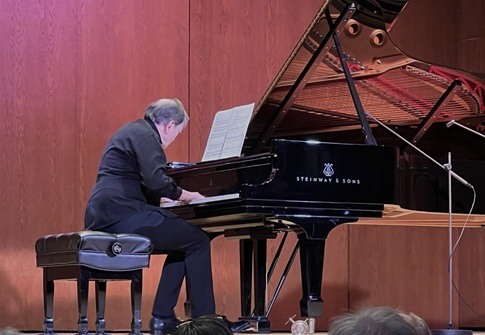
Instead of a conventional piano recital built around large-scale works, Pierre-Laurent Aimard offered an exploration of the world of miniatures. His program, titled ‘Intimacy’, brought together pieces that may last scarcely a minute yet contain an entire world of feeling and expression. Aimard interwove Schubert’s familiar dances with Kurtág’s often enigmatic miniatures, incorporating Schoenberg’s six-piece cycle and two brief compositions by Mozart into the larger sequence. Schubert’s waltzes and Ländler, rooted in domestic music-making, alternated with pieces conceived as musical tributes, experiments in sound or compressed expressions of grief. The resulting sequence revealed unexpected affinities between works separated by more than two centuries, their contrasting musical languages forming a remarkably coherent whole.
Aimard’s exploration of this repertoire dates back to the pandemic, when he turned to Schubert’s shorter piano works and began juxtaposing them with Kurtág’s miniatures. Schubert’s dances became the starting point for a dialogue with the radically different idiom of György Kurtág, the Hungarian composer whose centenary is being celebrated throughout the musical world this year. In his introductory note published in the concert program, Aimard described the recital as an ‘almost somnambulistic wandering’, hoping it would invite listeners to a closer relationship with music from a ‘secret garden’. The transitions drew on associations of mood, tonality, rhythm and sonority, highlighting similarities in some instances and exploiting sharp contrasts in others. Aimard played the entire recital attacca, sometimes positioning the score page for the next piece on the music desk before finishing the one he was playing.
Schubert’s apparently simple waltzes and Ländler often conceal harmonic subtleties beneath their regular rhythms. Many originated as improvisations among friends at informal gatherings rather than in the concert hall and formed part of the more than 400 piano dances Schubert composed during his short life. Kurtág’s Játékok (Games), begun in the 1970s and inspired by children’s spontaneous exploration of the keyboard, inhabits a seemingly different musical world. Many of these miniatures, often reduced to a handful of notes or gestures, reflect personal relationships, taking the form of musical portraits, birthday greetings or memorials dedicated to friends and fellow musicians.
Kurtág’s Quiet Dialog, from Book IX, appeared between two pairs of Schubert waltzes, D.145: Nos.5 and 9, followed by Nos.11 and 10. The right hand traced a succession of calm, descending scales whose downward progress became increasingly hesitant, while the left hand, playing in the lower register, grew more assertive. The surrounding waltzes – three of them in minor keys – suggested a different kind of dialogue, between successive sections of each dance rather than between the hands. Later, Kurtág’s Doina, an idiosyncratic reimagining of the plaintive, nostalgic Romanian folk song, led directly into Schubert’s Ländler, D.145, No.2 in E-flat major. Aimard’s deliberately slow tempo in the Ländler, as in several other Schubert dances, brought out an underlying melancholy that echoed the character of Kurtág’s miniature.
Aimard approached these miniatures with an affectionate, at times playful touch, without compromising his extraordinary precision. His articulation was wonderfully clear, each note distinctly shaped without sacrificing the richness and resonance of the pedaled sound.
Schoenberg’s Sechs kleine Klavierstücke anticipated the radical concision of his pupil Anton Webern, whose musical language would later influence Kurtág. Unlike the Schubert and Kurtág miniatures, which were interspersed throughout the recital, Schoenberg’s six pieces were played together as a complete cycle. Their contrasting characters ranged from delicate, fleeting gestures to abrupt outbursts, culminating in the austere, bell-like chords of the final piece, written in memory of Gustav Mahler. Here, as throughout the recital, Aimard maintained an almost yin–yang balance between sound and silence, allowing notes to linger and fade while giving the caesurae equal weight.
Mozart’s Adagio for Glass Harmonica, written in the final year of his life for the unusual instrument invented by Benjamin Franklin, acquired a suspended, almost weightless quality in Aimard’s hands. Between the Adagio in C major and Mozart’s March in the same key, K.Anh.139, No.3, Aimard placed Kurtág’s Organ and Bells in Memory of Doctor László Dobszay (Book V). Beginning with a C-major chord, Kurtág’s miniature retained something of the Adagio’s contemplative solemnity, while its bell-like sonorities foreshadowed the ceremonial character of the March.
The recital came full circle with Kurtág’s A Flower for Nuria, a musical condolence for Nuria Schoenberg Nono following the death of her husband, the composer Luigi Nono. Its opening gesture – four scattered notes followed by another four – had introduced the evening under the heading As it opens. Now, in The same as it closes, those notes returned in reverse order. In the tenderness of that final gesture, Aimard revealed a warmth sometimes obscured by his reputation for a cerebral approach, closing the evening with an intimate act of remembrance.
Edward Sava-Segal
Kurtág – Selections from Játékok: A Flower for Nuria – as it opens (Book VI); Birthday Elegy for Judit – for the second finger of her left hand (Book VI); Falling Asleep (Book I); Hommage à Vidovszky (Book II); Quiet Dialogue – To Árpád Göncz with much love, friendship and respect (Book IX); Chorale for Benjamin Rajeczky’s 80th Birthday (Book V); Lines for Zsuzsa Sirokay (Book VI); Bells for Margit Mándy (Book V); Magdi-memory… – alio modo (Book X); Organ and Bells in Memory of Doctor László Dobszay (Book V); Prelude and Waltz in C (Book I); In memoriam György Szoltsányi (Book V); Doïna (Book VI); Ligatura dolce-amara – amara-dolce – to Márta (Book XI); For Georg Kröll’s Birthday (Book VII); …für Heinz… (Book XI); …just so… (Book X); Jeu avec l’infini (Book III); A Flower for Nuria – the same as it closes (Book VI)
Schubert – Valses, D.145: No.5 in E minor, No.9 in F-sharp minor, No.11 in B major, No.10 in B minor, No.12 in E major, No.6 in B minor; Ländler, D.145: No.13 in A major, No.2 in E-flat major, No.16 in G major; Valses sentimentales, D.779: No.1 in C major, No.3 in G major, No.13 in A major, No.23 in E-flat major, No.28 in E-flat major, No.12 in D major; Deutsche Tänze, D.790: No.5 in B minor, No.6 in G-sharp minor, No.7 in A-flat major, No.8 in A-flat minor; Deutsche Tänze, D.783: No.2 in D major, No.3 in B-flat major; Originaltänze, D.365: No.36 in F major, No.21 in G major; Wiener Damen-Ländler, D.734: No.3 in G major, No.13 in G major, No.15 in G major, No.11 in G major
Schoenberg – Sechs kleine Klavierstücke, Op.19
Mozart – Adagio in C major for Glass Harmonica, K.356(617a); March in C major, K.Anh.139, No.3