
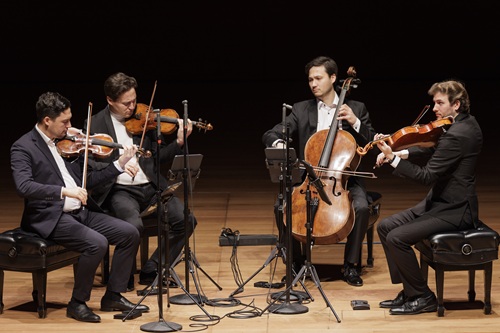
 United States Various: Schumann Quartet (Erik Schumann, Ken Schumann [violins], Matthew McDowell [viola], Mark Schumann [cello]). Alice Tully Hall, New York, 15.11.2026. (ES-S)
Mozart – Quartet in G major for Strings, K.80/73f, ‘Lodi’
Stravinsky – Three Pieces for String Quartet
Ives – Quartet No.2 for Strings
Tchaikovsky – Quartet No.1 in D major for Strings, Op.11
Encore: Ennio Morricone – ‘Deborah’s Theme’ from his score for Sergio Leone’s Once Upon a Time in America
Founded in Cologne in 2007, the Schumann Quartet now comprises three brothers, violinists Erik and Ken Schumann and cellist Mark Schumann, alongside violist Matthew McDowell. Over nearly two decades, the ensemble has established an international reputation for its expressive intensity, spontaneity and close musical communication. A former participant in the Chamber Music Society of Lincoln Center’s Bowers Program, the quartet returned to Alice Tully Hall under the Society’s auspices with a program that moved from Mozart’s youthful classicism to the experimental soundworlds of Stravinsky and Ives, before stepping back in time again to the Romantic lyricism of Tchaikovsky.
The concert opened with Mozart’s String Quartet in G major, his first essay in the genre, conceived at fourteen during his first Italian tour. The Schumann Quartet brought refinement and playfulness to the music which combines traces of Baroque writing with the melodic elegance of the Italian galant style. Unusually for a Classical string quartet, the work opens with an Adagio. First violinist Erik Schumann introduced its expansive, songlike melody with natural phrasing and expressive restraint. In the concluding Rondeau, added several years later, crisp articulation and lively exchanges brought out the music’s wit and buoyancy. Their seemingly effortless coordination would remain a distinguishing feature throughout the evening.
Mozart’s elegance gave way to the abrupt rhythms and fragmented textures of Stravinsky’s Three Pieces for String Quartet (1914). Lasting barely eight minutes altogether, the three pieces are strikingly different in character, with Stravinsky making little attempt to connect them into a larger whole. Even within the first piece, each instrumentalist pursues a seemingly unrelated musical idea. The four parts alternately converge and diverge, creating a strange, almost delirious dance. The Schumann Quartet kept the contrasting musical lines distinct without sacrificing momentum. The second piece, ‘Eccentric’, inspired by the jerky movements of the English music-hall comedian Little Tich, juxtaposes violent outbursts with grotesque humor. The final ‘Canticle’ replaces the preceding turbulence with a hushed funeral chorale, its solemn phrases suggesting a dialogue between preacher and congregation. The foursome sustained the movement’s quiet intensity through finely controlled dynamics and instrumental balance.
Composed around the same time as Stravinsky’s miniatures, Ives’s String Quartet No.2 (c.1913–15) shares their occasional eeriness, born of unexpected distortions of tonal and rhythmic conventions. A similar feeling emerges from Giorgio de Chirico’s contemporary painting Mystery and Melancholy of a Street (1914), where an apparently peaceful scene is overshadowed by an unseen menace. Five years later, Freud would explore how the familiar can become disturbing in his essay The Uncanny (Das Unheimliche).
Ives’s quartet moves between heated exchanges and passages of great delicacy, the latter made strangely unsettling by almost imperceptible harmonic shifts that at times recall Debussy. Reacting against the decorum of traditional quartet playing, he imagined four musicians conversing, arguing, quarreling and eventually climbing a mountain together. In the opening ‘Discussions’, fragments of American folk tunes punctuate the growing dispute, while moments of accord offer only temporary relief. In ‘Arguments’, Ken Schumann’s second violin repeatedly attempts to introduce the kind of syrupy Romantic lyricism that Ives delighted in mocking, only to be brusquely interrupted by the other instruments. The Schumanns shaped the mounting quarrel into a compelling musical drama. In the finale, ‘The Call of the Mountains’, the music takes a more contemplative turn. Against a descending whole-tone scale in the cello, the first violin soars into its highest register as the four instrumental voices gradually find common ground without surrendering their individuality.
Heard in the second half of the concert, Tchaikovsky’s music could have encouraged an exaggerated, declamatory approach. Yet the Schumann Quartet resisted any such temptation in rendering his early String Quartet No.1. The opening movement has an almost orchestral richness, its recurring syncopations lending momentum to an otherwise expansive musical discourse. The Schumanns gave the lyrical passages ample room while keeping the underlying rhythmic pulse alive. The second theme, introduced by the violin, gained additional warmth and depth when taken up by Mark Schumann’s cello. In the celebrated Andante cantabile, the Russian folk song ‘Sidel Vanya na divane’ (‘Vanya Sat on the Sofa’) alternates with a second melody of Tchaikovsky’s own invention, the two themes complementing each other while retaining their distinct characters. The Scherzo took on an earthier, more exuberant character through percussive accents and fiddle-like rhythms. In the final Allegro giusto movement, the Schumanns brought clarity to the contrapuntal writing while preserving the music’s playful spirit.
As an encore, the quartet offered Ennio Morricone’s ‘Deborah’s Theme’, from his score for Sergio Leone’s Once Upon a Time in America, its wistful nostalgia recalling the emotional world of Tchaikovsky.
Edward Sava-Segal