
 Canada Various: Kevin Zhu (violin), Vancouver Symphony Orchestra / Antony Hermus (conductor). Orpheum Theatre, Vancouver, 6.11.2026. (GN)
Scriabin – Rêverie, Op.24
Shostakovich – Violin Concerto No.1 in A minor, Op.77
Prokofiev (arr. Hermus) – Suite from Cinderella, Op.87
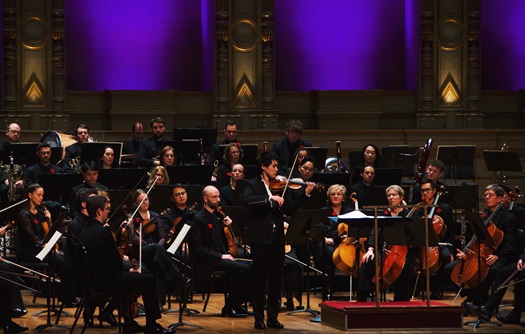
American violinist Kevin Zhu received considerable acclaim for his competition performance of Shostakovich’s Violin Concerto No.1 at the 2024 Queen Elisabeth International Music Competition in Brussels, even though he ultimately placed fourth. Now we were able to hear the Vancouver Symphony Orchestra version of this performance, lead by the same conductor, Antony Hermus. It was quite a magnetic reading, sensitive to the many half-lights in the work and maintaining concentration and line over the whole. The evident devotion, clear-headedness and sheer absence of affectation were notable and not what one usually expects from a 25-year-old artist. Scriabin’s touching Rêverie and pieces from Prokofiev’s Cinderella were the lighter Russian makeweights.
Shostakovich’s dark, brooding concerto has not been mainline repertoire for much of its life. What made it more untouchable is that the work’s dedicatee, David Oistrakh, was an unmatchable interpreter of it, having made a definitive recording by 1956. This verdict may still be true today, but in the last 25 years younger artists have been increasingly tempted to take on the challenge. It is an intriguing development since the work’s often subdued world of inner pain differs substantially from most romantic violin concertos. Luckily, Zhu understands the difference very well and his flexible, clean tone on top and tight, sinewed bottom offer appropriate tonal resources.
It took a little while for the violinist to settle into the opening Nocturne. Zhu’s first entry was too loud and bold with phrasing that felt rigid, but he soon assumed a more inward, searching posture, establishing the probing lyrical shape the movement demands. Though the pain was more implied than overtly stated, the sense of inexorable struggle and doubt was strongly conveyed, showing both sensitivity and a grasp of the music’s architecture and flow. Maestro Hermus offered a desirably firm orchestral backdrop – with notably pungent lower strings and winds – and the central climax was cunningly negotiated, with the quiet tension of its aftermath strongly held by both Zhu and the orchestra. In contrast, the following Scherzo demands relentless, continuous playing from the soloist, and here Zhu’s reading impressed in a different way, displaying tight, sharp precision and an unwavering rhythmic strength. Some might want more caustic wit and grotesquerie, but Zhu’s transparency and sense of line were impeccable, driving the DSCH motif with crisp authority and incisiveness.
The subsequent Passacaglia was the highlight of the performance. Rather than expanding its proportions with romantic phrasing, Zhu kept it as pure, distilled bleakness – matching the dark orchestral protestations. The playing was also special in the sense that one noticed the violinist’s harmonic awareness as he played. This treatment allowed the music to naturally move into the work’s celebrated cadenza without breaking concentration and intimacy. The same patience was sustained through to its unbridled moment of terror, presented with absolute technical assurance. There was a poised, considered balance over the entire span – an enviable flow of communication. The closing Burlesque was perhaps not as ostentatious as it might be, but it was set at just the right tempo. The violinist’s rhythmic sense was exceptional, and he cut through the frenzied atmosphere with wonderfully clean, direct playing, increasing his intensity as the piece closed.
Needless to say, some might prefer a more visceral, bigger-boned treatment of the work. While the violinist’s characterization will increase as he matures, what appealed about his performance was its overall purity of line and feeling, an awareness of structure and, in particular, the sheer absence of histrionics. It was presented as a deadly serious piece where any showiness or indulgence by the artist would seem to violate the spirit of the work. Innocence and a fresh sense of discovery can sometimes go a long way in an interpretation.
By design, the rest of the Russian works were lighter fare. Many have attempted to construct ‘suites’ from Prokofiev’s Cinderella, but it is an unfortunate observation that none come close in quality to those for Romeo and Juliet. In the compilation here, the heavy percussion conveying the doom-filled ticking in the ‘clock strikes twelve’ scene was arresting, as always, and there was a nice mixture of fantasy and discipline in the earlier numbers. But the dominance of pieces that featured the ballet’s signature bittersweet string theme did conjure a bit of a ‘night at the movies’ feel. Perhaps that was the intent.
Of equal interest was the orchestra’s fine playing: Antony Hermus secured much more discipline and character in his second visit to the VSO. Besides his sterling contribution to the Shostakovich, he consistently coaxed fine unanimity from the strings, notably in Scriabin’s opening Rêverie. His treatment of brass and winds created an idiomatic home in the Prokofiev, even if the winds might have found an even greater sense of caprice.
Geoffrey Newman
I was lucky enough to attend the same evening and agree that the highlight of an excellent VSO performance was Kevin Zhu’s leading role in Shostakovich’s violin Concerto No.1.
His rock steady composure and demeanour throughout the concert belied the degree of concentration and intent that went into his interpretation of such a monumental and historically relevant composition.
Kevin strode confidently onto the stage in a trim, impecably well-tailored suit. It was only after soloist had made his first bows that marks of the effort were revealed by the young virtuoso. Before our very eyes, it was as if Zhu had aged imperceptibly during the entirety of his time on stage. Every crease, every fold of his sartorial splendour had become just a little dishevelled. Fortunate for all future attendees, there is a long life of command performances in store for this remarkably talented young man.