
 United Kingdom Wagner, Bruckner: Oxford University Orchestra / Rémy Ballot (conductor). Sheldonian Theatre, Oxford, 12.11.2026. (KW)
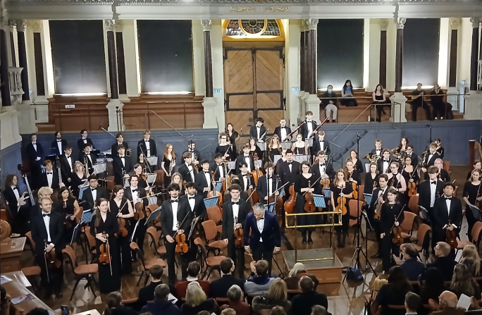
Wagner – Prelude to Die Meistersinger von Nürnberg
Bruckner – Symphony No.4 (Nowak 1878/80 edition)
The closing pages of Bruckner’s Fourth Symphony were subjected to revelatory treatment by Sergiu Celibidache, as recorded in Munich in 1988. At a very slow and steady speed, the sharply articulated string sextuplets sounded like a very quiet relentless march, slowly getting louder and louder, tension mounting all the time. Above them sounds a mysterious horn melody, sustained trombone chords, trumpet fanfares, inversion of the main theme in woodwinds, and finally a breakthrough into triple forte E-flat major motto theme that had introduced the symphony on a solo horn more than an hour previously. The Oxford University Orchestra showed their metal in this massively powerful and transcendent coda. Whatever the problems and limitations of inexperience, ability and rehearsal time they had to cope with along the way, suddenly it all came together, the whole extraordinary enterprise validated by their performance of Bruckner’s astonishing coda. As Benjamin Korstvedt writes in his book on the Fourth Symphony, ‘the sonic presence of this music fills the ear and the heart so full as to overwhelm … the power of objective observation, leaving instead sheer musical awe …’.
Their conductor, Rémy Ballot, has earned a great reputation as a Bruckner conductor, displayed in his award-winning recorded cycle of ten symphonies from Bruckner’s beloved monastery in St Florian, issued on the Gramola label. His performances are characterised by a patient grandeur that lets the music unwind unrushed, thereby unleashing poetry and power aplenty. Such performances make great demands on even most experienced orchestras, so it was intriguing to see him coax a very strong performance of the symphony from this student orchestra. As he told me, mostly they were not music students, mostly they had never met a Bruckner symphony before, and almost certainly never encountered that tradition of performance that Maestro Ballot enshrines. They are obliged to cram in rehearsals in time stolen from their primary studies.
The symphony opens with a tremolo, ppp. It was extremely quiet. Presumably the players could hear themselves, and Ballot could hear them, and perhaps the sharp ears of the young students who made up most of the audience could hear them, but to me the tremolo was purely visual, maddeningly inaudible until it became just perceptible at the entry of the solo horn, played courageously by Callum Scott. He had an awful lot to do in this symphony, much of it very exposed. Here and there it was somewhat less than perfect, but overall it was really well done and made you realise, again, how significant the horns are for Bruckner’s ‘Romantic’ Symphony, much more than just that opening ‘motto’ horn call.
As soon as the heavy brass came in with Bruckner’s characteristic duplet-triplet main theme, we were in much more confident territory, and the sheer joy of Bruckner’s music in this passage was great to hear. In the birdsong related second theme, the violins seemed a little hesitant to begin with but soon got into the swing of it, and the brassy third theme was presented with appropriate gusto. In the development, the woodwind ornamentation and countermelodies were all a delight to hear. The long line of the movement never faltered in its progress to its destination, all four horns (well, five – there was a bumper) blaring out the motto theme at the end – perhaps not quite so sonorous as one would have liked, but powerful nevertheless.
The Andante quasi Allegretto fought against the sounds of revelry from the streets outside, not to mention a rather large contingent of young people with bronchial infections in the audience. It began as a somewhat sombre trudge – and indeed ended that way, with an air of desolation to the lone drumbeats. The very beautifully played violas’ serenade carried a deep melancholy, the movement’s climax presenting the main theme more elegiac than glorious. The ensuing dark mood was brilliantly swept away by the layered fanfares, horns then trumpets, of the ‘hunting Scherzo’. It was not without its mishaps and fared better on the da capo, but was always carried along by Rémy Ballot’s clear beat, and proved an exciting foil to the wistful mood of the preceding movement. The Trio’s simple melody sounded wonderfully pure, played exquisitely by Isabella Gregory, flute, and Lucy Deng, clarinet, above the lilting Ländler beat on oboe and strings beneath it.
I felt that it was with the Finale that the performance really came into its own. At times, as in the fortissimo third theme material, the music approached a delightful cacophony – not that there were discordant errors, but rather the sheer energy and enthusiasm seemed to speak of elemental forces erupting. The interpretation was very much what one would expect and, indeed, hope to hear from Ballot, with the Langsamer (Slower) marking of the main theme unison very strikingly observed: it was vast and monumental. The second theme group, Noch langsamer (Still slower) was very beguiling and fed effectively into the wide range of emotions that combine to build the narrative of this vast movement. There are some performances when the movement can seem too long, to have lost its way, but on this occasion every moment was intriguing, and I became aware of the approach of that magnificent coda much too soon. Would that there had been more!
The close of the massive Finale coda left everyone in stunned silence. Several seconds passed – then enthusiastic applause broke out; Ballot being recalled over half a dozen times. Presented with a bouquet of flowers, he handed them immediately to Rowan Swain, principal of the viola section, which had performed so well throughout.
A moving though rather mellow performance of Wagner’s Prelude to Die Meistersinger, emphasising melody above bombast, began the concert. Just occasionally the line seemed a little fragile, but given the density of the writing, the requirement for all voices to be expressive but a part of the whole fabric, the student orchestra did well, the Prize Song melody particularly attractive. Given that the Bruckner symphony to follow was the version without cymbal, the cymbal and triangle players crammed into a corner at the back had their brief moments at the close of the Prelude.
Since 2024 Rémy Ballot has a long-term residency with the Oxford University Orchestra. On the evidence of this concert, this will be a very fruitful association. Oxford has a long-standing Bruckner tradition, following the lead of the Hertford Bruckner Orchestra, founded and conducted by the late and very much lamented Dr. Paul Coones. I was pleasantly surprised to find, on my way to this performance of the Fourth Symphony, posters announcing that two days later the Oxford Symphony Orchestra under Robert Max would be performing the same symphony in Oxford Town Hall.
Ken Ward