 United Kingdom These Violent Delights – ‘O Romeo, Romeo, wherefore art thou Romeo?’ ***
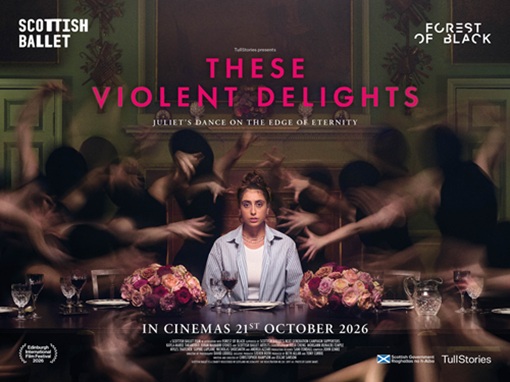
Scottish Ballet and Forest of Black are delighted to announce a special partnership with Tull Stories to release their dance feature film THESE VIOLENT DELIGHTS in UK cinemas from 21st October. It is described as ‘a visually ambitious ballet feature production [a re-imagined unconventional retelling of Shakespeare’s Romeo and Juliet] exploring identity, love and transformation through movement, by the BAFTA and multi award-winning director Oscar Sansom and the multi award-winning CEO/Artistic Director of Scottish Ballet, Christopher Hampson CBE.’
These Violent Delights had its world premiere at the Edinburgh International Film Festival in August and goes on general cinema release in the UK and Ireland from 21st October. The film was shot across various locations in Scotland and takes us into the world of Juliet’s fever dream. With a name for creating innovative dance on screen, this is the company’s first major feature-length film.
Christopher Hampson, Director and CEO/Artistic Director of Scottish Ballet, said: ‘The idea came about from thinking about a version I’d done of Romeo & Juliet as a ballet where I was always struck by the third act that it’s basically Juliet’s story. The film is a Romeo and Juliet story told very much from the viewpoint of Juliet and their reminiscences, their remembering and misremembering in real time. It’s probably only two or three minutes of Juliet’s awakeness, but the film delves much deeper into their unconsciousness. Scottish Ballet has made a name for itself in dance film over the last ten years, winning awards for short films and digital innovation, but this is on a whole other level, and I’m thrilled we’ll be in cinemas across the UK, reaching new and established audiences.’
Having made some notes about the events in the film while watching it I then found the following synopsis that does more than I could to prepare you for what you will see:
Juliet wakes in The Apothecary surrounded by traces of death: daggers, spilt poison, Romeo’s body.
Rewind.
Dragged into hallucination, Juliet slips between memory and nightmare. Two families divided by pride: at the Capulet table, Paris is paraded as a suitor; Juliet refuses. At the Montague feast, they are invisible. Romeo, restless and constrained, is lured by Benvolio and his boyfriend Mercutio toward a night of abandon.
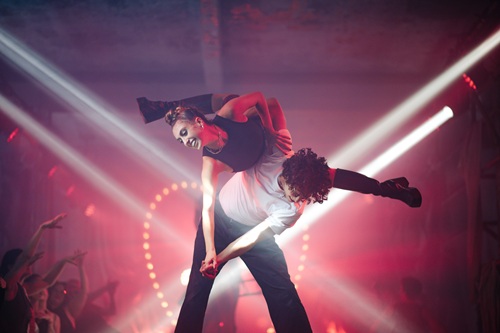
Urged by Nurse to escape expectation, Juliet seeks refuge at The Apothecary, a queer club reclaimed from an abandoned building and presided over by the drag Sisters Laurence and Giovanna. Beneath neon light and pulsing music, Romeo arrives. Across a haze of glitter and sweat, their eyes meet. The connection is immediate, intoxicating. In a flamboyant ritual before the crowd, their love is sanctified.
Outside, Tybalt’s resentment erupts. Mercutio is wounded; Romeo kills Tybalt. Juliet agrees to court Paris while secretly planning to flee.
A pill. A message mistaken for a suicide note. Romeo rushes back with poison in hand. We end where we began.
These Violent Delights is nothing like the legendary ballet versions of Romeo and Juliet from Sir Kenneth MacMillan or Rudolf Nureyev you will see from The Royal Ballet or English National Ballet. Nor is it Prokofiev’s music and what John Lemke’s accessible score has – with a few interpolated vocals and club anthems – is neo-classical soaring melodies mixed with percussion-driven electronic music. Sami Fendall’s costumes sets it very much in today with characters in modern streetwear with Juliet’s white vest, striped shirt and black shorts; Romeo in polo shirt and plaid trousers; Lady Capulet (Marge Hendrik) is – literally – in a yellow cat suit; Lord Capulet (Christopher Akrill) in an extravagantly patterned shirt; Paris (Yuri Marques) looks like a well-heeled student on a gap year; and the Nurse (Grace Horler) looks, well, like a nurse.
Juliet is lying on a red-shrouded bed in what we will come to know is The Apothecary before several hands drag her through the bed to … well where? Is she hovering between life and death because of the pill we will see her take? She relives the past, sometimes as an out-of-body experience or as they actually happened. The homes of the Capulets and Montagues are palatial, The Apothecary’s dereliction not so much.
Throughout the rethought scenario we get to hear (voiced by Jessica Hardwick) some lines from the original play culminating at the very end with those that have inspired the film’s title ‘These violent delights have violent ends / And in their triumph die, like fire and powder / Which, as they kiss, consume’. This follows an extended sequence where some of what we have seen is reprised possibly on the astral plane; as well as seeing Juliet interact with the ‘Shadows’ (faceless figures in black) who have been present from time to time. Their presence emphasises how fate is the inescapable, dominant force dictating the sad trajectory of the young lovers’ lives, and this was something Nureyev recognised in his legendary staging. To grab the attention of a 21st-century audience Friar Laurence is now Sister Laurence who looks part-RuPaul’s Drag Race contestant and part-catwalk (literally again) Milan model. She is aided and abetted by Sister Giovanna (Friar John, now in devilish red with a crown of thorns). Laurence dispenses what are probably Ecstasy tablets (small blue squares with a red heart) and Giovanna supplies the red and white capsules which condemn Juliet to her troubled sleep. Her text ‘I long to die / If what thou speak’st speak not of remedy’ is received by Lady Capulet, and Romeo too, as an admittance of suicide. Romeo gets a small phial of green liquid from one of the Shadows and swallows the poison in his despair … but – as we probably expected – Juliet awakes with a start.
Perhaps my biggest problem in this intriguingly structured short film is the choreography, or rather the armography, from the team of six. Don’t expect anything resembling classical ballet – you probably weren’t anyway – it is mostly, if not entirely, grounded contemporary movement (opposed to dance) with excessive – rather than overly expressive – gesticulating arms and (vogue?) hands. So much so, that they were all I often found myself concentrating on. There is an ‘all pals together’ moment for the androgynous Mercutio (Andrea Azzari), Benvolio (Bruno Micchiardi) and Romeo; ultimately Mercutio is beaten to death by Tybalt (James Garrington) in the film’s most graphic scene before he is thrown to the floor by Romeo and killed instantly. Other eye-catching moments are Juliet and her Nurse duetting, much chairography in a sequence between Juliet and Giovanna, or solos for Juliet, Romeo and Tybalt when they are yearning, conflicted, in anguish or distraught.
Where the adapted story fails Shakespeare is by concentrating on Juliet it takes too long to show her in any real relationship with Romeo. They only properly meet and duet in The Apothecary (which has morphed it seems into a Las Vegas Wedding Chapel); yet only kiss after they have taken the drugs. Too quickly they are then wrenched apart leading to the tragic ending we all know. Juliet gets an eye-catching performance from Kayla-Maree Tarantolo, Ishan Mahabir-Stokes does well in the comparatively little he gets to do as Romeo and the entire cast are clearly very-talented.
Shakespeare’s oft-told tale has withstood many different retellings and These Violent Delights is simply just the latest. Christopher Hampson and Oscar Sansom have indeed created a visually engaging film, yet which bares little relation to any ballet or modern dance you would see presented behind the proscenium arch in a theatre. Therefore, who it is targeted at I am not certain? Will it draw a sizeable new audience to future Scottish Ballet performances? I hope so, but the jury’s out …
THESE VIOLENT DELIGHTS is in cinemas on 21st October for one night only and select dates thereafter. To check cinemas click here.
Jim Pritchard
Cast included:
Juliet – Kayla-Maree Tarantolo
Romeo – Ishan Mahabir-Stokes
Tybalt – James Garrington
Sister Laurence – Harvey Littlefield
Sister Giovanna – Rishan Benjamin
Mercutio – Andrea Azzari
Creatives:
Written and Co-directed by Christopher Hampson CBE and Oscar Sansom
Choreographers – Julia Cheng, Morgann Runacre-Temple, Myles Thatcher, Sophie Laplane, Nicholas Shoesmith, and Andrea Azzari
Composer – John Lemke
Production and Costume designer – Sami Fendall
Director of Photography – David Liddell
Sound designer – William Aikman
Editor – Oscar Sansom