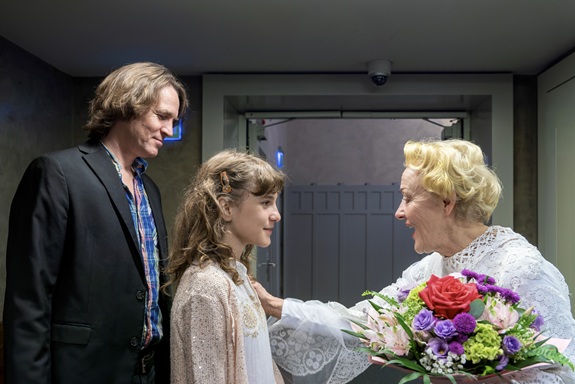
 Hungary Magyar Kincsek Ünnepe (Celebration of Hungarian Treasure): Concerto Budapest and guests . Grand Hall of Franz Liszt Music Academy, Budapest, 11.10.2026. (AK)
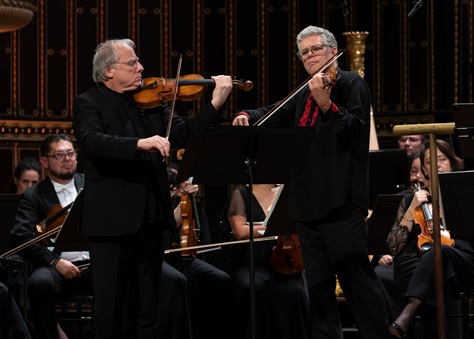
To accompany the three-day musicology conference in memory of György Kroó (8th-10th October 2026, Institute of Musicology, Budapest) that is to honour the 100th birth anniversary of the late musicologist/music critic György Kroó, Concerto Budapest presented a three-concert marathon on Sunday 11th October 2026.
Morning
Five composers were presented, two of whom are still alive and were present at the concert.
Rózsa – Spellbound Concerto
This is an orchestral suite in the shape of a piano concerto created by Miklós Rózsa (1904–1995) from his Oscar winning score for Hitchcock’s 1945 film Spellbound. The scary images are represented by the unusual instrument called theremin, this time played – for all to see – by Katica Illényi. A very large symphony orchestra is involved, as well as the piano soloist (here Valentin Magyar) but there seems to be only one motive in the music, repeated many times.
Dubrovay – Laudate for a solo instrument and strings
László Dubrovay (b.1943) composed his piece in 2024 since when it had several performances in several formations. This time we heard a version for solo flute and a small group of strings, with the excellent flutist Orsolya Kaczander on her alto flute. As with the Rózsa piece above, one musical motive dominates throughout.
Szőllősy – Addio
Composed in 2002 in memory of György Kroó but dedicated to violinist György Pauk, András Szőllősy (1921 – 2007) created Bachian variations on a dodecaphon theme for a solo violin and nine strings. Violinist András Keller and his team delivered a beautiful performance, worthy to Kroó, Szőllősy and the late György Pauk who would be 90 this month.
Perényi – Tre movimenti
Miklós Perényi (b.1948) is a highly respected cellist of profound musicality but he also composes from time to time. These three pieces for solo cello, possibly composed over a long period of time, were premiered at this concert. As always, Perényi’s cello playing was heavenly in spite of enormous technical difficulties. Double stops were expanded to true polyphony as if several cellos played. All three movements, played without any break, reminded of some Buddhist contemplation of exquisite beauty. I wonder how many cellists would be brave enough to take on this piece? Ironically – or perhaps out of respect for the audience – Perényi played his composition from music, turning pages himself. Final verdict? Unforgettable, beautiful cello playing.
Bartók – The miraculous mandarin, suite, BB 82
Conducted by famed violinist Kristóf Baráti – as many solo instrumentalists, Baráti also conducts – the suite was exciting, loud, and ably played by Concerto Budapest.
Afternoon
Liszt–Kocsis – Festive March for Goethe’s birthday
Liszt composed his piano piece in 1849 and arranged it for orchestra in 1857. The late and much missed pianist/conductor/composer Zoltán Kocsis – who died ten years ago aged only 64 – went back to the original piano version and created another orchestral version, dominated by brass instruments but providing dialogues within the wood instruments too.
Schubert–Dohnányi – Fantasia in F minor
In 1928, Dohnányi arranged Schubert’s four-hand piano piece for orchestra – in particular, for the Budapest Philharmonic Orchestra – to honour the 100th anniversary of Schubert’s death.
Great choice for these Kroó celebrations but, for my own enjoyment, I stick with the original four-hand version.
Veress – Concerto for Violin
A beautiful and exciting work by Sándor Veress (1907–1992), composed in 1939 and based on his earlier concerto for string quartet and orchestra. The Transylvanian origins of the piece are a perfect fit for violinist Barnabás Kelemen who delivered a virtuoso and highly musical performance, well aided by conductor András Keller. As encores, Kelemen and Keller (now on his violin) played three pieces (Ruthenian kolomejka, Sorrow, Transylvanian Dance) from Bartók’s 44 Duos for two violins. I wonder if I will hear such exciting rendering ever again.
Evening
This concert was an extraordinary tribute to composer György Kurtág, now 100 years and eight months of age.
In the first half of the evening, ten outstanding musicians presented twenty-four of Kurtág’s miniature solo – and chamber music pieces, representing several decades in the Kurtág canon. The presentation, even if we ignore the musical excellence, was imaginative and discreetly theatrical. All ten performers were on the stage throughout. The amazing 11-year-old pianist Noa Hendriks wore a very simple white dress, eight of the adult performers were dressed in black (as surely the ninth should also have been). There was no break between the pieces: we were listening to Kurtág’s miniature output as to one complete work.
Although all performers were there throughout, excellent flute player Orsolya Kaczander had the extra task of appearing with some of her various contributions from the balcony as well as in front of the organ pipes. She negotiated her numerous moves with admirable skill and discretion.
The standard of performances was mind-blowing. Apart from the brilliance of child pianist Noa Hendriks and flute player Orsolya Kaczander, we had the privilege of listening to the outstanding mastery and musicality of András Keller (violin), Miklós Perényi (cello), Tibor Tabányi (double bass), Csaba Klenyán (clarinet) and András Szalai (cimbalom). Contributions by members of the Keller quartet (András Keller, Zsófia Környei, Máté Szűcs, and Dóra Kokas) were also of importance.
The second half of this evening concert consisted of Kurtág’s second opera Die Stechardin, premiered in February 2026 and reviewed by me here.
This time the opera, or monodrama as I prefer to specify, was preceded by a cello-piano piece as an overture that is as an integral part of the opera. Cellist Miklós Perényi and pianist Valentin Magyar were on stage with stage lights focused on them while they gave a beautiful rendering of Liszt’s La lugubre gondola. I applaud the idea of this insertion as Liszt’s piece commemorates death and Kurtág’s opera deals with afterlife.
In spite of the excellent but discreet staging and a mesmerising musical rendering of the score, I am still uncomfortable with the piece. The libretto bothers me because it indicates the painful truth that paedophilia can come from highly respected educated people. On the other hand, the performance needs the extraordinary rendering of Maria Husmann (soprano). Will Kurtág’s music (orchestrated by Zsolt Serei) triumph without Husmann singing and András Keller conducting the excellent Concerto Budapest orchestra?
Agnes Kory
Featured Image: Young Noa Hendriks and soprano soloist Maria Husmann © Andrea Felvégi
Performers during the three concerts in order of appearance: Katica Illényi (theremin), Valentin Magyar (piano), Orsolya Kaczander (flute), András Keller (violin), Miklós Perényi (cello), Noa Hendriks (piano), Tibor Tabányi (double bass), Csaba Klenyán (clarinet), András Szalai (cimbalom), Zsófia Környei (violin), Máté Szűcs (viola), Dóra Kokas (cello) and Maria Husmann (soprano). With the Concerto Budapest orchestra and conductors Kristóf Baráti and András Keller.