
 Switzerland Concours de Genève 2026 I: Composition Final and Conducting Final (Part 1): Orchestre de la Suisse Romande. Victoria Hall, Geneva, Switzerland, 11.11.2026. (CC)
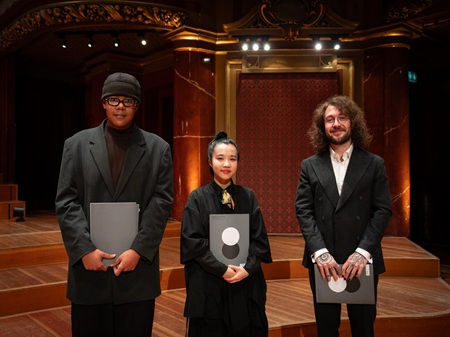
Conductor Gabriel Pernet
Beethoven – Egmont Overture, Op. 84
Rafael Marino Arcaro – invention in language of child, Op.22
Conductor Jacobus de Jager
Beethoven – Egmont Overture, Op.84
Sing-Yat Chen – Shattered Sky / Remaining Land.
Conductor Mats Thiersch
Beethoven – Egmont Overture, Op.84
Hanurij Lee – STUFF #1
There was a dual finale this year in Geneva, and so cleverly constructed, as the competition celebrates its 80th anniversary. The competition has a high hit-rate over the years, from pianists Arturo Benedetti Michelangeli in 1939, Pollini (1957/8), Argerich (1957) to Georg Solti (1941/2) and Alan Gilbert (1994) in conducting, to singer Marina Viotti (2008), one can list a litany of stars. Of recent competitions, the NOVO Quartet and the Quatuor Elmire, both in the same 2023 final, have carved out strong niches for themselves. So this is a major accolade for whoever wins.
So the first of the finals, that for composition, was led by the conducting finalists. On the Wednesday (November 11th), three conductors each took on Beethoven’s Egmont Overture and a work each by a composition finalist. Then on Friday, the conductors offered a major symphonic work from the core repertoire: Richard Strauss’s Don Juan, Stravinsky’s 1919 Suite from The Firebird, and extracts from Prokofiev’s Romeo and Juliet. This was, incidentally, the first conducting competition since 1994.
The juries were studded with familiar names: heading the composition jury was Unsuk Chin, and joining her were Toshio Hosokawa, Magnus Lindberg, Augusta Read Thomas and Katherine Rosenberger.
Leading the conducting jury, Bertrand de Billy, with Mark Stringer as vice-president. Joining them were Baldur Brönnimann, Martin Campbell-White, Laurent Gay, Sarah Nemtanu (concertmaster of the Orchestre de Paris), Eva Ollikainen, Peter Oundjian, Natalia Ponomanchuk, Arturo Tamayo, Wingsie Yip and, crossing over, Unsuk Chin.
This was a real opportunity to hear how a conductor can change an orchestra – within minutes of another – in Beethoven’s Egmont, its title referring to Schiller’s play. First up was Gabriel Pernet, who was also conducting Rafael Marino Arcaro’s invention in language of child, Op.22. It is amazing to think this is an LSO Panufniuk commission and was premiered at the Barbican under the baton of Maxime Pascal (review here). There, it was surrounded by Debussy, Neuwirth and Boulez and inevitably suffered somewhat. Here the focus was squarely on Arcaro’s piece, and it grew in stature for it.
Swiss-born Gabriel Pernet conducted, Beethoven first. He is a clarinettist as well as conductor, having worked in Basel and elsewhere, His Egmont was perhaps of an earlier era, the opening very strongly in six (the marking is Sostenuto ma non troppo). The metric modulation was perfect though into the Allegro, and there was certainly plenty of drama. Perhaps the most noteworthy moment was the balancing of horns and bassoons at the climactic statement of the base rhythm for horns and bassoon – usually only the horns are audible, here it was clearly a partnership.
But that was but one moment – the heaviness of the opening remained, and I wonder if Pernet really had that moment, and the coda, in mind from the very beginning? He is clear of beat, for sure, but a little more consistency of interpretation, both in intent and structurally, is required.
The composer, 37 year-old Brazilian Rafael Marino Arcaro (listed as ‘Brazil/Italy’) is based between London and Berlin and studied philosophy as an Undergraduate. He has also completed a PhD under George Benjamin in composition at King’s College London. He is interested in the natural world around São Paolo and reflects on Brazilian identity. It was at the age of 18 he decided to devote his life to composition, inspired by the second movement of Ravel’s G major Piano Concerto. The piece here, invention in language of child, is the second piece of a triptych on infanthood. It is inspired by a childhood memory: while in care of his grandmother, she forgot he was outside playing, and he spent the entire night playing with the animals. He claims to do a lot with little material, and his hallmarks include melody and richly layered scoring (all of which can be applied to French music in general).
The piece is certainly pictorial – its opening actually sounds like a forest, perhaps experienced in a sort of hyper-reality. Colours are almost too real; perhaps reflecting this, Pernet’s direction was exceptionally clear with the piece relying on creating a sense of continuum, of a sound organism. Arcaro creates a sense of expansiveness, almost as if he expands time. All credit to Pernet for holding exposed strings together as the music achieved a glacial quality.
There is no doubt Arcaro has a fine ear for scoring (the perfect use of stopped horn, a graveyard for many composers, was just one case in point). Pernet held the tension through the exquisite final passages, too, perfectly rendered by the orchestra.
Hearing Jacobus de Jager’s Egmont was a very different experience. Although again conducted in six, his Sostenuto ma non troppo moved more, and held more contrasts. Monumentalism in the Allegro came from balance (an emphasis on the lower registers, particularly cellos and double basses) rather than speed. de Jager does not micro-manage his orchestra, importantly – he knows exactly when to be ultra-clear and when gesture is important. He had to deal with a non-entry of the oboe in the approach to the coda (he certainly did the cue); he made a point of highlighting piccolo ascents during the coda (missed by most conductors) – thus linking the gesture to the famous piccolo anacruses of the very final chords. A fascinating performance.
de Jager’s allocated new piece was Hong Kong composer Sing-Yat Chen’s Shattered Sky / Remaining Land. She composes ‘immersive soundscapes’. The catalyst for her in compositional terms was the music of Ligeti, although she also mentions Messiaen (she apparently smelt frankincense while she played his music). Shattered Sky / Remaining Land is based on the idea of a light appearing through the sky – specifically James Turell’s Skyspace, and also the memory of the arrival of a long-expected sun in Michigan, where she was living at that time.
The stuttering, deep sound of a bass clarinet animates the opening; this is a sound image of complete exactitude, with lower strings imitating, percussion commenting, and flutterings abounding. The air is full of potential energy – positively abuzz. From wha-wha mutes to a raft of percussion, there is always the impression that every nanosecond is precisely imagined. And was that a string heartbeat towards the end? Maybe.
In a sense, the reverse of Marino Arcaro’s piece occurs here. He gave a sense of expanse within a short time, and yet we could experience that expansion fully. Here, in Chen’s piece, the music, for all its undeniable beauty, seemed to lose steam, as if (wo)man could not live by texture alone. There was no doubting de Jager’s resonance with the score, though, and his expertise and confidence shone through his beat.
A similar sense of sonic adventure comes through Chen’s chronotope_01 susurrus beneath lithic palimpsest which dares towards silence more, has a similar sense of exploration (the combination of cello and accordion particularly), and it achieves what it needs to say in 3’25”. I don’t necessarily think Chen is a miniaturist at heart, just that some tightening up of intent and realisation is required.
The final conductor was Cologne-born Mats Thiersch, whose Egmont was full of urgency, its opening section more of a three to the bar, and grander, even prouder than the two before it. The arrival at the Allegro was perfectly judged, an Allegro of velocity, but also of nuance, of biting accents, of tailed-off diminuendos – and a real understanding of important the role of the timpani in this piece. The sense of foreboding he achieved from the double basses was astonishing. The violins’ dismissive gesture was perfect – as was the subsequent elision into the coda. Amazingly, this is Thiersch’s first competition.
Tiersch was allocated 20-year-old South Korean composer Hanurij Lee’s Stuff #1, as avoidant a title as one is likely to come by. Lee is a student at the Korean National University of the Arts. His music has already been heard at Verbier and played by such musicians as Yunchan Lim. He explores sonic relationships between instruments through their inherent possibilities, and via restricted gestures. His first experience was of his grandmother playing him a Mozart CD every day aged three. Later, Scriabin was a huge influence. His piece STUFF #1 is about perspectives – how one item can change in meaning through placement. He gave a very common title, and used full orchestra, plus the sounds of a cheap synthesiser. He is inspired by concrete blocks built all over the Soviet Union to meet housing shortages, their repetitive nature and desensitisation is key to the work. Images of dust, fur and a shaggy figure nodding its head (!) are key, while repetition acts as a ‘sensory residue’.
Lee’s use of repetition is indeed individual: the various strands spin, seemingly creating a mesh of sound.
Tiersch was incredibly clear throughout as Lee’s lines accrued, stopped suddenly by an accordion whose sound seemed to be suspended in the air. If there is an influence apart from Scriabin’s rarefied Otherworld, it could be Ives in terms of layered rhythmic process. Tiersch’s greatest achievement was to create a spell at the work’s close, to invite his players to a near-silence garlanded by bisbigliando harp. Lee uses effects carefully and effectively: a glass against the fingerboard of a guitar, for example. The final gesture was almost an out-breath – perhaps Thiersch could have held the silence more, though.
It was a fascinating night. No whisperings about conductor order yet of course, but we did, after an extended break, get the results for the composers.
Hanurij Lee swept the boards, winning pretty much everything, including First Prize and no fewer than six special awards, including the Nicati-de Luze Prize, which includes a commission to compose a new work of between seven and ten minutes for solo instrument or voice; the Basel Sinfonietta Prize, which will see the ensemble perform a work by Lee; and the Primeurs Musicales Prize, which includes a commission to compose a short work for string ensemble for performance at the Primeurs Musicales Festival in autumn 2027.
Lee also won the Audience Prize, chosen by public vote, as well as the Young Audience Prize and the Student Prize. Rafael Marino Arcaro was awarded Second Prize and CHF 10,000 for his work invention in language of child, Op.22, and Third Prize and CHF 5,000 was awarded to Sing-Yat Chen for her piece shattered sky / remaining land.
Colin Clarke