 United Kingdom Tchaikovsky, Eugene Onegin: Soloists, Chorus and Orchestra of Opera North / Garry Walker (conductor). Lyric Theatre, The Lowry, Salford, 13.11.2026. (MC)
Tchaikovsky’s opera Eugene Onegin was originally set in 1820s Imperial Russia on a country estate near St. Petersburg. For this new reimagined staging (a co-production with Irish National Opera and Opera Queensland) Australian stage director Patrick Nolan, making his Opera North debut, and his design team had repositioned the mise en scène forward to the Soviet Union prior to and succeeding the Perestroika era of the mid-1980s. It was fascinating to watch the characters’ private lives evolve against the period of sweeping reform in the Soviet Union.
Tchaikovsky took a considerable risk in adapting Alexander Pushkin’s celebrated ‘novel in verse’, Eugene Onegin (1833). Aided by Konstantin Shilovsky, he wrote his own libretto, choosing ‘lyrical scenes’ rather than a continuous drama. Fearful and self-doubting, he entrusted the 1879 premiere to students of the Moscow Conservatory. After its first professional production at the Bolshoi Theatre in 1881, the opera’s reputation grew from strength to strength.
The opera centres on Eugene Onegin, a worldly but self-seeking gentleman, and Tatyana Larina, an innocent country girl. Tatyana declares her love in a letter, but Onegin dismisses her. He later regrets his actions and recklessly provokes a duel in which he kills his friend, the poet Lensky. Years later, Tatyana has married Prince Gremin and is now regal and beautiful. At a ball in Gremin’s palace, Onegin realises he loves her and writes a love letter. Though she still loves him, she asks him to leave, remaining faithful to her husband.
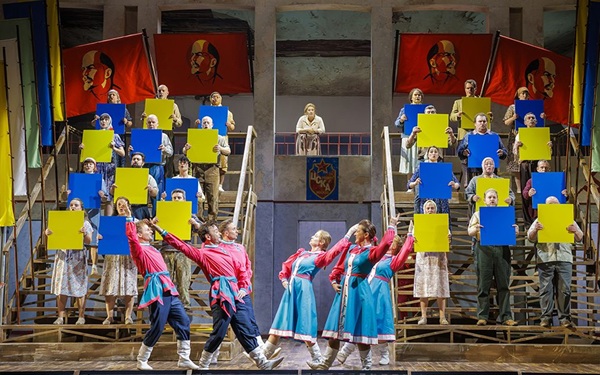
Patrick Nolan and his set designer Leslie Travers opened the production in a gymnasium in a small Soviet town preparing for the 1980 Moscow Olympics. The gymnasium remained constant: an all-purpose space with a simple wooden balcony and a pair of tiered wooden seating platforms that were moved as required. The first act with red flags bearing Lenin’s image and a hammer and sickle on display, all worked extremely well. Appearing throughout were banners and boards in yellow and blue, the colours of the Ukrainian flag, likely showing support for Ukraine in its war with Russia. In Act III the action moved forward some years to the time after the Soviet Union’s collapse in 1991.
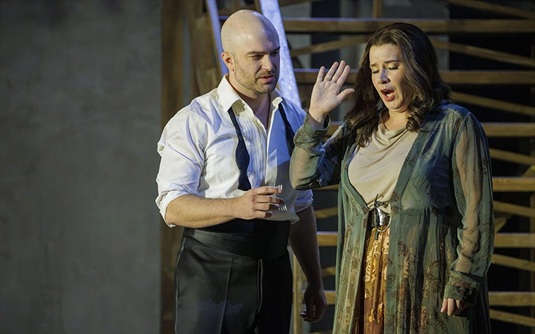
Elizabeth Gadsby’s costumes matched my vision of the Soviet era, the townspeople dressed in a mishmash of clothing that was certainly not stylish. I am not sure how Prince Gremin survived the Bolshevik persecution of the Russian aristocracy and nobility, which lasted until pre-Perestroika. In Act III the clothing became elegant, with black tie for men and glamorous evening gowns for women at the ball, reflecting the substantial reforms that followed Perestroika and the advent of the new mega-rich.
American baritone John Brancy impressed in the title role, committing fully to a convincingly arrogant and rakish Onegin. Though stretched at times, Brancy’s cleanly produced baritone proved effective and durable. My star of the show was Verity Wingate in the role of heroine Tatyana, so splendidly dressed by Elizabeth Gadsby. Wingate was a convincing singing-actor of both Tatyana the teenage girl and Tatyana the classy and mature woman. She demonstrated impressive breath control, and I relished the British soprano’s depth of expression together with such striking projection. In Tatyana’s famous and demanding ‘Letter Scene’ Wingate was simply outstanding.
From Katowice in Poland, tenor Kamil Bień demonstrated his quite bright and attractive voice, acquitting himself well as an impetuous and passionate Lensky. Chinese mezzo-soprano Jingwen Cai sang Olga Larina, portraying her as more outgoing and impulsive than her older sister Tatyana. Cai did all that was asked of her and used her voice to satisfying effect.
Standing out like a beacon was the commanding Chorus of Opera North. Especially notable was its unity while from its wide dynamic range it was able to produce real power.
Conductor Garry Walker excelled keeping everything together tautly with the Orchestra of Opera North responding with spirit and commitment. I must mention the many glorious solos played by the orchestra principals.
Director Patrick Nolan and his designers have created a thoroughly worthy new production, reimagining Eugene Onegin in the years surrounding Perestroika.
Michael Cookson
Featured Image: Opera North’s Eugene Onegin © James Glossop
Cast:
Eugene Onegin – John Brancy
Vladimir Lensky – Kamil Bień
Madame Larina – Hannah Mason
Tatyana Larina – Verity Wingate
Olga Larina – Jingwen Cai
Prince Gremin – Joshua Bloom
Monsieur Triquet – Florian Panzieri
Filipyevna – Claire Pascoe
Creatives:
Stage Direction – Patrick Nolan
Set designer – Leslie Travers
Costume designer – Elizabeth Gadsby
Lighting designer – Malcolm Rippeth
Choreographer – Maxine Braham
Chorus master – Anthony Kraus