
 United States ‘Royal Illuminations’ – Various: Julia Bullock (soprano), Cleveland Orchestra / Dame Jane Glover (conductor). Mandel Concert Hall at Severance Music Center, Cleveland, 12.11.2026. (MSJ)
Handel – Water Music Suites Nos.2 & 3; Music for the Royal Fireworks
Britten – Les Illuminations, Op.18
Stacy Garrop – Spectacle of Light
‘Splendor’ was the operative word for this splendid concert that unexpectedly paired Handel and Britten. While the two might not often be seen as program-mates, it proved a deft choice. Bookending the concert were suites from George Frideric Handel’s Water Music and Royal Fireworks, both entertainments commissioned by the English king from his most renowned composer. In between came visionary fireworks of a different sort, from Benjamin Britten and Stacy Garrop.
Heard on this occasion were the second and third suites from Handel’s Water Music, a collection of dances and airs written for a barge party for King George I and his retinue. Like a master pop tunesmith, Handel knew how to write a melodic hook and these pieces are full of them. In reality, it is an 18th-century party mix, the dances as addictive as any pop music today. But at the same time, Handel was utterly aware of the status of his audience, and he managed to make these tunes the very essence of the regal Georgian style of the period. That, combined with the fact that Handel was the sort of genius who could write a melody in a way that sounded like unfolding conversation, full of glimmers and shadows, makes the Water Music a genuine masterpiece.
The D major Suite, the second, was replete with brilliant brass exchanges and timpani flourishes. The more intimate third suite in G major replaced the brass and percussion with flute and recorder, allowing for greater intimacy. Dame Jane Glover’s handling of the pieces was lithe and pliant with, for once, a Lentement that remembered to dance. She solved the issue of the third suite not having a grand ending – these were modular dances, made to be taken in various orders and/or be repeated – by reprising the Rigaudon as a festive finale. It is as good a solution as any other that I have heard.
While Benjamin Britten wrote with an intense, post-Mahlerian sinew, his early song cycle Les Illuminations was, well, illuminating in the context of this program. Handel conjures the baroque flair of his age, but Britten was conjuring the surreal, hallucinogenic flair of poet Arthur Rimbaud’s imagination. Rimbaud was a child prodigy (and enfant terrible) in late-19th-century France. The spectacular burnout of his affair with poet Paul Verlaine helped fuel a frenetic outpouring of visionary poems from the teenage Rimbaud, including the ones selected for this Britten cycle. Rimbaud’s visions include spectacular descriptions of self-proclaimed royals, indigenous people from around the world, mythological figures, tricksters, demons and more. It turns out that this ‘savage parade’ of imagery is its own sort of baroque flair, with Britten’s string trills and glissandos looking forward to the fireworks to come later on the program.
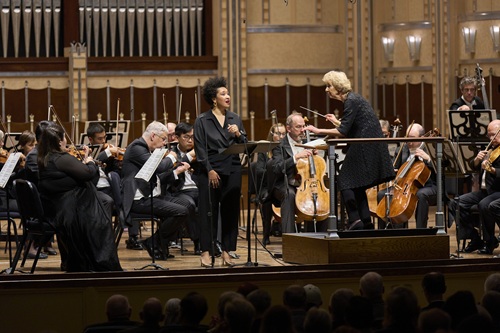
The soprano soloist was the marvelous Julia Bullock, who deployed Britten’s demanding vocal lines with gorgeous tone and commanding poise. Her absolute immersion in the material was further demonstrated by the remarkable fact that the texts in the program came with Bullock’s own annotated translations of Rimbaud’s originals. Speaking as a poet and longtime reader of the standard translations of Rimbaud, I can only salute Bullock’s literary prowess: I would rank these translations as better than any I have previously seen. Perhaps it is her musical background that gives her an edge in capturing the music of Rimbaud’s voice while clarifying the dense counterpoint of imagery and suggestion. The performance was spectacular, from the whirring opening to breathtaking moments like the suspended poise of the third song, ‘Phrase,’ to the raw sensuality of ‘Antique’ to the chilling closing. Glover was with Bullock for every twist and turn, and the Cleveland Orchestra strings blazed, including eloquent solos from first associate concertmaster Elizabeth Fayette and principal cellist Mark Kosower.
After intermission came a welcome chance to hear more music by Stacy Garrop, an Ohio-born composer previously covered here when the glorious Philadelphia-based choir The Crossing performed Garrop’s hypnotic and hallucinogenic A House Besieged during a tour stop at the Cleveland Museum of Art (review here). On this occasion, the Cleveland Orchestra performed Garrop’s short but eventful Spectacle of Light, itself inspired by an etching of the original fireworks event for which Handel’s Royal Fireworks Music was written. While busy evocations of pyrotechnics were part of the work, what was remarkable was the uncanny balance Garrop struck between brilliance and darkness, whether mischievous or more wistful. References to the Handel to come were woven into the music without relying on the Handel quotes for its expressive interest. Unexpectedly, the piece ended with an elusive glissando from the violins flying up and disappearing like a spark.
Then came the Handel Fireworks Music itself, with a full complement of winds in addition to the strings and timpani, including a delectable contrabassoon growl to underline everything. Glover kept tempos moving but also unfolded the full splendor of the orchestra’s tone, a dazzling golden wall of sound. Elements of historically-informed playing style were present, such as dovetailed phrase endings and hard-stick timpani, but Glover kept details in relation to the glory of the big picture, an irrefutable reminder of both Handel’s greatness and of the value of keeping baroque music in the repertory of modern orchestras.
Mark Sebastian Jordan