
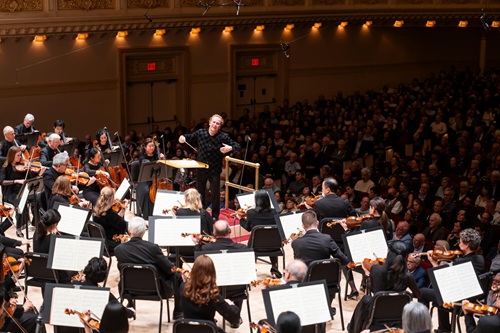
 United States Various: Philadelphia Orchestra / Yannick Nézet-Séguin (conductor). Stern Auditorium, Carnegie Hall, New York, 13.10.2026. (ES-S)
Webern – Im Sommerwind (Idyll for Orchestra)
Julia Wolfe – Liberty Bell
Mahler – Symphony No.5 in C-sharp minor
On Tuesday night, Yannick Nézet-Séguin launched his season-long cycle of Mahler symphonies at Carnegie Hall. The Philadelphia Orchestra joined him for the opening concert, with the Vienna Philharmonic and the Metropolitan Opera Orchestra scheduled to perform other symphonies under his baton later in the season.
Nézet-Séguin began the Trauermarsch of Mahler’s Fifth Symphony with dramatic urgency, establishing a measured tread through sharply articulated rhythms. Principal trumpet James Vaughen delivered the opening fanfare with a commanding, firmly focused tone. As the movement progressed, however, the conductor at times slowed the tempo further, despite the score’s Nicht schleppen (Do not drag) indication, somewhat diminishing the movement’s forward momentum.
The second movement followed attacca, its stormy turbulence interrupted by moments of lyrical repose. Here, the Philadelphia Orchestra’s formidable power and full-bodied sound came to the fore, especially in the resounding brass chorale that prefigures the one in the finale. The slower passages, however, tended to linger, affecting the movement’s overall continuity.
The expansive Scherzo, with its shifting Ländler and waltz rhythms, could have benefited from greater buoyancy and assurance in its dance character. Nézet-Séguin clearly delineated the movement’s contrasting episodes, although individual instrumental entries were not always equally precise. Jennifer Montone’s prominent, almost concertante horn interventions, too, might have had a touch more éclat.
Nézet-Séguin took the Adagietto at a leisurely pace, bringing out the finer details of its texture, though some transitions between phrases did not fully capture its subtle shifts in color and expression. The Philadelphia cellos were particularly affecting, their rich sonority and sensitive phrasing standing out throughout the performance.
In the Rondo finale, Nézet-Séguin favored speed and sheer orchestral power, generating considerable excitement while leaving less room for the score’s metaphysical dimension. The intricate contrapuntal strands remained distinct even at the briskest tempos, though their gradual convergence seemed driven more by rhythmic momentum than by a sense of inevitability. The return of the brass chorale, first heard in the second movement, was imposing, but its triumph registered more as a display of orchestral brilliance than the hard-won culmination of the symphony’s dramatic trajectory.
The first half of the program was devoted to a pair of shorter pieces. Composed in the summer of 1904, a few months before Mahler’s Fifth Symphony was first performed, Anton Webern’s Im Sommerwind is an orchestral idyll in a lush late-Romantic idiom indebted to Richard Strauss and Mahler. One of his last works before he began studying with Arnold Schoenberg, it received a warm, finely shaded reading from Nézet-Séguin who brought a delicacy to its luxuriant textures that hinted at the composer’s mature style. Chromatic harmonies created an undercurrent of tension beneath the pastoral surface, and the climactic waltz-like passage emerged organically. Rediscovered in 1961 and premiered the following year by the Philadelphia Orchestra under Eugene Ormandy, it remains a bozzetto: skillfully crafted but more revealing of Webern’s influences than of his emerging individuality.
Julia Wolfe’s Liberty Bell, co-commissioned in part by the Philadelphia Orchestra and Carnegie Hall, received its New York premiere at this concert. Inspired by Philadelphia’s famous cracked bell, silent for nearly two centuries, the work gives it a new voice rather than attempting to reproduce its original sound. ‘Music is my way of adding to the clamor’, Wolfe writes in her program note. Over some 12 minutes, competing rhythmic patterns accumulated across the large orchestra, punctuated by the striking resonance of metallic percussion. Written for the 250th anniversary of American independence, Liberty Bell presents liberty as an unfinished struggle, a compelling idea that proved less persuasive in its musical realization. As in Nézet-Séguin’s Mahler, impressive orchestral effects did not entirely compensate for a less convincing sense of musical development.
Edward Sava-Segal