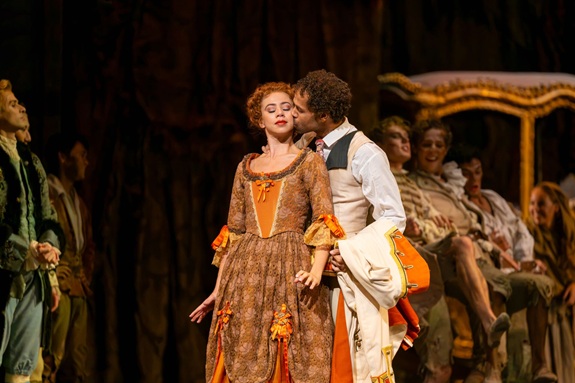
 United Kingdom Kenneth MacMillan’s Manon: Dancers of The Royal Ballet, Orchestra of the Royal Opera House / Koen Kessels (conductor). Broadcast live (directed by Ross MacGibbon) from the Royal Opera House, Covent Garden, London, 27.10.2026 and seen at Everyman Cinema, Chelmsford, Essex, 3.11.2026. (JPr)
When coming back to Sir Kenneth MacMillan’s Manon I do tend to repeat myself both about its background and – having checked recently – about the performances of some leading couples. The production is now in its 53rd year and I first saw it in 1980 (how many others commenting on this revival saw it as long ago as that?). Creating the roles of Manon and Des Grieux in 1974 were Antoinette Sibley and Anthony Dowell and I first saw Lesley Collier and Stephen Jefferies. Of course I have seen it several times since then, both at Covent Garden or more recently at the cinema (2014, 2018, 2024 and now).
Introduced by the urbane Petroc Trelawny and the charming (but always slightly chaotic) Dame Darcey Bussell, as ever there was a lot of interesting background information in the films and interviews we were shown to accompany this live relay. What I took away most of all was how Kenneth MacMillan focussed on how well the roles could be acted and as Kevin O’Hare, director of The Royal Ballet, explained ‘He really wanted us to be natural, real people on stage. So even when we’re being a prince or whatever, a fairytale, we’ve got a naturalism that I think he gave us through the ballets that we do, like Manon, like Romeo and Juliet’.
Manon is Yasmine Nagdhi’s first role after her maternity leave following the birth of her son in December 2025. It was quite poignant when Naghdi made clear her concern about whether she would as good as before (she is, if not better!) having mused on motherhood and the precarious nature of life as a ballerina. However, nothing we heard was better than when Lady MacMillan said in 2014 how she was so often asked who her favourite Manon was that she got so fed up and jokily answered that all the movement was ‘worked out on me at home in the nude’ … and it was published!
If you are not aware, the story of Manon originated in Abbé Prévost’s 1731 eponymous novel. She is a teenage woman who struggles to choose between the genuine love of penniless student Des Grieux, or the loveless luxury offered by Monsieur G.M., a rich roué. It is 18th-century Paris populated by the rich and powerful with an inordinate interest in the lives of women on the fringes of respectable society; or the poor and destitute whose only escape routes from their plight is criminality or prostitution.
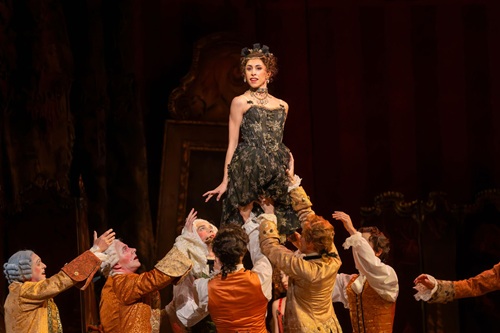
The riches-to-rags story is highlighted in the late Nicholas Georgiadis’s designs with an almost ever-present backdrop of rags which contextualises the opulence and finery we will see acted out before them in the first two acts. There are beggars scrounging money where they can and courtesans parading around and available to those with the deepest pockets. The three-act narrative ballet begins in the bustling courtyard of an inn near Paris and ends in the murky swamps of Louisiana. The rather uncomfortable, misogynistic tale clearly greatly appealed to Sir Kenneth with the thieving and cheating, love and lust, sex (consensual or otherwise), jealousy, murder, wrongful conviction and the far-from-happy ending.
The score remains a problem because although Manon is choreographed to music by Massenet – originally arranged by Leighton Lucas in collaboration with Hilda Gaunt and subsequently re-orchestrated by Martin Yates – it does not include a note from the composer’s opera of the same name. On this occasion, the hotchpotch of Massenet melodies – which includes the yearning Élégie in each of the three acts – has never sounded so inappropriately cheerful as it occasionally now did with all the cavorting in Act I and partying in Act II. Also, I noticed more than ever the oddly Spanish-inflected moments in the first two acts. I am led to believe that the ecstatic music the end of Act III might reflect triumph (of true love?) over adversity. Yet, Manon’s downfall has been so harrowing that we need to truly experience in what we see and hear the use and (sexual) abuse Manon has suffered from the men – Des Grieux apart – in her life. Through the excellent sound system of the Everyman Cinema the Orchestra of the Royal Opera House gave an outstanding account of the – now seeming lusher than ever – music. Music director Koen Kessels’s account was generally beautifully judged (though I wondered if he indulged the leading dancers just a little at times?). Again, there was another wonderfully evocative cello solo between the scenes in Act III from Christopher Vanderspar.
I am reminded of how for the ballerina dancing Manon she is ‘an ingénue in Act I, queen of the demimonde in Act II, or destitute convict in Act III’. The returning Yasmine Naghdi encompassed the heart-wrenching emotional journey captivatingly. On her arrival in Act I she was not a wide-eyed innocent and quickly understood her ability to entice men and reel in a wealthy protector. There was a fluid weightlessness to Naghdi’s dancing which was unforced and natural throughout MacMillan’s demanding choreography with all its extravagant balances, lifts, solos, duets, and pas de trios displaying Manon’s passion, depravity, and physical exhaustion. Naghdi with her cropped hair and ragged clothes in the last act was unrecognisable from the woman wearing the furs and jewels in Act II. Whether revelling in being alone with Des Grieux in his bedroom or having to endure the brutality of Bennet Gartside’s lecherous Gaoler at the Louisiana penal colony, Naghdi’s interpretation was as compelling as any I have seen in the past.
This of course was helped by some of Ross MacGibbon’s camerawork which revealed in close-up what a fine dancer and actor Naghdi is. It also showed up that while the long-limbed William Bracewell could portray the emotions Des Grieux was going through and has a graceful ‘princely’ technique when dancing, he was entirely incapable, to me, of acting and dancing at the same time. This is more apparent on a large cinema screen than it would be to anyone sitting in the amphitheatre at Covent Garden. Des Grieux is a difficult role combining significant technical challenges with complicated partnering and believable acting. While Bracewell was visibly distraught when Manon died at the end of the ballet, too often he had stopped acting when he needed to dance instead of allowing it to inform his movement. Bracewell’s two major solos looked exactly the same; though he was professing love in Act I and pleading for Manon’s affections in Act II. It is not the first time I have commented like this over the years on a Royal Ballet male principal and it must be a coaching issue.
Joseph Sissens, a true dance-actor, was outstanding as Lescaut. This is a thoroughly despicable character who gets a peculiar comic drunk scene in the second act as he attempts to partner Leticia Dias, equally good as his provocative mistress. Lescaut later gets to engage in a swordfight, lifted straight from MacMillan’s earlier Romeo and Juliet. Thomas Whitehead was Monsieur G. M. and had the haughty mien of someone used to getting whatever he wanted. Alone with Manon he loses control and can hardly keep his hands off her with some distasteful-looking stroking and foot fetishism. Christina Arestis also stood out as an unscrupulous Madame with the air of sophistication.
In its 323rd performance by The Royal Ballet at Covent Garden, Manon remains a richly textured ballet, with those around the edges of the stage almost as important as the principals in creating a proper background for the tale of two doomed lovers. The company were on their best form with no one at the fringes appearing to switch off and all dancing with admirable commitment in the ensemble moments.
Jim Pritchard
Featured Image: Leticia Dias (Lescaut’s Mistress) and Joseph Sissens (Lescaut) © Mihaela Bodlovic
Credits:
Choreography – Kenneth MacMillan
Music – Jules Massenet (orch. Martin Yates, originally compiled by Leighton Lucas with the collaboration of Hilda Gaunt)
Designer – Nicholas Georgiadis
Lighting designer – Jacopo Pantani
Staging – Artistic Supervisor for the MacMillan Estate Laura Morera
Staging director – Christopher Saunders
Cast:
Manon – Yasmine Naghdi
Des Grieux – William Bracewell
Lescaut – Joseph Sissens
Monsieur G. M. – Thomas Whitehead
Lescaut’s Mistress – Leticia Dias
Madame – Christina Arestis
The Gaoler – Bennet Gartside
Beggar Chief – Daichi Ikarashi
Courtesans – Olivia Cowley, Mariko Sasaki, Lara Turk, Julia Roscoe~Gentlemen – Luca Acri, Leo Dixon, Joonhyuk Jun
Clients – Lukas B. Brændsrød, Brayden Gallucci, Philip Mosley, Aiden O’Brien, Christopher Saunders
Old Gentleman – James Hay
Artists of The Royal Ballet and Students of The Royal Ballet School