
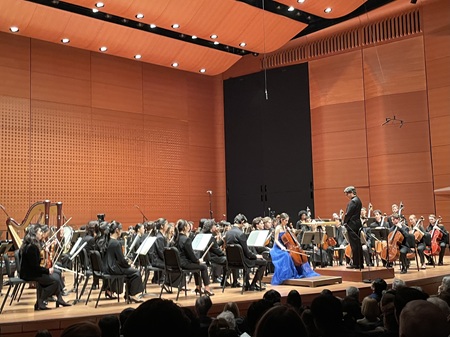
 United States Various: Nahar Eliaz (cello), Juilliard Orchestra / José Luis Gómez (conductor). Alice Tully Hall, Lincoln Center, New York, 14.11.2026. (DS)
Lera Auerbach – Icarus
Elgar – Cello Concerto in E minor, Op.85
Mahler – Symphony No.1, in D major, ‘Titan’
The Juilliard School Orchestra’s 2026-27 season is an exciting one. With new compositions that can appeal to broad audiences and guest conductors who bring ensemble energy to exceptional musicians, one wants to catch them all. Thus far, Teddy Abrams and Gemma New have conducted the musicians while a recent performance featured José Luis Gómez, Music Director of the Tucson Symphony Orchestra. His ability to shape stories through music and his clarity of interpretation made for an excellent match with Juilliard’s attentive, ambitious musicians.
They opened with Juilliard Composition alumna Lera Auerbach’s Icarus – a fantastic tone poem that grasps the themes of freedom, hubris and grief in a way that would leave anyone clutching their heart. With a propulsive foundation drawn from fast opening rhythmic figures, horns evoke the brashness and tense urgency surrounding this well-known father and son. When the mood of possibility and the elixir of freedom (they were escaping King Minos’s labyrinth on Crete) begins to fracture, a lamenting violin solo, performed by concertmaster James Birch with a gorgeous pure sound, signals the fall with a gradual descent into the symbolic expression of a single drifting feather. This fragile voice is overtaken by the orchestra’s thunderous descent, punctuated by bells and sliding sound textures which make the catastrophic fall feel positively devasting. With a vast orchestration (including not just one but two harps) that would match the evening’s performance of Mahler’s First Symphony, Auerbach’s work also featured instrumental sections in brightly colored dialogue that Gómez led with structured responsiveness to form: a cello and harp passage remains particularly memorable.
The evening offered one musical success after another. The hall was packed with people to hear Nahar Eliaz play Elgar’s Cello Concerto; she won this performance opportunity at the Juilliard Cello Competition Finals on 16 October. Despite it being a work that carries the storied weight of its famous performers, Eliaz was not intimidated and produced a breathtaking interpretation that was discerning and personal. The precise timing in her left-hand articulation combined with a variety of bowing textures that ranged from Baroque-inflected lightness to contemporary virtuosic power drew out the modern fragmentation of the concerto without sacrificing its sweeping melodic lines. In fast passages, Eliaz’s sound carried a hummingbird-like energy that repeatedly drew the ear closer. And in the quiet, ponderous moments, Gómez brought the orchestra down to the soloist’s intimate level, preserving a remarkable sense of shared space that allowed Eliaz to sustain the musical details she so carefully configured for her cadential moments. Together, orchestra and soloist matched colors and textures to great effect.
Mahler’s Symphony No.1 closed the evening with a rainbow of sounds. Echoes from Auerbach’s opening work also appeared, like the charged sections of col legno that added rhythmic tension and physicality to both works. Gómez set up the ‘Titan-like’ chapters unfolding, and the narrative line that he pulled relied a great deal on juxtaposition of tempi, sometimes restraining sections even to exaggeration. Players followed him steadily and had clearly taken note of his guidance on musical decisions: strings always matched on the amount of bow use, winds articulated melodic lines with set phrasing and solid entrances. The effect of having rehearsed these details made for a rousing rendition of this monumental work which is often the gateway piece separating the novice orchestral player from the soon-to-be expert. We were privileged to watch these musicians take that leap.
Daniele Sahr