
 United States ‘Rouvali Conducts Strauss’: Steven Banks (soprano, alto saxophone), Cleveland Orchestra / Santtu-Matias Rouvali (conductor). Mandel Concert Hall at Severance Music Center, Cleveland, 21.11.2026. (MSJ)
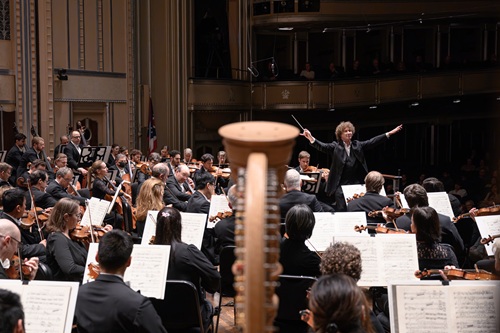
Childs – Diaspora: Concerto for Saxophone and Orchestra
R. Strauss – Ein Heldenleben, Op.40
Encore: Banks – ‘One Night Alone in Hilversum’
Much speculation has circled around the question of who will become the next music director of the Cleveland Orchestra. Just a few weeks ago, Czech conductor Petr Popelka stated that he regarded his two weekends with the orchestra as a job interview. Consensus is that he scored high on part of his interview (a richly expressive Brahms Ein deutsches Requiem) but didn’t do as well on the other part (an underpowered Mahler 5). An interview with Finnish conductor Santtu-Matias Rouvali quickly followed the Popelka article, even though Rouvali’s visit was weeks away, reminding everyone that he was under consideration as well. His two weekends are spread out, the other not coming until February. The immediate question is, how did his first interview go?
To look at his sheer assurance on the podium and his total control over the performance, you would think he already has the job. Richard Strauss’s memoir, Ein Heldenleben (A Hero’s Life), is not an easy piece to pull off in performance. Too much indulgence and the piece sags, but too streamlined and it stops being fun. Too much energy in the early moments of the work and it runs out of steam later. Indeed, the work is so notoriously problematic, it is all too easy to write off the piece as flawed. After forty-plus years of listening to performances and recordings, I had largely relegated the concept of a perfectly satisfying Heldenleben as falling in the same category as stories of the Loch Ness Monster or, to use an Ohio favorite, Bigfoot.
Against all odds, Rouvali went out and caught a Bigfoot. I was concerned at the opening of the work, which started almost casually and utterly without any attempt to display excess muscle or energy. But that was a shrewd choice by Rouvali who knows that his natural exuberance would begin flexing bit-by-bit, with attention to a particular phrase here, a little extra oomph in an accent there. Before long, the piece was swaggering along but without self-conscious effort. It didn’t need it. That confidence, combined with the stellar playing of the Cleveland Orchestra, resulted in a spacious but rollicking opening paragraph.
When the carping of the critics began, depicted by Strauss with nagging woodwinds and solemnly moaning low brass, Rouvali gave the Cleveland winds room to characterize their petulance with delicious humor. Accents in the trombones were knife-edged, sketching out Rouvali’s frame of reference for this performance as both genuinely amusing and potentially serious, a balance that proved key to the work’s later pages.
Then came one of the score’s big danger zones: the wife! Richard Strauss self-aggrandized his life with this autobiographical score, especially in the portrayal of his wife Pauline in the long concertante section which is nearly like a full violin concerto hidden away in the middle of this giant quasi-symphony. Pauline can be perceived as, shall we say, wordy, and all too often it feels like this section is never going to end.
Enter Elizabeth Fayette, a fantastic addition to the orchestra this year as first associate concertmaster. This means she sits in the concertmaster position quite often for concertmaster Joel Link is also first violinist of the Dover Quartet, requiring him to spend a portion of every year performing with them. This left the Heldenleben solo for Fayette, and she didn’t waste the opportunity. I have seen great actors perform Hamlet with less psychological acuity than Fayette brought to bear on Strauss’s portrait of his beloved, if high-strung, wife. A danger of the solo is that it regularly careens from impetuosity to tenderness and everywhere in between, sometimes within seconds. But in this case, Rouvali stepped back and gave Fayette all the space she needed to bring the music to life which she did to a degree I have frankly never before heard. Nothing sounded like pattern-spinning, and she managed to make every gesture of the long solo sound emotionally motivated. At the height of Pauline’s anger, one might have feared Fayette was about to saw her instrument in half, but seconds later she pulled the solo back into a flirty coyness that was completely believable. For once, this extended segment of the work didn’t feel too long: it drew the listener in and proved that Strauss didn’t make a mistake. Past performers of the solo haven’t brought it to the level that Elizabeth Fayette does.
That includes past performances in Cleveland. Seven years ago, Franz Welser-Möst did an overly sleek performance, the equivalent of a roller coaster ride where someone is constantly warning you to keep your arms down and hands inside the car. Christoph von Dohnányi sounded downright embarrassed by the battle sequence in his Decca recording, and Lorin Maazel’s CBS recording from the early eighties loses focus toward the end. No such problems here: while Rouvali made no attempts to exaggerate the battle sequence, he didn’t pull any punches, reenergizing textures after the intimacy of the love scene. And the performance did not flag toward the end, either.
The next section of the work is another vulnerable spot: Strauss goes into ruminative mode and quotes some of his own greatest hits. Again, instead of trying to rush through it, Rouvali tucked into the quotes with relish, completely committing to Strauss’s indulgence while at the same time keeping it poised and moving forward, making it feel more like the composer is asking himself, ‘Here’s what I’ve done. Was it good enough?’ Handled like this, it was affecting and felt emotionally compelling. With that solid foundation, Rouvali was able to move without haste into the closing section which, for once, felt like an earned valediction. The harmonic progressions seemed to expand the focus outward to a cosmic level so that the work’s sunset flare was moving and all-encompassing. It was a performance met exultantly by the audience, with a ringing volley of cheers rightly reserved for Elizabeth Fayette. It was a performance that, frankly, restored my faith in a work I had grown doubtful about, and for that I can salute Rouvali with gratitude.
Before all that came a first half that was a triumph. The Cleveland premiere of Diaspora, a concerto for saxophone and orchestra by Billy Childs, was a tour de force by Steven Banks, with keen support from Rouvali and the orchestra. The work depicts the forced diaspora of Africans in the Atlantic slave trade but does so with an emphasis on musicality. The storytelling is clearly there, but one could hear this piece without knowledge of any program and find it effective and powerful. The first movement, Motherland, starts with the soprano saxophone riffing over rhythmical marimba patterns and remains exultantly virtuosic, even as darker disruptions amass. After a dissonant, cutting chord by the orchestra, the saxophone launches into a despairing cadenza that brings the movement to a dark close.
The second movement, If We Must Die, depicts the horror of the Middle Passage, when captured African slaves were shipped across the Atlantic Ocean in appalling conditions. Interestingly, the concerto takes an unusual but ingenious tack in this movement: as the orchestra plays a somber introduction, the soloist puts down the soprano saxophone and takes up an alto saxophone. When he begins playing, it is as if the previous solo voice has now grown hoarse and bruised. The movement builds to a painful split-tone climax, followed by frenetic struggles.
If We Must Die ends with another remarkable touch. Banks stepped over to the rear corner of the stage and played a tender passage accompanied only by Paul Wyse on the piano. This passage hit hard because the bulk of the previous movements ran on a relentless, non-stop virtuosity. Here, finally, the saxophone was allowed to sing, and sing it did. That delayed lyricism felt earned.
This flowed into the third movement, And Still I Rise, which moved from hymnlike material to martial drive, with Banks changing back to the soprano saxophone – programmatically finding his original voice again – for the thrilling close of the work. Audience response was an immediate explosion of cheers, for both Banks’s brilliance and Billy Childs’s compelling writing. Rouvali and the orchestra kept with Banks every step of the way in this moving and important new work.
Banks responded to multiple curtain calls with an encore of his own composition, ‘One Night Alone in Hilversum’, which depicts a soloist’s life on the road, combining a bereft meditation with a vigorous, if questioning, riff.
As for Rouvali’s job interview, you can’t do much better than catching Bigfoot. Now we wait to see what he does with Shostakovich’s masterful but enigmatic Symphony No.15 in February.
Mark Sebastian Jordan