
 United States Fresno International Cello Festival – Closing Gala Concert: Gary Hoffman, Jennifer Kloetzel, Wesley Baldwin, Attila Pasztor and Thomas Loewenheim (cellos), Fresno Junior and Senior Cello Ensembles, Fresno State Symphony Orchestra / Thomas Loewenheim, Emilio Colón and Cara Elise Colón (conductors). Fresno State School of Music Concert Hall, Fresno, 14.11.2026. (LV)
French Folk Song – ‘Les Bossus’ (arr. Cara Elise Colón)
Bizet – Themes from Carmen (arr. Cara Elise Colón)
Johann Strauss I – Radetzky March (arr. Cara Elise Colón)
Piazzolla – Suite del Ángel
Tchaikovsky – Variations on a Rococo Theme, Op.33
David Popper – Requiem for Three Cellos, Op.66
Bloch – Schelomo
There are many kinds of musical accomplishments. The closing gala of Fresno State’s International Cello Festival made a persuasive case for one too easily overlooked: creating a musical community in which aspiration is not a slogan but a shared, audible fact.
I drove four hours from Los Angeles for the concert, unsure what to expect. Preceded by three days of master classes, workshops and ensemble rehearsals, the evening began with an army of more than 50 young cellists, aged from about nine years through their teens, playing arrangements of a French folk song, themes from Carmen and the Radetzky March. There were moments of the inevitable unevenness of a large youth ensemble. But that was not the lasting impression: what registered was concentration, excitement and collective purpose.
That spirit framed the festival’s more ambitious work. Thomas Loewenheim, the festival’s founder and the conductor who has rebuilt Fresno State’s orchestral life since arriving 20 years ago, took the solo part in Tchaikovsky’s Variations on a Rococo Theme and played with directness and feeling. The Fresno State Symphony Orchestra, conducted by yet another premiere cellist, Emilio Colón, responded alertly, full of life and with particular commitment in the work’s shifts of color and tempo.
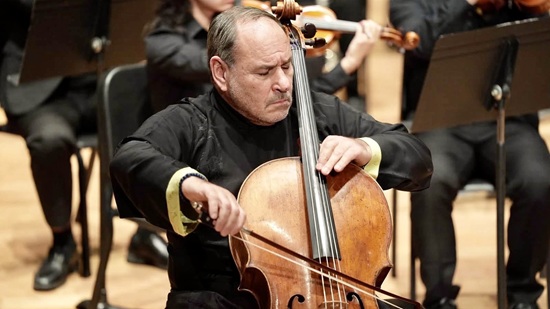
Gary Hoffman’s account of Bloch’s Schelomo was the evening’s summit. Hoffman is a player of extraordinary command but his authority never became self-regard. His use of weight, color and rhetorical timing gave every phrase an urgent inward pressure. The cello could darken into a near-vocal lament, then rise with startling clarity above the orchestra. Schelomo is often treated as a vehicle for the soloist’s eloquence, but its larger dramatic character came through strongly here – the cello as speaker, questioner and wounded witness, never merely an object of display.
Conducted by Loewenheim, the orchestra met him with passion and attention. Hoffman’s response to Bloch’s sorrowful message, especially in this time and place, seemed to extend naturally into his collaboration with the students. Hearing an artist of his caliber at such close range was a privilege; watching him listen and respond to the orchestra made the encounter more than a guest appearance. When he left the stage, his face was beaming. He appeared to have been as energized by the students as they had been by him.
Fresno State’s music program, now officially a School of Music, has nearly 300 undergraduate and graduate students and is celebrating its centennial this year. The string program is thriving, and former students are leading local school programs which include three youth orchestras and the Fresno Orchestra Summer Academy. An extensive university music library and the School of Music’s own performance collection provide an unusually rich foundation for that work.
Driving back to Los Angeles after the festival, I thought of the young cellists who had played in an orchestra and heard an idol and been transformed by the experience. Fresno had reminded me of the dreams music can make real.
Laurence Vittes