
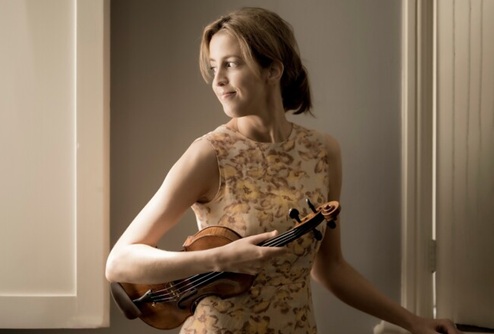
 United Kingdom Sibelius, Hindemith, R. Strauss: Vilde Frang (violin), London Philharmonic Orchestra / Robin Ticciati (conductor). Royal Festival Hall, London, 18.11.2026. (JR)
Sibelius – King Christian II Suite, Op.27
Hindemith – Kammermusik No. 4, Op.36 No.3
R. Strauss – Ein Heldenleben (A Hero’s Life) Op.40
Sibelius composed his incidental music for the play King Christian II written by his Swedish friend Adolf Paul in 1898. Initially he provided three short instrumental pieces plus a song, all for small orchestra. Later he decided to add three further pieces, this time for larger orchestra, and eventually these came together to form a five-movement concert suite. This is early Sibelius, even though he was over 30 when he composed the work and it precedes all his symphonies. It is recognisably Sibelius even though his skill for inventing catchy themes had not yet fully developed.
A charming, romantic Nocturne starts the work, anticipating the composer’s First and Second Symphonies. Then comes a grieving, beautiful Elegy, for strings only, and then the Musette, a playful, jaunty dance imitating the sound of street musicians (including, so said the programme, a bagpiper! I didn’t hear anything resembling one). A stately Serenade follows, and the suite ends with a turbulent Ballade which depicts the ‘Stockholm Bloodbath’ of 1520 (In case you were wondering, this was a mass execution of one hundred Swedish nobles, bishops and citizens, all accused of heresy by the invading Danes). The work is underwhelming, though it had some interest, especially for lovers of Sibelius; the orchestra’s heart was not really in it.
And on to Hindemith: Dan Whitfield in the concert programme puts it in words I cannot think more apposite: ‘Hindemith has long suffered from a kind of affection deficit, with the court of public opinion awash with adjectives such as “astringent”, “bracing” and “cerebral”.’ Even passionate classical music-lovers are hard pushed to come up with naming more than one of his works: and it is usually his relatively popular and approachable Mathis der Maler. His eight Kammermusik miniature concertos are much less well-known. In this concert we heard No.4 for chamber-sized orchestra. Sadly, this five-movement work will have done little to significantly bolster the numbers of the Hindemith Fan Club. Despite Vilde Frang’s best efforts, which were considerable, the work does the listener few favours. Angular patterns, stern brass, and a brooding lament do not make for a crowd pleaser. It does not help that in the very fast and wild finale the thrilling tour de force by the soloist is played sotto voce. Vilde Frang rewarded our patience with the Hindemith with a delightful encore, the third movement from Ysaye’s Sonata No.1.
Richard Strauss’s lengthy tone poem Ein Heldenleben is almost certainly an orchestral autobiography, even if the composer occasionally tried to deny it. It oozes orchestral colour. It blew us away right from the outset, with the bombastic brilliance of its first main, sweeping theme. Then Strauss takes at swipe at music critics (how dare he!): the tubas belting out their four-note theme to ‘spell out’ the name of Strauss’s chief critic Doc-tor Deh-mel. Strauss changes the mood and woos his wife Pauline with a love song on solo violin (Leader Pieter Schoeman coming up trumps). The drums of the tempestuous Battle Scene brought us all to the edge of our seats – the offstage trumpets (a blemish can be forgiven) were judiciously placed. The bass drummer and two side-drums were given full rein to add to the excitement; followed by quotes from many of Strauss’s tone poems: the musical equivalent of a pub quiz. In the final chapter, we moved from bravado to serenity – Strauss’s Hero withdrawing from the world with a pastoral cor anglais theme, beautifully played by Sue Böhling. Benjamin Mellefont (clarinet) was, for me, the Man of the Match, with mellifluous playing; excuse the alliteration.
The orchestra, including nine horns and two glistening harps, clearly enjoyed being under Robin Ticciati’s clear direction; and Ticciati’s control of tempi, dynamics, phrasing and structure could not be faulted at any stage.
A very satisfying end to the concert indeed.
John Rhodes