 United Kingdom Wagner, Die Walküre: Soloists, Orchestre de l’Opéra national de Paris / Pablo Heras-Casado (conductor). Livestreamed (directed by Jérémie Cuvillier) from Opéra Bastille, Paris, 17.11.2026. (JPr)
Whatever you might have thought about Calixto Bieito’s Das Rheingold (review here) at least it might have had you thinking – as I did – wither this Ring? As we left them, Wotan and Fricka had put on their blue astronauts’ flight suits and I posited they entered the spaceship (possibly?) of a cybernetic hive-mind collective, like Star Trek’s Borg. Thoughts turned to what would follow after humankind had succumbed to the uncontrolled influence of AI, think the Terminator films. However, watching Die Walküre I was sadly disappointed with the over-familiar dystopian, post-apocalypse scenario with the idea that those in authority who have survived (Wotan and the gods?) impose strict control through heightened security.
The staging again mostly relies on the single set covered by a metal mesh grille, Sarah Derendinger’s eclectic video projections, and Michael Bauer’s strobe lighting (occasionally a lurid green) that often seems entirely random. The set clearly has a set of stairs going from floor to floor and Sieglinde and Hunding’s Act I flat is on the second floor on the right and Wotan’s Act II committee/living room is bottom left. So, it is now a building of sorts.
During the opera’s opening storm, images from myriad surveillance cameras are seen which show Siegmund almost base-jumping through a building before arriving at the strip at the front of the stage (where most of the action of this Ring actually takes place). He is battered and bloody, in a green sou’wester, wearing a gas mask and has a tank on his back like those used to spray pesticide (though others claim it is for oxygen). He encounters Sieglinde – battered and bruised herself due to physical abuse – brandishing an automatic weapon in a ramshackle flat, with war-torn curtains, a sapling in a pot and a hint of blood smearing it and the walls. Siegmund soon reveals the nasty wound on his abdomen. Most of the action is captured live and projected on the surrounding meshwork in close-up and black-and-white. Hunding arrives in the same protective gear as Siegmund bringing in a slaughtered ram (one of Fricka’s?) and his cruelty to Sieglinde is soon evident. There is no meal, no drugging of Hunding’s drink and soon Siegmund and Sieglinde get kitted-up and leave. Hunding just sits-up clearly tormented by something (just like Hagen will later in the Ring) before changing into a military uniform which has been on a mannequin at the side. There has been no sign of springtime nor a tree with a sword, indeed Nothung seems an afterthought and is just picked up from the floor. Siegmund and Sieglinde bed down on a grubby mattress while above Hunding takes his resentment out on the dead ram.
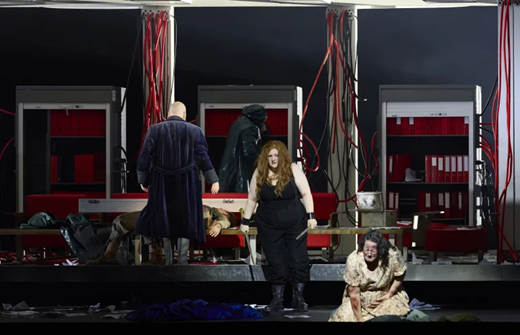
Act II opens with vivid blue, red/gold thermal camera slow-mo images, of men and hounds in pursuit of deer. Wotan’s abode has lots of red and black cables, is lined with cabinets (oddly filled with old-school box files of past heroes and not servers!), a long table, red chairs, two TV screens and obviously more security cameras for the close-ups. Wotan wears a long, dark-blue smoking jacket and has a risible robot dog as Brünnhilde rides in on her Grane hobby horse. Fricka strides in with platinum hair and in turquoise couture, the victim of a plastic surgery fetish (think Donatella Versace or Katie Price) and berates Wotan into agreeing Siegmund must die. As a result, the spear – which has been mounted as a trophy – gets broken into a number of pieces in Wotan’s despair. Brünnhilde will soon show how intrinsically she is frightened of Wotan. How constrained Wotan feels is revealed by him placing a belt round his neck, and on another occasion some cables he had pulled down. On ‘Das Ende!’ he threatens to punch Brünnhilde who herself is conflicted about saving Siegmund and strips down from her blue dress to a black jumpsuit.
When Sieglinde enters with the sword-less Siegmund she is obviously pregnant which make a nonsense of some of the ensuing libretto. When Brünnhilde threatens Siegmund, Nothung appears out of nowhere before she takes it off him. Now determined to save Siegmund, she snogs him. Wotan enters with the sword and breaks it before using it to apply the coup de grâce and dispatch Siegmund (who earlier had seemed to recognize Wotan as his father Wälse). Brünnhilde retrieves the sword from Wotan’s hand before he yanks down more cables.
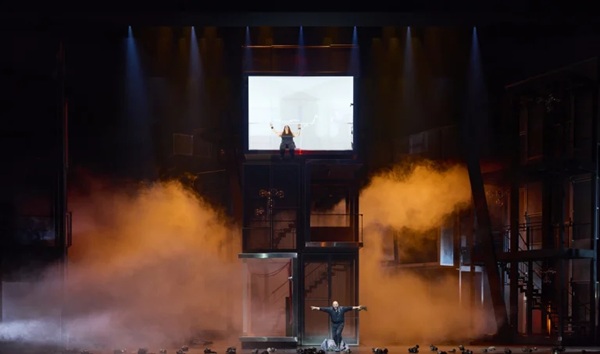
Before Act III began there was time for the audience to boo the return of the robot dog. The imagery goes into overdrive during the ‘Ride of the Valkyries’ from massed, formally dressed, uniform male and female androids as an audience (in the opera house?), old newsreels, to ending with the history of cinema – fantasy, horror and science fiction especially – almost flashing in monochrome before our eyes. Meanwhile the eight Valkyries (cyborgs in black and yellow spacesuits with two small green lights on their heads) are throwing bodies down from above while extra ones abseil to the floor. Surely Sieglinde realises by now her bulge is because she is pregnant and not simply the result of a big meal? Wotan picks up a naked sex doll for some reason as he accuses Brünnhilde. He turns out the lights of her Valkyrie sisters and they glitch. Brünnhilde has a knife and threatens Wotan this time herself but cannot go through with it; though soon he will again turn the tables on her. Weirdly Wotan starts putting rows of gas masks across the entire width of the stage. After acceding to the distraught Brünnhilde’s wishes she pummels Wotan on the back, and he bids her a final farewell (‘Der Augen leuchtendes Paar’) singing to one of the gas masks. (It is 2026 and we should not see a darkly-clad stagehand at the rear of the stage!) Brünnhilde is in a white plastic-lined room on the third floor and there is a lot of red ‘smoke’. Wotan’s flickering hands have conjured the flames and he dances amongst the gas masks while Brünnhilde on high smiles before slumping forward at the last minute.
So wither Bieito’s Ring? Well, this otiose Die Walküre did not get us anywhere despite the committed performances of some fine actor-singers. Tamara Wilson’s journey as the red-haired Brünnhilde has just begun. I am yet to be convinced that she is a natural stage animal. Nevertheless, this Brünnhilde began as a naïve, gauche and gawky daddy’s girl. Wotan quickly begins to take his exasperation out on her before Siegmund’s devotion to his sister clearly moves her and what Wotan’s truly wants for him has become clear. Wilson has a rich soprano voice and even if she didn’t take any risks with her Act II battle cry, she successfully expressed the emotions her character goes through.
Christopher Maltman is embittered from the get-go and because of his inability to accept his diminished authority it will be Brünnhilde who suffers most. Maltman’s voice has dramatic heft allied to a Lieder-like use of the text. There was a degree of tenderness to his farewell to Brünnhilde (‘Leb wohl’), as rather too late Wotan’s softens and surrounds her with magic fire that only a fearless hero can cross.
I was slightly disappointed by Stanislas de Barbeyrac’s Siegmund that was more forthright (‘Wälse! Wälse!’ resounded) and less lyrical than I was hoping for. Of course, the production is far from a romantic one, and this Siegmund has clearly been through the wars and de Barbeyrac acted that well. Equally from the start, Elza van den Heever’s Sieglinde was traumatised by the abuse she has suffered at Hunding’s hands; later visibly succumbing to guilt and fear. Her agile voice also encompassed pain, grief, despair and finally some hope, though she brought more angst to ‘O hehrstes Wunder’ than soaring triumph.
Günther Groissböck was the brutal, controlling Hunding whose violence might have been the result of PTSD. His vocal performance was a typically mannered one, but all the notes were there, if a touch harsh. Eve-Maud Hubeaux was frightening-looking, though strangely charismatic, as the domineering – in voice and portrayal – Fricka. Completing the cast the eight Valkyries were a spirited bunch and sang their warlike calls fiercely though it was difficulty to visually distinguish one from another.
The orchestra played solidly for Pablo Heras-Casado who had a strong grasp of the opera’s ebb and flow. From the opening storm onward, his conducting never lingered, remaining fleet-footed even in the more intimate, contemplative moments. Certainly, the concluding Magic Fire Music lacked nothing in orchestral colour and was incandescent, even if the stage picture wasn’t.
Jim Pritchard
Featured Image: Calixto Bieito’s Die Walküre final scene © Herwig Prammer/OnP
Creatives:
Staging – Calixto Bieito
Sets – Rebecca Ringst
Costumes – Ingo Krügler
Lighting – Michael Bauer
Video – Sarah Derendinger
Dramaturgy – Bettina Auer
Cast:
Siegmund – Stanislas de Barbeyrac
Wotan – Christopher Maltman
Hunding – Günther Groissböck
Sieglinde – Elza van den Heever
Brünnhilde – Tamara Wilson
Fricka – Eve-Maud Hubeaux
Gerhilde – Louise Foor
Ortlinde – Margarita Polonskaya
Waltraute – Marie-Andrée Bouchard-Lesieur
Schwertleite – Katharina Magiera
Helmwige – Jessica Faselt
Siegrunde – Ida Aldrian
Grimgerde – Marvic Monreal
Rossweise – Marie-Luise Dressen