
 United Kingdom ‘A Christmas Miracle’: Hilary Cronin (Angel Gabriel), Andrew Watts (Herod), Besu Burns-Tucker (King Iasper), Idunnu Münch (King Mechior), Robert Gildon (King Balthasar), Nick Mercer (Preco), Angela Tait (Mary), Alexander Semple (Ioseph), Jubilee Opera, Alde Vallet Academy, Angels’ Chorus, Britten Pears Arts Choirs: Cuckoos and Sparrows, Ensemble X, Eliza Forgiel and Polly Forgiel (fiddles), Walland Express (handbells), Wooden Roots (drummers), John Andrews (conductor), Ben Vonberg-Clark (choir director), Jodi Rabinowitz (lighting designer), Ruth Paton (designer), Frederic Wake-Walker (director). St Bartholomew’s Church, Orford, Suffolk, 20.11.2026. (PC)
Errollyn Wallen – A Christmas Miracle (world premiere)
With columns and fittings festooned in holly and ivy, Orford’s medieval parish church was the atmospheric setting for the premiere on the frosty evening of 20 November of Errollyn Wallen’s new community opera, A Christmas Miracle, a Mahogany Opera and Britten-Pears Arts co-production. The choice of venue was entirely apt, since it was here that Benjamin Britten’s pioneering community opera, Noye’s Fludde was first performed in 1958. That work was based on texts from the medieval Chester Mystery Plays and another opera, entitled A Christmas Sequence, to a libretto from the same source was planned by Britten in the mid-1970s, but he died before he could compose the music for the project. Fifty years after Britten’s death, A Christmas Miracle realises his vision of telling the Nativity story, also to Middle English words from the Chester Mystery Plays.
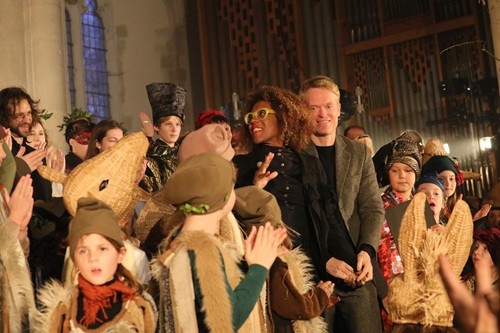
It was a spectacular production, with over a hundred performers, including children and adults, as well as twenty professional performers and a team of offstage volunteers. Frederic Wake-Walker’s staging was a resounding success, not least in marshalling a large cast that included shepherds, mothers, knights and demons and assorted animals, several of the last mentioned sporting wonderfully wrought wicker heads, designed by Ruth Paton. Guided by the text, the director unfolded the Christmas narrative succinctly and with great fluency. Many elements were of course, very familiar and sensitively realised, such as the Annunciation and journey to Bethlehem, as well as the arrival of the Three Magi, bearing gifts. Other events depicted were less often encountered in Nativity plays. A particularly affecting scene featured distraught mothers and female family members of the Slaughtered innocents carrying their dead babies and symbolically throwing down swaddling rags into a communal pile. The simple, plaintive rendering of the 16th century Coventry Carol in the aftermath of a brutal act of infanticide was genuinely poignant and haunting. No less effective was the appearance of grieving mothers at Herod’s court, the latter’s mental deterioration and his descent into hell, dragged down by fearsome demons and accompanied by bloodcurdling screams. The switch from these infernal proceedings to the Angel Gabriel preparing Mary and Ioseph for their concluding departure was executed with the disorientating sleight of hand of a cinematic jump cut. In fact, one of the joys of the production was its sweeping transitions from scene to scene, liberated from the need for ponderous exposition or elaborate scene-setting by a presumed prior knowledge of the story.
As in Britten’s Noye’s Fludde, children were placed at the dramatic centre of their scenes, among which a boisterous shepherd’s brawl, featuring much vigorous sparring, generated raw energy. Of the professional performers, soprano Hilary Cronin’s Angel Gabriel was a commanding vocal and physical presence, supplying considerable emotional gravitas. Andrew Watts’s Herod also made a strong impression, his versatile countertenor voice sufficiently nuanced to suggest paranoia and insecurity as well as might and arrogance. Also very striking was mezzo-soprano Idunnu Münch’s saintly King Melchior, offering a beneficent, regal counterpoise to Herod’s edgy malevolence.
In a welcome, warmly inclusive touch, members of the audience were invited to take part, singing along with traditional Advent and Christmas carols, some of which were subtly and satisfyingly arranged by Errollyn Wallen and crowned with arresting vocal or instrumental descants. If O Little Town of Bethlehem and We Three Kings were well within the concertgoers’ capacity, Entre le boeuf et l’âne gris proved ultimately over-challenging, though the composer’s thoughtful and dignified instrumentation made this beautiful 16th-century French carol a glorious highlight among the congregational items.
Binding all the set pieces together, Errollyn Wallen’s music was undoubtedly one of the opera’s chief glories. Whether providing an instantly memorable idea such as the delightful waltz-like theme accompanying the dance of the animals, crafting tuneful melodies for young voices or underscoring the more violent aspects of the story with atonal dissonances, the composer enhanced the narrative at every turn. Her love of found material included a delightfully off-kilter reference to J. S. Bach’s aria Sheep may safely graze. She has described Bach as her ‘greatest inspiration’ and the fleeting parody was affectionately intended and deftly accomplished. Situated at stage level to the left of the dramatic action and augmented by handbells, fiddlers and drummers, members of Ensemble X were superbly conducted by John Andrews and provided top-flight musicianship throughout the evening. The players’ poetic approach to the composer’s elegant clarinet and trumpet solos, refined string timbres and piano and percussion pulses invariably enriched the onstage action.
Though there were intrinsically operatic elements in the stage work, with full-blown, well-characterised arias for Angela Tait’s Mary and Alexander Semple’s Ioseph, for example, and some rousingly melodic choruses, the evening’s events occasionally suggested aspects of other forms, including those of a morality play: Herod’s demon-assisted descent into hell was a gripping spectacle, staged with the visual flair of a vivid tableau. There was even a touch of audience-generated pantomime: when Herod came to take his curtain call, he was soundly booed and hissed, a time-honoured reception for villainy which the sporting Andrew Watts gamely and light-heartedly shrugged off.
A Christmas Miracle triumphantly upholds Britten’s ideals of showcasing local participation and shared artistic endeavour. However, guided by Errollyn Wallen’s subtle and inspiriting vision, the community opera genre has been broadened in appeal and made relevant for contemporary performers and audiences. This engaging and all-encompassing piece of music theatre embraces a wide range of genres, ideas and musics, its assorted facets held together by the composer’s enduring gift for considered eclecticism. The audience’s enthusiastic and heartfelt response was fully deserved.
Paul Conway
A Christmas Miracle will be staged at St Magnus Cathedral in Orkney on the evening of 4 December and the afternoon and evening of 5 December.