
 United States Glass, Complete Piano Etudes: Cal Performances: Timo Andres, Anton Batagov, Sarah Cahill, Janice Carissa, Aaron Diehl, Simone Dinnerstein, David Kaplan, Daniela Liebman, Jason Moran, Clara Yang (pianists). Zellerbach Hall, University of California Berkeley, 20.11.2026. (HS)
Glass – Complete Piano Etudes 1-20
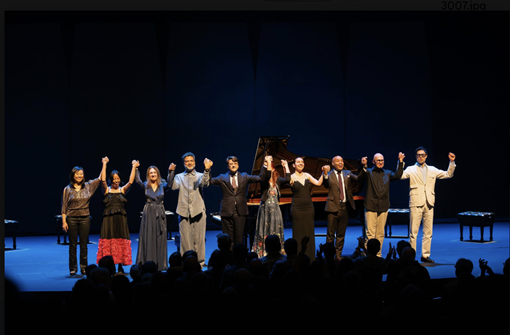
The piano stood front and center on the Zellerbach Hall stage. Arranged in an arc behind it, nine empty piano benches waited, each under its own bright spotlight. The set-up accommodated a succession of 10 pianists, each assigned to two of Philip Glass’s 20 Etudes. The benches, adjusted for each pianist, took only a few minutes to swap out, along with the iPads and paper scores (two played theirs from memory). These short breaks between performance allowed listeners a few minutes to ponder what we had just heard.
The astonishing range of approaches to this music was the most rewarding aspect of a ravishing series of encounters with thoughtful and soulful music-making. For classical pianists, etudes are meant to focus on technique, but the great ones also achieve extraordinary, concert-worthy statements, including those of Chopin, Liszt and Ligeti.
The Glass Etudes belong in that conversation. A performance of all 20 takes about more than two hours, taxing not just for a single pianist but also for an audience. When Glass performed them all in one concert, he often assigned the more technically challenging ones to other pianists, and it is not a leap to assign two to each soloist. The rewards in the performance at Zellerbach Hall in Berkeley lay in the distinctive and often moving approaches of these pianists.
Their personal approaches underlined how flexible Glass’s music can be. Even in commercial recordings of several of them, I found striking differences in tempo, touch, emphasis and, especially, accelerations and decelerations. Among the ten musical minds in Friday’s performance, it is difficult to find a ‘best version’ – just a fascinating range of emotional focus possible in Glass’s music.
Glass, who turns 90 in January, pioneered minimalism. Over the years, the repetitive scales and arpeggios jelled into something more complex and musically rich. The Etudes, written between 1991 and 2012, have become a lodestar for many pianists in this century.
The first four pianists in the lineup set the standards. Clara Yang began with 1 and 2, in a crisply staccato approach that mirrored the clarity in Philip Glass’s own performances. That is not surprising as she has performed alongside Glass in previous concerts. With 3 and 4, Janice Carissa found a softer touch. Carissa, who debuted at 16 with the Philadelphia Orchestra, shaped the music into a sort of elaborated dream. On 5 and 6, Simone Dinnerstein, known for her distinctive recording of J. S. Bach’s Goldberg Variations, went for the heart, searching for a touch that could reveal the music’s emotional core.
For my jazz-loving ears Jason Moran, who has been the jazz director at the Kennedy Center since 2012, gave 7 and 8 a sense of rhythm and an emphasis in melody or harmony that reflected his roots in hip-hop and jazz. A familiar lilt to his interpretations was beguiling. Wrapping up the first half, David Kaplan, known for his passion for contemporary music of all kinds, found layers of subtlety in 9 and 10.
After the intermission, Sarah Cahill, a Bay Area veteran who champions women musicians and has commissioned more than 70 works for piano herself, found an array of colors in 11 and 12. Daniela Liebman, born in Guadalajara, aimed for elegance and found her own sense of rhythm in 13 and 14, not quite Latin but fluid and distinctive. Aaron Diehl, a player and composer whose main milieu is jazz, used his touch to achieve remarkable elegance in 15 and 16.
As a sort of definitive finale, Anton Batagov and Timo Andres, who have both recorded the Glass Etudes, summarized the lyrical side of the works. This approach has, in my listening, become the standard of today’s pianists. Both pianists are also regulars in teams of ten in this series of concerts over the past several years, most recently at Tanglewood last summer and Houston in September.
In 17 and 18, Batagov clearly found extra depth and soulfulness and a balance to the harmonies and rhythms, producing an elevated effect. Andres made the music float in midair for 19 and especially 20 – timeless, exquisitely subtle and soulful. The sense of introspection in number 20 faded into a profound silence.
Harvey Steiman