 United Kingdom Oscar Wilde’s The Picture of Dorian Gray: A Tilted Wig and Watford Palace Theatre production at Yvonne Arnaud Theatre, Guildford, 3.11.2026. (BF) ****
A solid attempt by Seán Aydon to translate Wilde’s famous unsettling novel of decadence to the stage. This is Wilde’s version of the Faust legend: the exquisitely beautiful young man Dorian Gray, his head turned by his aristocratic mentor’s admiration, (not to mention his epigrams: ‘It is only shallow people who do not judge by appearances’ and the like) declares he would give his soul if he could retain his youth and beauty while his portrait grows old instead. He then proceeds to lead a life of extreme depravity to test his wish to the max.
The story revolves around the portrait of Dorian painted by artist Basil Hallward, a friend infatuated by his beauty, through whom Dorian meets Lord Henry Wotton. Lord Henry acquires a psychological ascendancy over Dorian, preaching hedonism, that beauty and sensual fulfilment are the only things that matter in life. He exhorts Dorian always to search for new sensations while he is still young and beautiful.
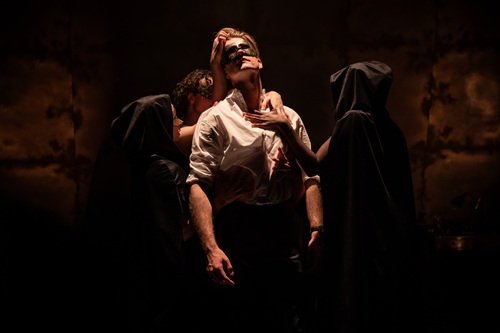
The stage adaptation by Seán Aydon, who also directs, does its best to overcome the novel’s poetic vagueness as to the precise activities indulged in by Dorian as he follows this advice and as to the specifics of the immorality and depravity to which it leads him, after he makes a clear start on the primrose path by rejecting the young actress Sybil Vane so cruelly – ‘you disgust me’ – that she kills herself. He sleeps with a number of women and there seems to be a visit to an opium den and a louche party. There is a definite flavour of homoeroticism in Basil’s passionate expression of his feelings for Dorian and in Dorian and Lord Henry’s relationship, which is not made explicit, though it is moving given Wilde’s own fate. The lighting and stage design create an atmosphere of Gothic horror around activities nowadays discussed – recommended? – in the Sunday papers. In any case, it is clearly all so bad that the painting gradually changes to reflect depravity, leading Dorian to commit actual murder and then blackmail to cover up the crime.
Particularly relevant to today’s world is the characters’ obsession with beauty and surface appearance, their terror of wrinkles. Other themes include the importance of art: is it moral or immoral? Is it more important than human sympathy? Is it more than an obsession with surface appearance? There are themes of social class: Sybil and her family are poor and lower class, ripe for exploitation by the wealthy and upper-class Dorian, as are some of the women he uses; Lord Henry the aristocrat, uttering paradoxes and aphorisms without a care for their consequences – his wife too, cushioned by money.
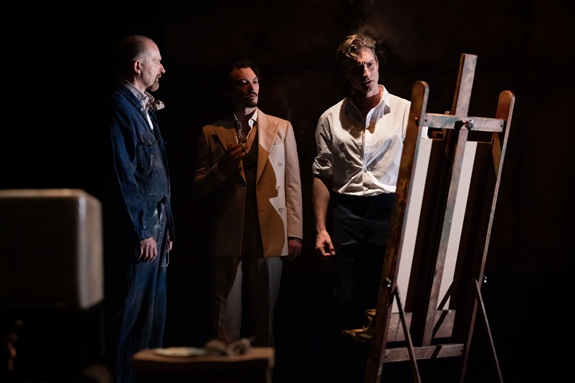
The actors playing the central trio of three men are all excellent. Jack Crumlin, a suitably beautiful young man, is convincing as Dorian Gray himself. He develops persuasively from the enthusiastic youth of the first act to the self-absorbed hedonist at the end. Mark Oxtoby plays Basil Hallward movingly, the mature artist – the only one who creates art rather than just talking about it – losing the object of his love to the malign influence of the cynical Lord Henry. Mark Hawkins enjoys himself in the plum role of Lord Henry, wafting around languidly preaching selfishness and egotism. The women’s roles are more limited. Lydia Whitehead is touching as the rejected lover Sybil and Lydea Perkins makes the most of her scenes as Lady Henry, the counterpart to her husband. Ayesha Griffiths does her best with two underwritten roles as the vengeful sister of the rejected Sybil and the scientist blackmailed into helping Dorian cover up his crime, both somewhat awkward as they were originally male characters, more appropriate for the Victorian social setting.
The set design is impressively simple dominated at the back by a giant tarnished mirror, which suggests a metaphor for Dorian’s worldview and also a slanted glass roof giving north light to an artist’s studio, a reminder of the eponymous picture.
Tilted Wig Productions is a touring company based in Bournemouth. Audiences might remember their excellent Spitfire Girls which is being relaunched next year.
This tour of The Picture of Dorian Gray started in Watford and now ends at the Yvonne Arnaud Theatre in Guildford on 7 November 2026.
Barbara Ford
Featured Image: Basil Hallward (Mark Oxtoby), Lord Henry Wotton (Mark Hawkins) and Dorian Gray (Jack Crumlin) contemplate the picture together
Cast:
Dorian Gray – Jack Crumlin
Lord Henry Wotton – Mark Hawkins
Basil Hallward – Mark Oxtoby
Sybil Vane / Hetty – Lydia Whitehead
Lady Victoria Wotton / Woman – Lydea Perkins
Catherine Vane / Dr Ellen Campbell – Ayesha Griffiths
Romeo / Boy / Servant – Max Burnett
Creatives:
Writer – Oscar Wilde
Adaptor & Director – Seán Aydon
Designer – Sarah Beaton
Lighting designer – Peter Small
Sound designer – Russell Ditchfield
Fight & Intimacy director – Kaitlin Howard
Costume designer – Abigail Caywood
(This review was published in Guildford Dragon NEWS)