 United States Mozart, The Marriage of Figaro: Soloists, Chorus and Orchestra of San Francisco Opera / Sebastian Weigle (conductor). War Memorial Opera House, San Francisco, 3.11.2026. (HS)
I have a litmus test for Mozart’s The Marriage of Figaro. If the forgiveness scene at the very end doesn’t bring a tear or two, I wonder what was missing. It is one of the most touching moments in all of opera and should bring a flood if done right.
In San Francisco Opera’s current production, it did not. In the second of ten performances – the most of any opera this season – I found much to like. The cast was full of good voices, singers who could act with energy and a flair for the comedy. A veteran conductor kept things light and sleek.
Pondering later, I pinpointed what was missing: the subtle inflections that lift a performance from ‘like’ to ‘love’ and affect the way the music touches us where it counts, in the heart. This was especially evident in the singing. Hearing the voices was no problem: their sounds were distinctive and often appealing. If anything, they pushed the sound to be heard in the last balcony and often missed the tenderness that Mozart infused into this timeless score. Too often they sounded stentorian.
One exception to that was the Susanna of Vienna State Opera soprano Slávka Zámečníková. Her ‘Deh vieni, non tardar’ aria in the Act IV garden scene was a sublime moment, supple in texture and lightly adorned with gentle ornamentation. Like her similarly high mark in her debut here as Adina in 2023’s L’elisir d’amore, she had it all in every scene.
Bass Peter Kellner, her real-life husband, had the flexibility and all the physical presence one could want in a Figaro. In this, his U.S. debut, the Slovak singer’s hijinks, especially hiding in the Act IV garden scene, brought the necessary levity. But his big aria in that scene, ‘Aprite un po’ quegli occhi’, fell short on conviction. Still, the rich sound of his voice went a long way to flesh out the character, even if the necessary inflections weren’t always there.
Similar quibbles kept me from loving the singing of Canadian soprano Olivia Smith as the Countess and British baritone Thomas Mole as Count Almaviva. Smith, who has sung non-star roles on the main stage here and Mole, who was effective as James Stewart in Mary, Queen of Scots earlier this season, looked fine but sang with obvious effort. The notes were there and often impressively, but the music did not reflect the complicated emotions between their characters in that moment of forgiveness in the finale. Earlier, in Smith’s ‘Dove sono’, the notes sounded fine but did not touch our emotions.
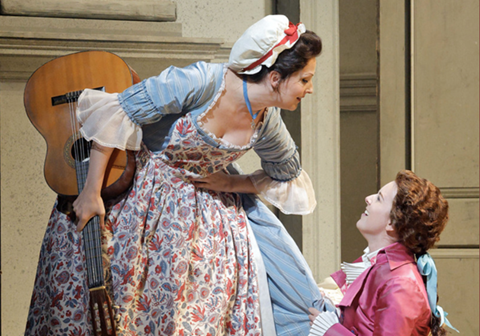
Mezzo-soprano Simone McIntosh, a recent product of the company’s Adler Fellowship program, fleshed out a distinctly boyish Cherubino. Her tiny frame and charming body language invested the character with the required spice, and her singing caught much of the humor and attitude the character needs. Both of her arias – ‘Non so più’ and ‘Voi che sapete – reached off the stage to draw us in.
The rest of the cast distinguished themselves by investing their characters with enough sass to fit the production. They found creative ways to mine the comedy while singing with gusto. The best was soprano Sofia Gotch as Barbarina, whose ‘l’Ho erduta, me meschina’ kicked off the final act in style.
As Dr. Bartolo, Italian bass Maurizio Muraro (who sang the title role in a feisty Don Pasquale here 10 years ago), captured the musical bounce in his ‘La vendetta’ and acted appropriately fussy. As his partner Marcellina, company veteran mezzo-soprano Catherine Cook successfully portrayed the character’s grumpiness without missing a note. Tenor Alek Schrader, who was a terrific Nemorino to Zámečníková’s Adina in L’elisir, played Don Basilio as flamboyantly effeminate (which fit the chatty, opinionated character) and sang all the notes with conviction.
These touches added an extra something to the production which had its debut here in 2019. Original director Michael Cavanagh and set designer Erhard Rom set the action in post-revolutionary United States (around the same late 18th-century era in which Mozart and Da Ponte wrote it). Enough comparable class conflicts abound in the count’s mansion to work believably.
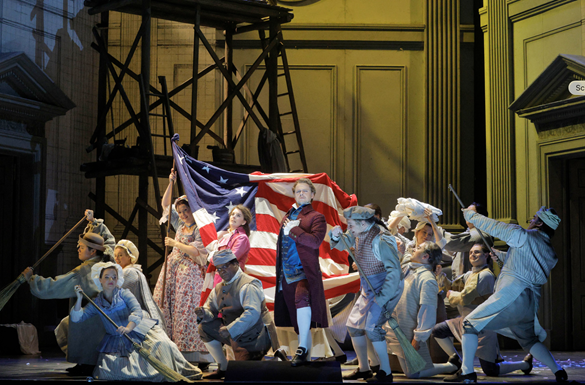
Revival director Shawna Lucey kept the sauciness and increased the bawdiness that bubbles through Da Ponte’s libretto. As an example, in the scene in which Figaro discovers that Marcellina and Bartolo are his parents, Susanna usually slaps Figaro when she arrives to see him hugging Marcellina. This time, she whacked him with a big bag of money in the much-lower place that can make a man double over. There were also witty sight gags, such as the chorus’s tableau vivant hoisting an American flag and pantomiming the famous ‘Washington crossing the Delaware’ painting.
Conductor Sebastian Weigle, longtime musical director of Frankfurt Opera and currently chief conductor of the Yomiuri Nippon Symphony Orchestra in Tokyo, got the music going with a fleet overture and quick tempos throughout. The music breathed but it breathed fast, which may have had led singers to emphasize notes over subtleties.
Maybe I am being too picky but this could have been so much more extraordinary than it was.
Harvey Steiman
Featured Image: Peter Kellner (Figaro) wants to be in charge like George Washington © Cory Weaver
Creatives:
Production – Michael Cavanagh
Revival director – Shawna Lucey
Sets & Projection – Erhard Rom
Costumes – Constance Hoffman
Original Lighting – Jane Cox
Revival Lighting – Justin A. Partier
Choreographer – Colm Seery
Chorus director – John Keene
Cast:
Figaro – Peter Kellner
Susanna – Slávka Zámečníková
Count Almaviva – Thomas Mole
Countess Almaviva – Olivia Smith
Cherubino – Simone McIntosh
Dr. Bartolo – Maurizio Muraro
Marcellina – Catherine Cook
Don Basilio – Alek Shrader
Don Curzio – Chance Jonas-O’Toole
Barbarina – Sofia Gotch
Antonio – Philip Skinner