 Italy Donizetti Opera Festival [2] – L’esule di Roma (The Exile from Rome): Soloists, Coro dell’Accademia Teatro alla Scala, Orchestra Donizetti Opera / Fabrizio Maria Carminati (conductor). Teatro Donizetti, Bergamo, 21.11.2026. (JMI)
This year’s Donizetti Festival opened on 13 November with L’esule di Roma which premiered at the Teatro San Carlo in Naples on 1 January 1828 – barely two months after the premiere at the same theater of Le convenienze ed inconvenienze teatrali (Viva la Mamma, review here).
L’esule di Roma was the first opera Donizetti composed that was set in ancient Rome, and it was a great success, quickly moving to La Scala and soon reaching Barcelona. Curiously, the opera fell into oblivion around 1870 and was not performed again until 1982 in London; it returned to the Italian stage in Savona in 1986. There is no doubt that the revival of such forgotten works fully justifies the existence of festivals like the one in Bergamo. Banished Roman tribune Settimio secretly returns to Rome to see his beloved Argelia yet is condemned to die in the arena and is spared through a twist inspired by Androcles and the Lion.
In my opinion, it is not one of Donizetti’s best operas. While the music is clearly reminiscent of other works by the composer, it lacks the inspiration found in his more famous operas – those that remain in the public memory and are present in opera house repertoires.
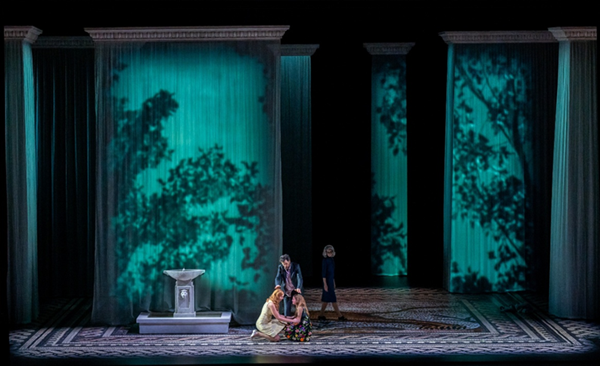
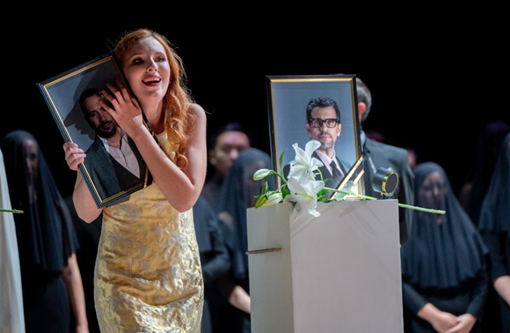
For this production, the festival commissioned a new staging by the German director Katharina Thoma whose career has unfolded primarily in her native country, with only rare appearances in Italy. Her staging shifts the action to the modern era, leaving no trace of ancient Rome. The set design features columns that descend from above, complemented by numerous video projections centered on the main characters, though these add little of real interest. The chorus members are all dressed in black and look as if they are performing in a concert version – they remain motionless on stage. In short, it is a production of little interest.
The musical direction was to be under Italian conductor Antonino Fogliani who, sadly, passed away unexpectedly on 28 August at the young age of 50. It is a great loss for the world of opera, for the Donizetti Opera Festival and for us, the fans. His absence was keenly felt here as the conducting of Fabrizio María Carminati proved to be merely routine – much as in many of his performances that I have witnessed. Under his baton were the Donizetti Opera Orchestra and the Chorus of the Accademia Teatro alla Scala.
The exile, ‘L’esule’, is Settimio, sung by Russian tenor Sergey Romanovsky. I had not seen him for nearly a decade, and I found that his voice has evolved. His middle register retains its quality, but the most significant change is in his upper register which now possesses an impressive volume – the kind one rarely hears. His vocal approach is another matter. While his high notes are indeed spectacular, there was not a single mezza voce to be heard: every high note was sung ‘open’ and with surprising volume. I prefer a more delicate and emotionally nuanced vocal performance.
Argelia, the daughter of Senator Murena who is in love with Settimio, was played by Russian soprano Lidia Fridman. Her performance grew stronger as the evening progressed; the second half was particularly noteworthy, and she successfully surpassed the challenges the opera presents in its final scenes. She was, without a doubt, the vocal standout.
Senator Murena, Argelia’s father and the instigator of the false accusations against Settimio, was played by Luca Pisaroni. A look at the opera’s original cast reveals the name of Luigi Lablache, one of the great basses of his era. Pisaroni lacks the ideal voice for the role of Murena, and his vocal interpretation failed to convince – it fell rather short.
Publio, the great Roman warrior, whose role in the opera is less significant than that of the other three protagonists, was baritone Marcelo Solis, a student of the Bottega Donizetti 2026 program. Having been granted Argelia’s hand in marriage by her father, he readily agrees to step aside upon learning of the love between Argelia and Settimio.
The supporting roles were played by Vittoria Vimercati (Leontina) and Matteo Mollica (Lucio and Fulvio), and both did well.
José M. Irurzun
Featured Image: Donizetti Opera Festival’s L’esule di Roma © Photo Studio U.V./Fondazione Teatro Donizetti
Production:
Director – Katharina Thoma
Sets – Devin McDonough
Costumes – Irina Bartels
Lighting – Fiammetta Baldiserri
Videos – Luca Scarzella
Chorus director – Salvo Sgrò
Cast:
Settimio – Sergey Romanovsky
Argelia – Lidia Fridman
Murena – Luca Pisaroni
Publio – Marcelo Solis
Leontina – Vittoria Vimercati
Lucio / Fulvio – Matteo Mollica