 United Kingdom Guildhall Opera Double Bill – Bernstein and Menotti: Soloists, Chorus and Orchestra of Guildhall School of Music & Drama / Dominic Wheeler (conductor). Silk Street Theatre, GSMD, London, 2.11.2026. (CC)
Bernstein – Trouble in Tahiti (1952)
Menotti – Amelia al ballo (1936, UK premiere)
Menotti’s Amelia al ballo here receives its UK premiere, but it enjoys regular if infrequent outings in Europe – and what makes it all the more interesting is the couplings of the various evenings. The Bernstein/Menotti here takes some beating because of its investigation of differently skewed relationship dynamics: in Verona in October 2026, it was coupled with Stravinsky’s ballet Jeu de cartes; at the US-China Institute of Bard College, it appeared with Gianni Schicchi (also 2026), to give but two examples. Here, it was heard with Leonard Bernstein’s Trouble in Tahiti, a one-act, seven-scene study of a fractured relationship first performed in 1952. Neatly, too, both composers provide their own libretto.
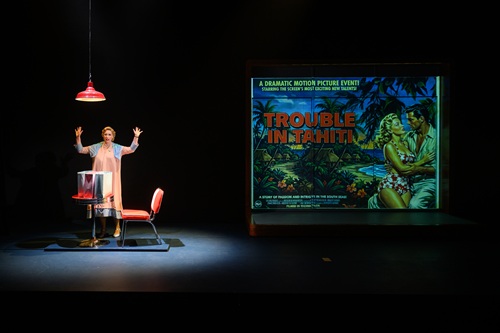
Ironically, Bernstein worked on Trouble in Tahiti during his own honeymoon, basing the story, a study in marital dysfunction, on his own parents’ marriage. The opera is centred around Dinah and Sam but also includes a work boss, a shrink, and a jazz vocal trio referred to by Bernstein as ‘A Greek chorus born of the radio commercial’. They open the opera, here the beautifully balanced trio of Laura LeVoir, Thomas Aminfar-Antoniw and Gennady Grebenchuk. Every word was beautifully enunciated, leading to a lovely blossoming of a most heavenly ‘Suburbia’. The music is pure Bernstein, jazz with spicy seasoning. The music screamed the 1950s as much as the beautifully compact and effective sets by Adam Wiltshire which underlined the contrast between the veneer of the American Dream and the eternal tribulations of relationships.
Space is brilliantly used to suggest separation that is not just physical – Ashley Dean is clearly a fine director (who was previously involved with the excellent coupling of Pauline Viardot’s Cendrillon and Bizet’s Le Docteur Miracle here, among others) who marshals his forces – lighting (Nic Farmen), movement (Victoria Newlyn, also Intimacy coordinator) – to perfection. Nothing seems crowded; and yet there is the feeling of two is a crowd in the scenes with Sam and Dinah. Lighting heightens bared emotions (when Dinah visits the psychiatrist), sometimes using light (daylight) as a metaphorical spotlight on their dynamic (the crossing of Dinah and Sam on the street, almost as strangers, a dolorous waltz).
The use of projection for a vividly colourful poster for the movie Trouble in Tahiti is a high point visually; musically, Dominic Wheeler ensured that Bernstein’s tightly organised score came across in the best light, his young players giving their all (despite the dry as sawdust acoustic of the Silk Street Theatre).
Mezzo-soprano Cecily Shaw did well in Dinah’s big aria when she is with the psychiatrist (‘I was standing in a garden’) but overall I found her voice a bit of a blank slate, somewhat neutral. She sings also on November 6, so maybe all will be more settled by then. Baritone Twm Tegid as Sam threw himself into the role; while we felt both major protagonists’ pain, it seemed more potent with Tegid (who will compete in the next Welsh Singer of the Year awards in Cardiff). Tegid is possessed of a large and expressive voice, but he also carries significant stage presence.
Bernstein’s score is a miracle – he knows exactly how to pace (and so does conductor Wheeler, come to that). But so is Menotti’s. The score of Amelia al ballo is sometimes seen to mark Menotti’s maturity as a composer, and it is masterly. Amelia is preparing to go to the first ball of the season. Unfortunately, her husband bursts in with proof she has a lover. It’s all about the ball, though – if he will still take her, she will tell him the name (he lives upstairs). Warning her lover – ‘Boobi’ he is called, affectionately and hilariously – from the balcony as her husband rushes to confront his rival, Amante slides down on a rope (to hilarious effect). A compromised pistol means the two men bond over a debate about the nature of love while Amelia gets ever more frustrated, breaking a vase over her husband’s head. The police arrive, and more chaos ensues: the lover is arrested, the husband goes to hospital, and Amelia finally goes to the ball – on the arm of the dashing Chief of Police!
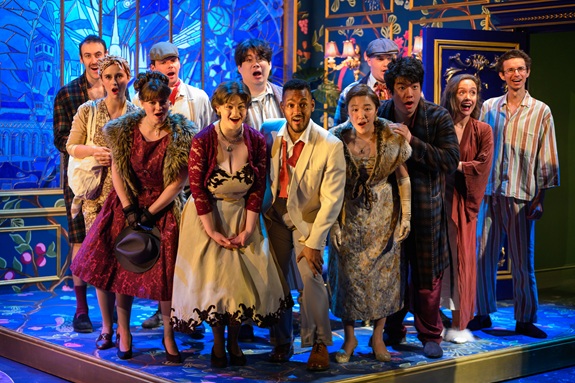
The staging offers a far fuller space, with Milan Cathedral in the background sharing space with an overstuffed wardrobe. The atmosphere is totally different from the Bernstein, but as effectively conjured.
The scent of Puccini hangs over Menotti’s score; somewhat (and rightly) minimised by Wheeler so we heard more of Menotti’s own voice. Much of the score demands quickfire delivery as the sounds from the pit froth over to the stage; all credit to every singer for their pinpoint responses.
Again, the female lead felt a little unsettled, here Zoë Jackson. The distinctly Puccinian lines given to Marito in ‘Amelia cara’ made full effect with the strength and full tone of Tegid though, and tenor Sebastian Hill delivered a strongly-voiced Amante.
Rather nicely, character names point to function: the lover is Amante (Sebastian Hill) and the husband is Marito (Twm Tegid). The finale finds a swathe of singers on the stage (an unnamed ‘chorus’) and there are several smaller roles. The Police Commissioner is baritone Yonwaba Mbo who makes quite a mark in a short space; a special word, too, for the ‘Seconda Cameriera’ Ellie Stamp, who delivers tons of character and mops up her (very, very) brief moments in the sun.
Most of all, the production – a UK premiere – pinpoints the opera buffa heart of Menotti’s little masterpiece. Given GSMD has previously staged Menotti’s The Telephone (coupled with Judith Weir’s Miss Fortune), one can only hope for more.
A most enjoyable evening, with the orchestra in fine form whether collectively as pinpoint ensemble or in individual solos. I would dearly like to hear the second cast, too … not to mention more Menotti.
Colin Clarke
Featured Image: Menotti’s Amelia al ballo © David Monteith-Hodge
Creatives:
Director – Ashley Dean
Assistant Directors – Eleanor Strutt & Daisie Sitlani
Designer – Adam Wiltshire
Lighting designer – Nic Farman
Assistant Lighting designer – Howard James Shakespeare
Movement & Intimacy coordinator – Victoria Newlyn
Bernstein Trouble in Tahiti Cast:
Dinah – Cecily Shaw
Sam – Twm Tegid
Jazz Trio – Laura LeVoir, Thomas Aminfar-Antoniw, Gennady Grebenchuk
Menotti Amelia al ballo Cast:
Amelia – Zoë Jackson
Amante – Sebastian Hill
Marito – Twm Tegid
L’amica – Marianne Ruel
Il Commissario di Polizia – Yonwaba Mbo
Prima Cameriera – Beth Stirling
Seconda Cameriera – Ellie Stamp
Carabinieri – James Emerson & Gennady Grebenchuk