 Germany Rodgers and Hammerstein, The Sound of Music: Soloists, Chorus of Oldenburg State Theatre, Oldenburg State Orchestra / Gyuseong Lee (conductor). Oldenburg State Theatre, 31.10.2026. (DM-D)
The life of Maria Rainer and her family came to wider attention thanks to her book, The Story of the Trapp Family Singers, published in 1949. Two German films of 1956 and 1958, respectively, were made on the basis of the book, with what was then a stellar and most popular cast. The Rodgers and Hammerstein musical The Sound of Music was premiered on Broadway in November 1959. In London it was premiered in November 1961. The film of the musical opened in 1965, was nominated for 10 Oscars and won five. Comments on the film of the musical suggest that it was considered very, even overly sentimental and corny. Compared to the two 1956 and 1958 German films, however, the film of the musical is sober and distanced, while the German films are almost unbearably sentimental to me.
In England there was a major new West End production in 1981. In 2006, a further new UK production gained nationwide attention through an 8-part, 16-hour TV casting show that culminated in Connie Fisher winning and performing the role of Maria from November 2006 for 15 months, followed by a national tour from 2009 to 2011. The musical has since been revived for national touring and for the repertory of theatres outside London. Compared with that major popularity of The Sound of Music in the UK, it is striking that in Germany the popularity of the two 1950s films was so strong that German audiences did not warm easily to the musical. It received is premiere production as late as in 1982, with a title reminding audiences of the German films rather than the Hollywood movie.
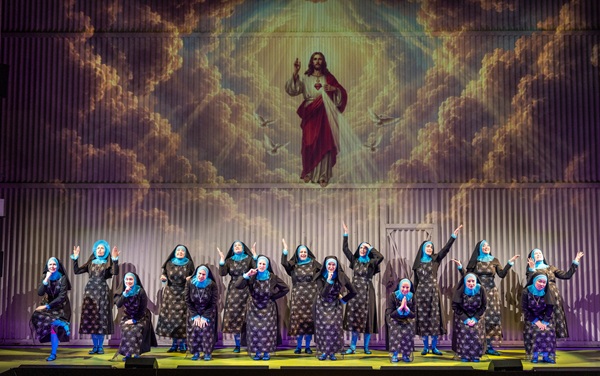
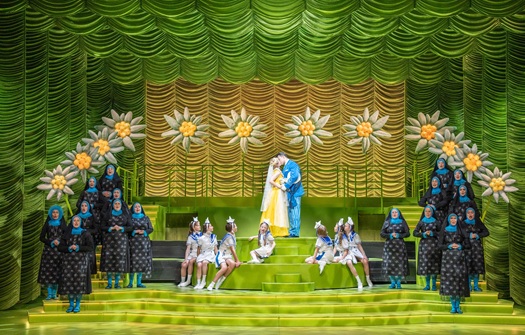
This brief stage history goes some way to signal that the current production of The Sound of Music at Oldenburg State Theatre, which opened on 31 October 2026, is not just another production of a perennial favourite, but in fact quite a rarity. The Oldenburg production team with director Katja Wolff overall trusted the libretto and the score, and emphasised jollity, not allowing the more serious aspects of the plot – the rise of National Socialism and in particular Austrian Anschluss and the eventual escape of the Trapp family into exile in the USA – to overshadow the feelgood nature of the production. The Statue of Liberty, which appeared from the fly tower at the end, was carrying a guitar. The set, designed by Saskia Wunsch, was given shades of green, referencing the green mountain fields of the opening of the film. An image of Jesus in a ray of sunshine projected onto the iron curtain signalled the scenes in the Abbey. Friederike Zeidler as Maria was full of smiles throughout, expressing general joy, enthusiasm, coy shyness, motherly feelings towards the von Trapp children, her singing, and her love. She combined a very pleasant speaking voice with a clean, focused musical-trained and experienced singing voice. Nicky Wuchinger combined initial military awkwardness with the believable shift towards increased openness towards his own feelings for his children, for Maria, and those as the basis for his initially loud and later quietly determined political position. His singing voice was suitably musical.
Thomas Bönisch elevated the chorus of nuns and Marija Jokovic the chorus of the von Trapp children to a high level of precision and unison. Francine Gunderson and Lukas Sima Löbner stood out pleasantly as Liesl and Rolf. Rodgers composed the main song of the Mother Abbess for an operatic soprano rather than for a singer trained to sing in musicals, and even for operatic singers the role is most demanding. Carolin Scholz did her best, was accurate in the lower range of the voice, but in the ascent to the exposed A-flat 5 (as composed by Rodgers), potentially the most gorgeous passage of the musical, her voice sounded too thin and shrill. Some scene changes were a bit noisy and awkward and some microphones were turned on too late, but this will be sorted in due course, I am sure.
Gyuseong Lee conducted the score with a good balance of melodic sentiment and refreshing rhythmic gusto. Oldenburg State Theatre is in the fortunate position to offer multiple casting for the lead roles. It would be interesting to hear sopranos Penelope Kendros and Taylor Haines as Maria and the Mother Abbess, respectively, and singing actor Hagen Bähr as von Trapp.
Daniel Meyer-Dinkgräfe
Featured Image: Oldenburg State Theatre’s The Sound of Music © Sascha Walzl
Production:
Director – Katja Wolff
Stage design – Saskia Wunsch
Costume design – Luzie Nehls-Neuhaus
Choreography – Thomas Helmut Heep
Lighting design – Philipp Sonnhoff
Sound design – Thomas Busse, Dierk von Domarus
Chorus director (children) – Marija Jokovic
Chorus director – Thomas Bönisch
Dramaturgy – Anna Neudert
Cast:
Maria Rainer – Friederike Zeidler
Captain Georg von Trapp – Nicky Wuchinger
Mother Superior – Carolin Scholz
Sister Bertha – Maaike Poorthuis
Sister Margareta – Lea Bublitz
Sister Sophia – Daniela Köhler
Franz, servant – Thomas Marx
Frau Schmidt – Sharon Starkmann
Liesl – Francine Gunderson
Friedrich – Michael Kölblinger
Louisa – Nina Goesmann
Kurt – Tede Koop
Brigitta – Paula Ungermanns
Marta – Aurelia Ramke
Gretl – Frieda Urban
Rolf Gruber – Lukas Sima Löbner
Elsa Schrader – Gabriela Ryffel
Max Detweiler – KS Paul Brady
Herr Zeller – Stephen K. Foster
Baron Eberfeld – Holger Schoon
Baronin Eberfeld – Esther Vis
Admiral von Schreiber – Andreas Lütje