 Germany Puccini, Madama Butterfly: Soloists, Chorsolisten der Komischen Oper Berlin, Orchester der Komischen Oper Berlin / Yi-Chen Lin (conductor), Komische Oper Berlin at the Schillertheater, 21.11.2026. (AB)
Madama Butterfly ranks among the most performed operas in the world, and few works are burdened as heavily by their own performance tradition, which tends to present a colourful, pretty and clichéd Japan full of cherry blossom and paper lanterns, in productions that often remain in the repertoire for decades. Andrea Breth’s production – first seen in Aix-en-Provence in 2024 and now at the Schillertheater, the Komische Oper’s temporary home while its own house is being renovated – does not deny us Japanese topoi, but presents them with a remarkable, somewhat sombre quietness and inwardness. One cannot help wondering how closely this Berlin revival resembles the Aix premiere, reviewed (here) in Seen and Heard International by my esteemed colleague Mark Berry, though the restraint he admired there seems to have travelled well.
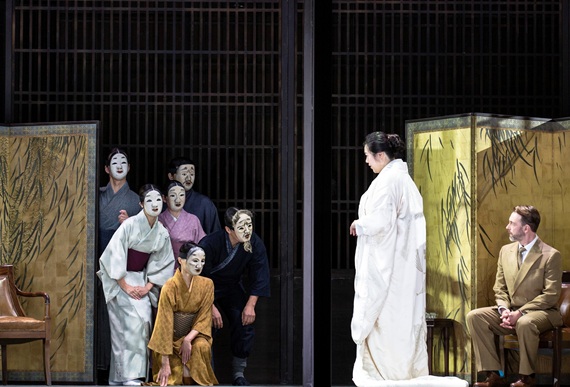
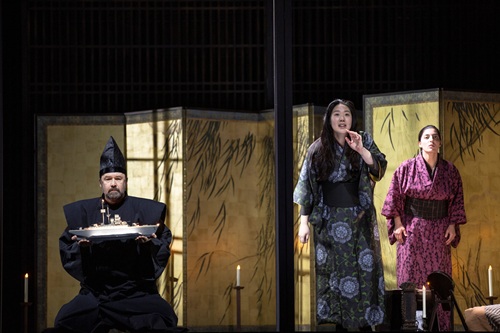
Raimund Orfeo Voigt reduces the setting to the spare interior of a traditional Japanese house, while the shōji screens appear as dark lattices that may equally be read as prison bars. Ursula Renzenbrink’s costumes follow the same logic, with faded kimonos whose patterns seem drained of colour, so that only Butterfly’s white wedding garment shines.
At the heart of Breth’s reading lies the confrontation between a ritualised Japanese society and an unreflecting American self-assurance. Seven Japanese performers in No-like masks embody Butterfly’s relatives and ancestors and, dressed in black, also take on the silent stage business: with solemn, slowed-down gestures they carry lanterns, guide cranes on rods above their heads, mime in front of the unseen chorus or freeze into stillness, so that the cultural divide is never underlined, merely present. The Americans, by contrast, are sketched with understated precision: Pinkerton turns his back on the registrar after signing the wedding contract and pockets the pen until it is pointedly reclaimed, while Sharpless, the American consul, receives his host’s whisky-fuelled toast to America with cool reserve.
The movements of the Japanese characters are slow and fluid, lending the evening a quiet dignity, although at times the stage seems almost frozen – and some may feel the evening only truly comes alive when its protagonist sings. In the second act, however, Breth finds images of great beauty, developing a motif of wings – a butterfly pinned on needles, cranes that symbolise luck and longevity – and at its close the Bonze steers a model warship – presumably Pinkerton’s Abraham Lincoln – across the stage.
Not everything works equally well. In the final scene, Pinkerton cannot bring himself to look at his child bride, as his ‘real’ American wife, Kate, enters the house to take the child Cio-Cio-San bore him and sits down in the adjoining room to drink tea with Suzuki and the boy, while Butterfly brutally ends her life by cutting her throat. The juxtaposition may be meant as an image of American presumption, but whether it adds meaning or merely disturbs the restraint of everything that precedes it remains unresolved.
What the production does achieve is a portrait of a Cio-Cio-San who is anything but a doll-like ingénue: a figure of serene grace and tenderness, whose steadfast faith in Pinkerton’s love for her makes her suffering even more acute. Given the ongoing efforts of the United Nations to end child marriage, it is impossible to overlook that she is only fifteen, and while Breth makes no thesis of it, her unsentimental gaze leaves little room for romantic illusion. Those in the audience expecting the ‘grand emotion’ that is usually so reliably delivered may be disappointed – yet the drama loses little of its force.
Musically, the evening was not fully convincing. Yi-Chen Lin, at the helm, avoided sentimentality, but her reticence often seemed to tip into caution, and in the first act the orchestra lacked blend and sensual glow, the strings sounded thin – perhaps partly owing to the Schillertheater’s difficult, dry acoustics –, and stage and pit were repeatedly out of step. Puccini’s richly coloured orchestration seemed held on a short rein, the great climaxes lacking the necessary breadth, and though tension built in the later acts, it rarely reached incandescence. Singing from offstage, the chorus was beautifully balanced and atmospheric.
At the centre of the cast stands Gloria Jieun Choi. The Korean soprano possesses a bright, warm and evenly produced voice, radiant and golden at the top, and her portrayal charted illusion, insecurity and despair without a single superfluous gesture. Her ‘Un bel dì, vedremo’, free of all verismo excess, rightly earned enthusiastic applause mid-scene.
Mihails Culpajevs’s light, slightly cool tenor suited the calculating officer, and after a pale start he grew in confidence in the course of the ‘love’ duet. Susan Zarrabi, as Suzuki, was a fully equal partner, her soft, warm mezzo-soprano blending beautifully with Choi’s soprano. Günter Papendell’s noble, Italianate baritone made his Sharpless the true conscience of the piece, while Johannes Dunz gave Goro a characterful, suitably oily profile, and Dimitry Ivashchenko’s dark, sturdy bass lent the Bonze gravity rather than rage. The smaller roles, including Naomi Steele’s Kate Pinkerton and Ivan Turšić’s Yamadori, were also well served.
In the end, this Madama Butterfly emerges as a production of considerable integrity, if not quite of irresistible force, and while its heroine’s wings may be pinned on needles, in Gloria Jieun Choi’s voice they unfold all the same.
Andreas Bücker
Featured Image: Gloria Jieun Choi (Cio-Cio-San) and Günter Papendell (Sharpless) © Bernd Uhlig
Production:
Director – Andrea Breth
Set design – Raimund Orfeo Voigt
Costumes – Ursula Renzenbrink
Lighting – Alexander Koppelmann
Movement – Tomoya Kawamura
Chorus director – David Cavelius
Dramaturgy – Klaus Bertisch, Daniel Andrés Eberhard
Cast:
Cio-Cio-San – Gloria Jieun Choi
Pinkerton – Mihails Culpajevs
Suzuki – Susan Zarrabi
Sharpless – Günter Papendell
Goro – Johannes Dunz
Bonze – Dimitry Ivashchenko
Yamadori – Ivan Turšić
Kate Pinkerton – Naomi Steele